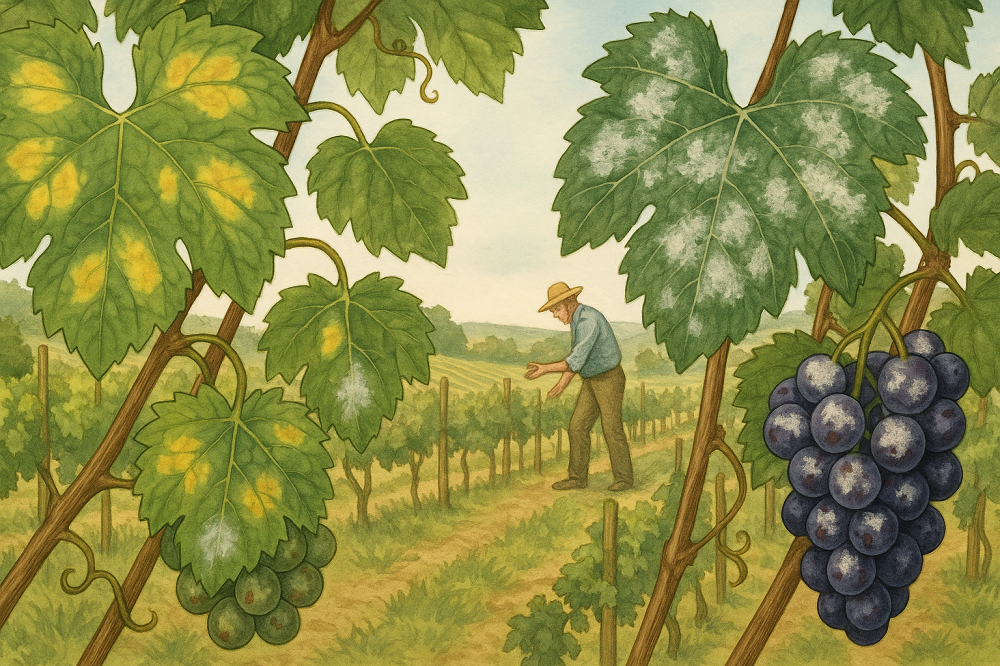
Grapevines are highly susceptible to both downy mildew and powdery mildew, two of the most destructive diseases in vineyards worldwide. Early and accurate identification is crucial for effective management and to prevent significant yield and quality losses. Here’s a practical, farmer-focused guide to help you distinguish between these two diseases in the field.
Practical Field Identification
Downy Mildew
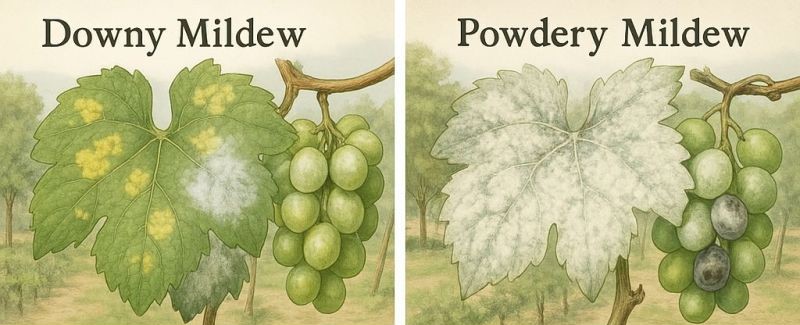
- Early Signs: Look for small, round to angular yellowish or translucent spots (oil spots) on the upper leaf surface, often limited by veins.
- Underside of Leaves: On humid mornings, check the underside of these spots for a white, fluffy, downy or cottony growth—this is the hallmark of downy mildew.
- Progression: As the disease advances, the center of the spots may turn brown and dry out, sometimes leaving a yellow ring around the dead tissue.
- Shoots and Fruit: Young shoots may show oily brown lesions, thicken, curl, and develop white down. Infected berries turn brown to purple, shrivel, and fall off easily.
- Example: After a rainy spell, you notice yellow spots on the upper side of leaves. Turning the leaf over, you see a white, fuzzy mold directly beneath the spots—this confirms downy mildew.
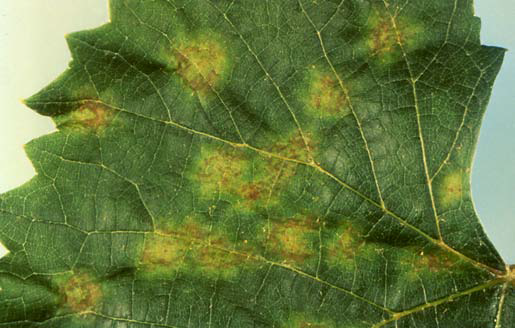
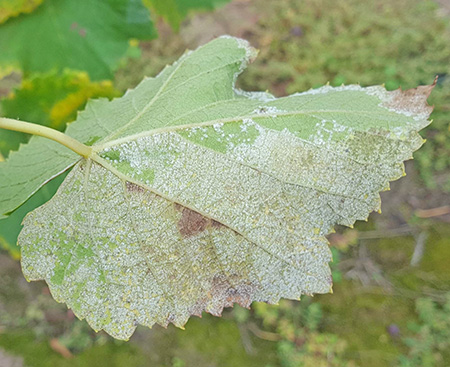
Source: https://ohioline.osu.edu/, Late Season Downy Mildew on Grapes – Michigan State University Extension,
Powdery Mildew
- Early Signs: Look for small, white or gray powdery spots on the upper surface of leaves, which expand and merge into a powdery coating.
- Leaf Texture: Unlike downy mildew, powdery mildew appears on both sides of the leaf and feels like flour or dust when touched. Leaves may curl upwards as infection worsens.
- Fruit and Stems: Berries, stems, and shoots can also develop a powdery coating. Infected fruit may split, become deformed, or drop prematurely.
- Example: In dry, warm conditions, you spot a white, powdery layer spreading over leaves and fruit, with no need for recent rain—this is typical of powdery mildew.


Source:https://fruit.wisc.edu/
Key Differences: Downy Mildew vs. Powdery Mildew
|
Feature |
Downy Mildew (Plasmopara viticola) |
Powdery Mildew (Erysiphe necator) |
|
Appearance on Leaves |
Yellowish, oily spots ("oil spots") on upper surface; white, downy or cottony growth on underside |
White or grayish powdery patches on both leaf surfaces |
|
Leaf Symptoms |
Spots often limited by veins; can turn brown and necrotic, leading to leaf drop |
Irregular yellow blotches; leaves may curl, distort, and turn brown |
|
Fruit Symptoms |
Berries turn light brown to purple, shrivel, detach easily; white cottony growth in humid weather |
Berries covered in white/gray powder, may crack, become misshapen, or rot |
|
Stem/Shoot Symptoms |
Oily brown areas, thickening, curling, and white down during sporulation |
White/gray powdery coating, twisting or cracking of stems |
|
Favorable Conditions |
Warm, wet, humid weather; needs leaf wetness for infection |
Warm, dry to moderately humid weather; does not require free water |
|
Spread |
Rapid after rain or heavy dew; sporulation on humid nights |
Spreads in dry conditions; continues infecting through summer without rain |
|
Where to Look |
All green parts, especially lower leaf surfaces after rain |
Young leaves, shoots, fruit, and stems, especially upper leaf surfaces |
Practical Tips for Farmers
- Inspect Regularly: Walk your vineyard after rain or heavy dew for downy mildew, focusing on leaf undersides. For powdery mildew, check during dry, warm periods, focusing on new growth and fruit.
- Use a Hand Lens: A magnifier can help distinguish the fine, downy growth of downy mildew from the granular, powdery appearance of powdery mildew.
- Check Weather Patterns: Wet, humid weather favors downy mildew; dry, warm weather favors powdery mildew.
- Manage Canopy: Prune to improve air circulation and reduce humidity within the canopy, helping to prevent both diseases.
- Sanitation: Remove and destroy infected leaves and fruit to reduce sources of both mildews.
- Resistant Varieties: Consider planting grape varieties with resistance to these diseases if available.
Quick Reference Table
|
Symptom Location |
Downy Mildew |
Powdery Mildew |
|
Upper Leaf Surface |
Yellow, oily spots |
White/gray powdery patches |
|
Underside of Leaf |
White, downy/cottony growth |
Powdery, but less distinct |
|
Fruit |
Brown/purple, shriveled, cottony mold |
White/gray powder, cracked fruit |
|
Shoots/Stems |
Oily brown, thickened, white down |
Powdery coating, twisting/cracking |
In summary:
- Downy mildew: yellow oil spots, white downy growth underneath, thrives after rain.
- Powdery mildew: white/gray powdery coating, thrives in dry, warm conditions.
Early detection and correct identification are essential for effective control and to minimize losses in your vineyard. Regular monitoring, good canopy management, and prompt removal of infected material are your best lines of defence.
Further reading
Vineyard Management Using Advanced Precision Viticulture Techniques
Innovative Robotic Technology Revolutionizes Table Grape Spraying
How to Grow Grapes for Profit - Commercial Grape Grower’s Essential Guide
Common Grapevine Pest and Diseases
EU Plant Health Alerts 4th quarter of June 2025 - Overview for Farmers
EU Plant Health Alerts: 3rd quarter of June 2025 - Overview for Farmers