
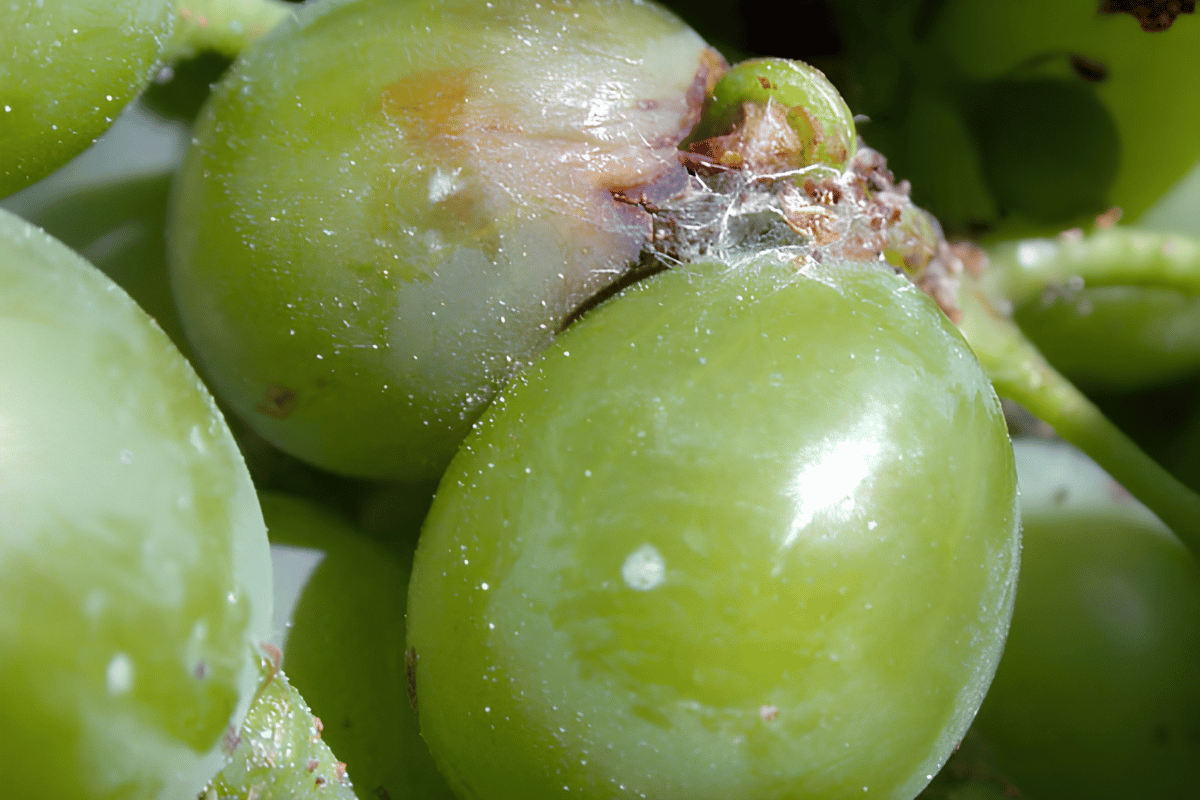
The European grapevine moth is the most serious pest of the grape, and its fruit generation is the one that strikes the berries directly. In June, with the vine at fruit set and berry development, the larvae bore into the berries, opening the way for botrytis and other rots, so the damage becomes a loss of both quantity and quality. The June 2026 advisory bulletins in Greece show that the fruit generation is underway in almost all viticultural zones. Below we look at the life cycle, the correct timing of the intervention by zone, and the other threats of the season.
The life cycle and why the fruit generation is critical
The European grapevine moth (Lobesia botrana) has successive generations through the season. After the flowering generation on the inflorescences, the fruit generation attacks the young berries. The larvae enter the berry and feed inside it, so once they get in the treatment becomes ineffective and the door opens to botrytis and other rots.
For this reason, control is preventive and aims to kill eggs and young larvae before they enter the berries. The rise in adult catches in the pheromone traps signals the start of the fruit generation, and the first attacks follow about 4 to 5 days later, depending on the weather.
Timing the spray by zone
The dates below come from the current bulletins and vary widely by region and ripening zone, both in timing and population. They work as a guide, while the traps in each vineyard give the final picture.
| Region | Grapevine moth stage | Indicative spray window |
|---|---|---|
| Central Greece (Tyrnavos) bulletin of 9 June |
Rising catches, start of the fruit generation | Ovicides 2-3 days after the rise in catches, larvicides 4-5 days later |
| Eastern Macedonia and Thrace (Kavala, Serres, Drama, Xanthi) bulletin of 10 June |
Fruit-generation flight underway, fruit-set stage | First spray from 11 June, repeat in 10-12 days |
| Crete, Heraklion, and Lasithi bulletin of 10 June |
Fruit generation is underway by ripening zone | Mid-early zone 8-10 June, late zone 13-15 June, with early zones on repeat 6-12 June |
| Crete, Chania, and Rethymno bulletin of 10 June |
Fruit generation underway by the ripening zone | Mid-early zone 11-13 June, late zone 15-17 June |
When an ovicidal product is used, the application is advised within 2 to 3 days of the rise in catches, while the mainly larvicidal products go in 4 to 5 days later. Among the larvicides, Bacillus thuringiensis formulations are preferred for their safety to beneficial fauna, followed by growth regulators and products of natural origin. The sprays target the bunches and perform better at dusk, while a proper leaf removal helps the spray reach the clusters fully.
Downy mildew, powdery mildew, and other threats of the season
Downy mildew (Plasmopara viticola) advances mainly in vineyards with frequent night dews, where new attacks appear on leaves and young bunches. Even in hot, dry weather, the risk stays high because the tender growth and the small berries are vulnerable to infection, so where rain is forecast, we spray preventively beforehand. The same attention is needed to powdery mildew, which is favored by current conditions and the sensitive stage of the bunches. Among insect pests, mealybugs warrant systematic checks, while leafhoppers exhibit locally higher populations and are treated only after monitoring.
Choosing and applying the products
Use only products approved for grapes and for the specific pest or disease in your country, and follow the label strictly for the dose, tank-mix compatibility, phytotoxicity risk, and pre-harvest interval. For the repeat spray, consider the persistence of the previous product, the catches in the traps, and the rate of berry growth.
The dates above are from the regional bulletins and reflect a general trend. The flight differs greatly from vineyard to vineyard, so the final decisions rest on your own traps, on your field observations, and on the most recent local bulletin. For serious or uncertain infestations, consult an agronomist, and use only approved products in line with the label and the operator protection measures.
Sources
All data come from the plant protection advisory bulletins of the Greek Ministry of Rural Development and Food (ΥΠΑΑΤ):
- Regional Plant Protection Centre of Volos, vine bulletin No8 (Tyrnavos area) (9 June 2026).
- Regional Plant Protection Centre of Kavala, vine bulletin No22 (Kavala, Serres, Drama, Xanthi) (10 June 2026).
- Regional Plant Protection Centre of Heraklion, vine bulletin No12 (Crete) (10 June 2026).