
In October 2026 the EU indicative import price of navel oranges from Mediterranean countries was 0.75 US dollars a kilo, 28.6% lower than in October 2025, 72.2% below the series high of December 2024 and in the middle of the Octobers since 1990, according to a Wikifarmer analysis of World Bank data. Meanwhile Spain exported in the 2025/26 season the fewest tonnes of oranges of the 16 seasons since 2010/11, at an average export value of 0.99 euros a kilo, close to the highest of those seasons, as the new export season now enters its peak months.
The October price sits in the middle of the Octobers since 1990
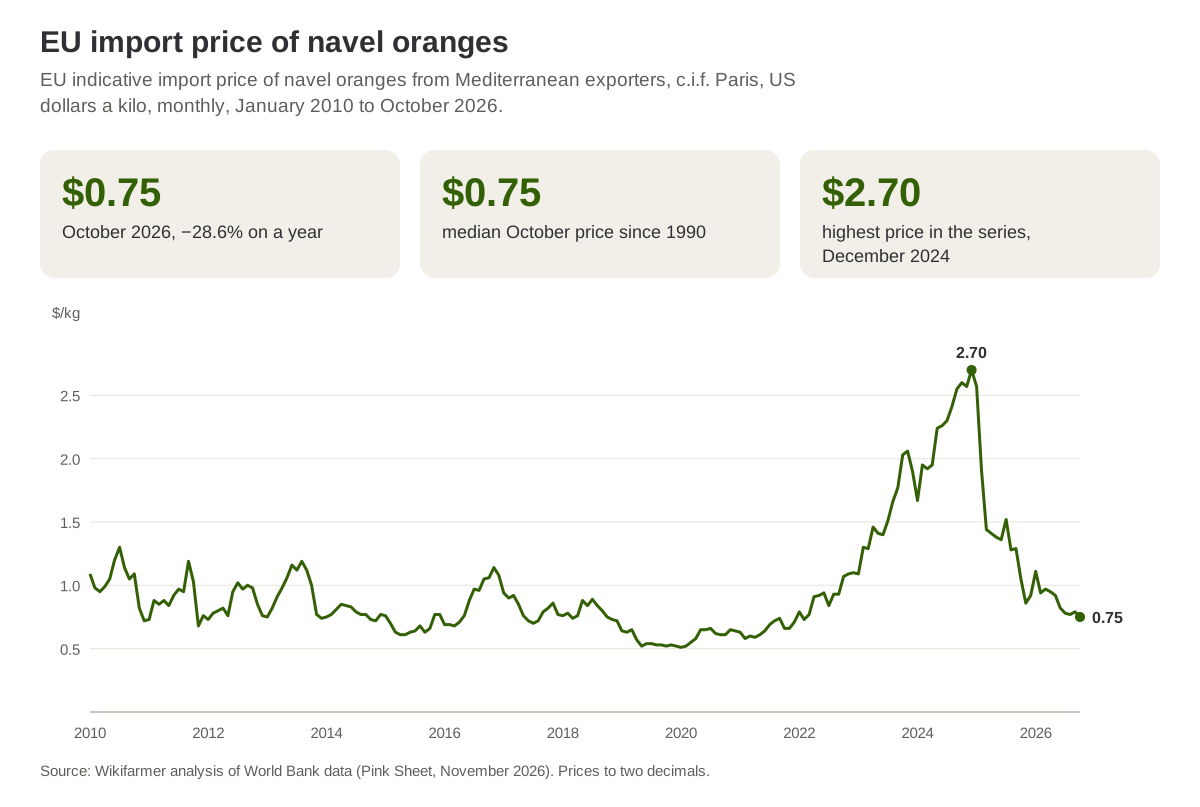
The World Bank publishes in its monthly commodity price series, the Pink Sheet, the EU indicative import price of navel oranges from Mediterranean exporting countries, delivered c.i.f. to Paris, in US dollars a kilo. The October 2026 price, 0.75 dollars, was 28.6% lower than the 1.05 dollars of October 2025 and the lowest in any month since February 2022, when it was 0.73 dollars. Of the other 36 Octobers since 1990 the price was lower in 18, higher in 17 and the same in one, October 2018, so for the time of year the 2026 price sits in the middle.
Source: Wikifarmer analysis of World Bank data (Pink Sheet, November 2026), prices to two decimals.
After the December 2024 peak the price fell 72.2%
The price rose steeply from spring 2022, reached 2.03 dollars in October 2023 and 2.60 dollars in October 2024, the highest October price in the series, and in December 2024 it reached 2.70 dollars a kilo, the highest level since the series starts in 1960. The October 2026 price is 72.2% below that level. The average for the season from October 2025 to September 2026 was 0.907 dollars, 50.6% below the 1.836 dollars of 2024/25 and within the range of the 2010/11 to 2021/22 seasons, 0.577 to 0.975 dollars, but at the top of it, as of those 12 seasons only 2012/13 had a higher average.
Spain exported the fewest tonnes of oranges in 16 seasons at a value per kilo close to the highest
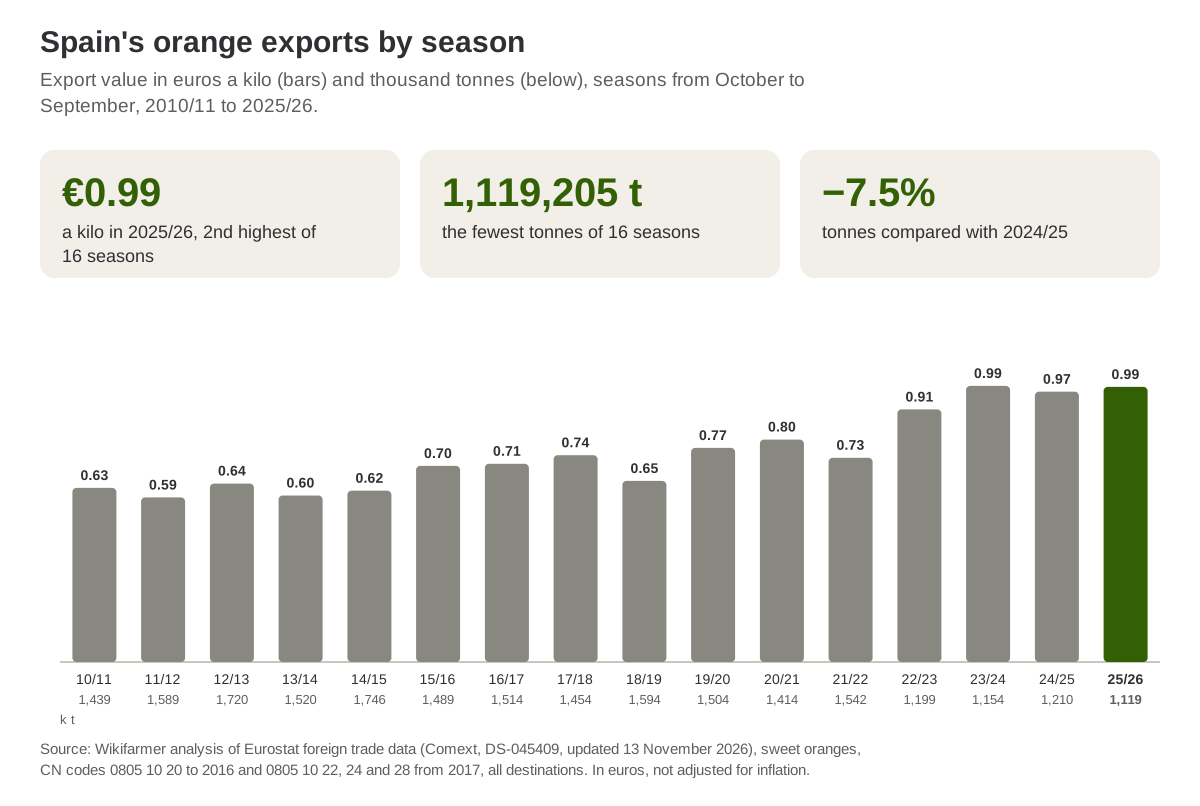
From October 2025 to September 2026 Spain exported 1,119,205 tonnes of sweet oranges, 7.5% fewer than in 2024/25 and the fewest of the 16 seasons since 2010/11, 26.2% below the median of the 2010/11 to 2021/22 seasons, according to Eurostat's Comext foreign trade database. The exports were worth 1,106.4 million euros, 5.9% less, while the average value per kilo, 0.99 euros, was 1.8% higher than in 2024/25, the second highest of the 16 seasons after 2023/24 and 45.9% above the median value per kilo of the 2010/11 to 2021/22 seasons.
Source: Wikifarmer analysis of Eurostat foreign trade data (Comext, DS-045409, updated 13 November 2026), in euros, not adjusted for inflation.
The two series measure different prices
The World Bank price fell by half from 2024/25 to 2025/26, while the value per kilo of Spain's exports stayed close to its highest level. The two series differ in three ways: the first covers navel oranges only, is an indicative price delivered to Paris and is measured in dollars, while the second covers all sweet oranges, is the declared value of shipments up to the Spanish border and is measured in euros, so they cannot be compared as levels, and the analysis does not examine why their course differs. Among the buyers of Spanish oranges, Portugal pays far less than other buyers for Spanish oranges.
The new season will show in the months with the most exports
In 2025/26 October was the month with the smallest Spanish exports from October to April, with 24,194 tonnes, and December the month with the largest, with 180,387 tonnes, so the October price describes only the start of the season. The next World Bank prices are published early each month and Eurostat's data on Spain's October exports in mid-December, while on past evidence citrus prices fall from November to Christmas in most years. The data concern Mediterranean orange growers and exporters and their buyers in Europe, and are not a forecast.
The analysis uses World Bank prices and Eurostat trade data
The analysis is Wikifarmer's, based on the World Bank's monthly orange series (Pink Sheet, November 2026 edition), the EU indicative import price of navel oranges from Mediterranean exporting countries, c.i.f. Paris, in US dollars a kilo to two decimals, from January 1960 to October 2026, and on Spain's exports of sweet oranges to all destinations in Eurostat's Comext database (dataset DS-045409, updated 13 November 2026), with CN code 0805 10 20 until December 2016 and codes 0805 10 22, 0805 10 24 and 0805 10 28 from January 2017, added together. The season runs from October to September, the average value per kilo is declared value divided by declared quantity, and values are not adjusted for inflation. October is compared with the Octobers since 1990, and prices to two decimals make the comparisons approximate. The median of the 37 Octobers from 1990 to 2026 is 0.75 dollars, and without 2026 it is 0.74 dollars. Eurostat's figures for the latest months are provisional. The analysis does not examine why prices changed. All figures were recomputed independently from the original files. The data describe what prices did and are not a forecast.
Sources
- World Bank. (2026). Commodity Markets, Pink Sheet monthly prices (CMO Historical Data Monthly), November 2026 edition.
- Eurostat. (2026). International trade in goods, Comext database (DS-045409), updated 13 November 2026.