
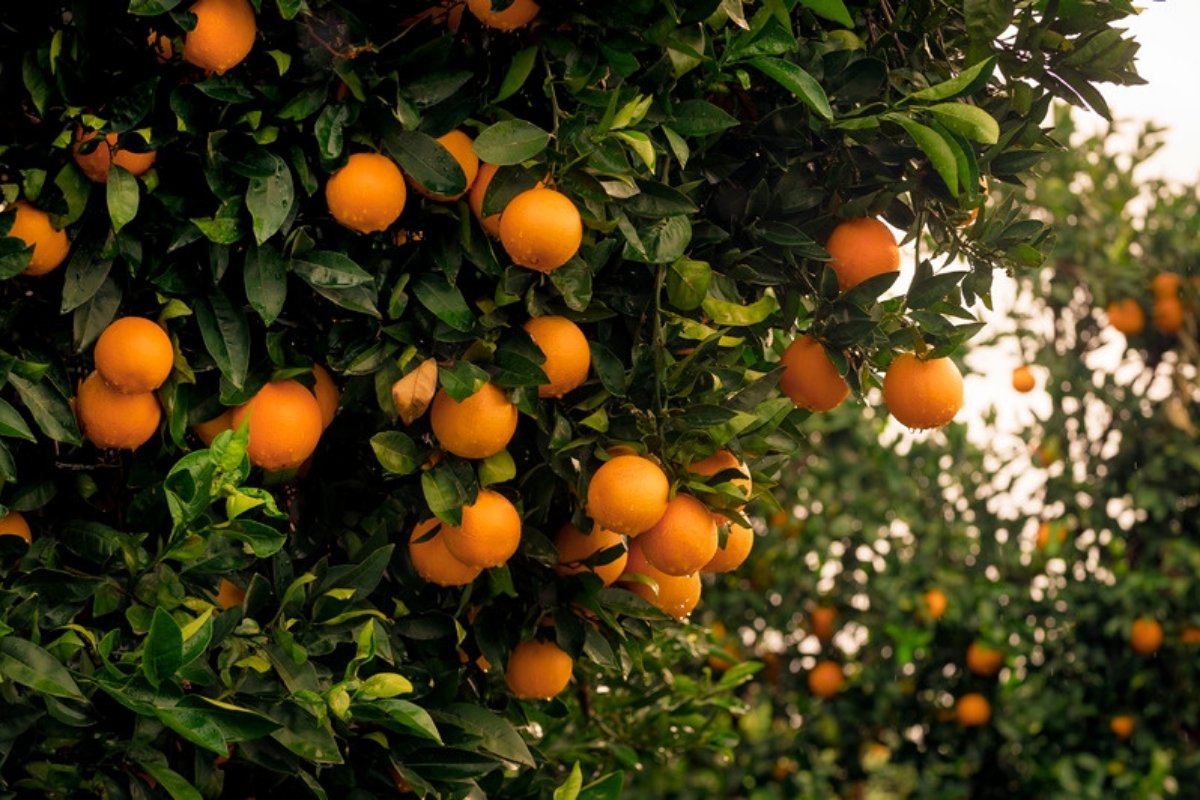
White, mealy colonies between two touching oranges or under the calyx of the fruit are usually the first sign of citrus mealybug, Planococcus citri. In western Greece, the insect is listed among the serious pests of the season for Achaia, Ilia, Aitoloakarnania, Messinia, Zakynthos, Kefalonia and Ithaca, alongside armoured scales, spider mites and the Mediterranean fruit fly. It damages the crop in two ways: by sucking sap from the fruit and excreting honeydew on which sooty mould grows, and because small colonies hide well, an infestation is often noticed only once it has already spread.
How to recognise citrus mealybug on the tree
Adult females are oval, 2.5 to 5 mm long, and covered in a white, waxy secretion that gives them a floury appearance, with 18 pairs of wax filaments around the body. The last pair is slightly longer than the rest but never more than a quarter of the body length, which separates this species from mealybugs with long tail filaments. Young nymphs range from pink to orange, while the male is winged, about 1 mm long and looks nothing like the female.
After mating, the female produces a cottony wax mass, the ovisac, which protects the eggs from natural enemies and from drying out. This cottony cover, together with honeydew on branches, leaves and fruit, is what gives an infestation away in the grove.
What damage does it causes to the fruit and the tree
Direct damage takes the form of chlorotic spots where the insect feeds, seen mostly where two fruits touch. On oranges, feeding also leaves hard lumps. A colony on the fruit stem can cause fruit drop, and insects left on the fruit after harvest keep breeding during transport and storage.
Indirect damage comes from the honeydew and the sooty mould that grows on it, which spoils the appearance of the fruit and reduces photosynthesis in the leaves. The same honeydew also feeds adult Mediterranean fruit flies, which at this time of year attack fruit as it loses its green colour.
For this reason, Mediterranean fruit fly control in citrus is planned together with the management of scale insects and mealybugs in the grove.
Where the insect hides throughout the year
In Mediterranean citrus groves such as those of Valencia, citrus mealybug completes five generations a year, and in summer, a full cycle takes about six weeks. From May to July, the nymphs shelter mainly under the fruit calyx, and from August, they spread over the rest of the fruit, while on navel oranges, they retreat into the navel. Navel varieties suffer more for exactly this reason, since natural enemies struggle to reach the insects inside the navel.
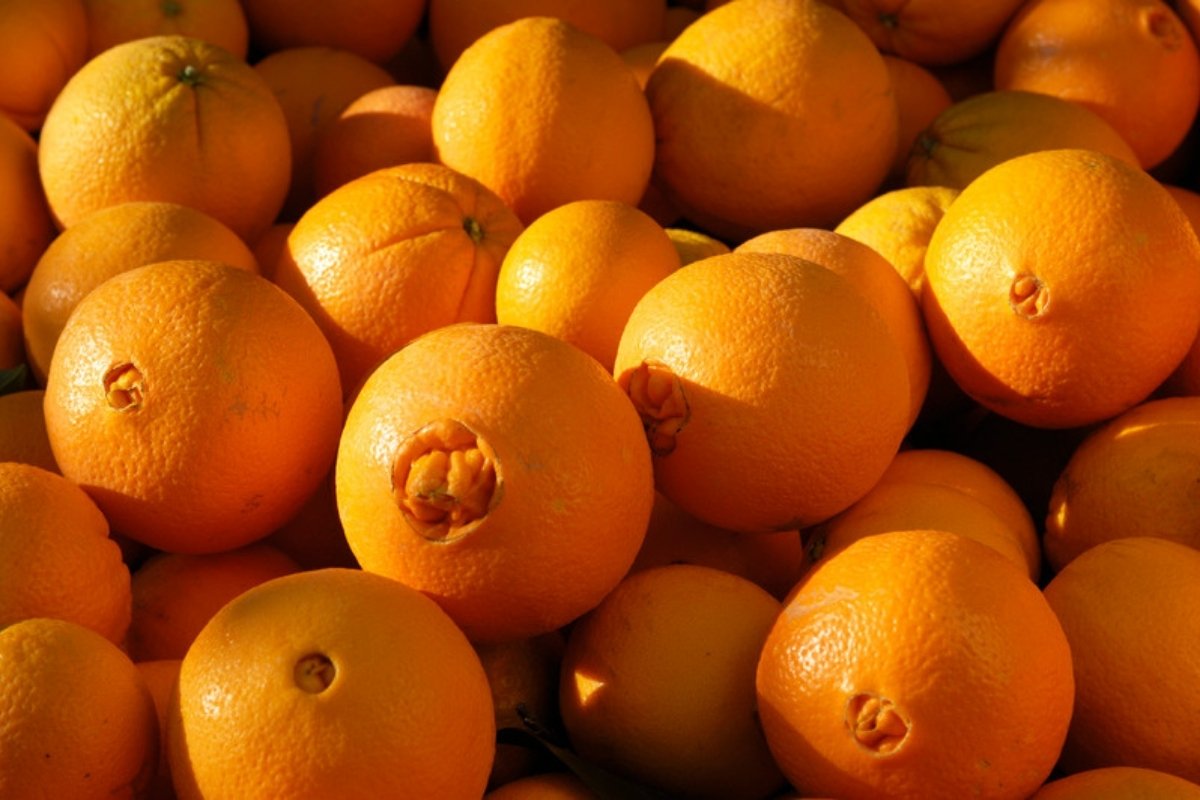
In navel oranges, the nymphs retreat into the navel, where natural enemies struggle to reach them.
Development is favoured by relatively high temperatures and high air humidity. It slows down in dry sites, so dense canopies and trees that touch each other are where the first hotspots usually appear. Damage is most severe in spring and autumn, and light infestations are easily missed because the insect hides in crevices and between fruits.
Why ants make mealybug worse
Ants feed on the honeydew and guard the colonies, and they attack the natural enemies of mealybugs, which stops biological control from working. In groves where natural enemies are protected, and ants are kept out of the trees, treatment is usually unnecessary.
A field experiment in 32 citrus groves in Valencia showed that partial removal of ants significantly reduced mealybug attack. The only four groves that needed an insecticide spray, because they exceeded the 20% threshold for infested fruit, all belonged to the group where ants had been left in the trees.
Ant control starts in late April by checking the base of the trunks. On trees with heavy ant traffic, the lowest branches are pruned so that none touch the ground, weeds are cleared around the trunk, and a band of tape 20 to 30 cm wide is wrapped around the trunk and coated with a sticky barrier, leaving ants no other route to the canopy. The sticky material goes on the tape because, on bare bark, it can be phytotoxic, especially on young trees exposed to the sun, and it is checked regularly so that it stays effective from May to October.
Which natural enemies control the citrus mealybug
The main predator is the mealybug destroyer, the lady beetle Cryptolaemus montrouzieri, native to Australia, whose females lay eggs inside the mealybug ovisac, allowing the larvae to feed on the eggs and nymphs. The larvae are also covered in white filaments and look like mealybugs, but their filaments are much longer, and they move faster, so they can be told apart with a little care. Because the beetle does not survive Mediterranean winters and is very sensitive to insecticides, releases are made in early spring in groves that had a problem the previous year. In California, the recommended rate is about 500 beetles per acre, roughly 1,200 per hectare.
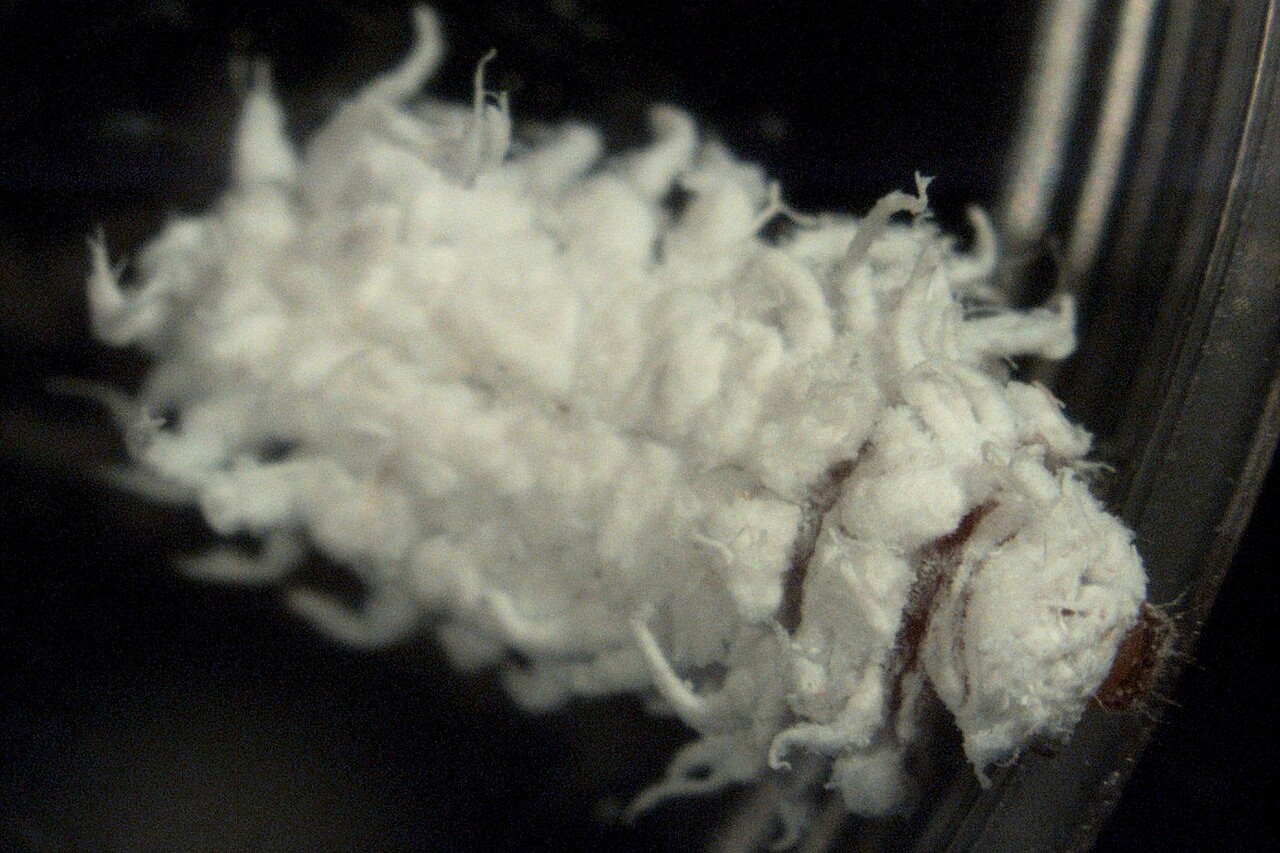
The Cryptolaemus larva looks like a mealybug, but its wax filaments are much longer, and it moves faster.
The main parasitoids are Anagyrus pseudococci, a native Mediterranean species that prefers young females without eggs, and Leptomastix dactylopii, introduced from Brazil, which prefers females that have already laid eggs. Parasitised mealybugs swell and turn honey-coloured, so it is easy to see in the grove whether parasitoids are already at work, and June releases of parasitoids complement the spring releases of Cryptolaemus. The lady beetle Nephus includens is another natural enemy of the citrus mealybug.
In the Valencia experiment, L. dactylopii established and multiplied in most of the groves where it was released, but did not reduce mealybug numbers, and Cryptolaemus was barely found in the samples. These results suggest that controlling ants and protecting the beneficial insects already present in the grove often count for more than releases.
When a spray is justified
In western Greece, chemical control is recommended when infestation exceeds 5 to 10%. In groves below that level, pruning that opens the canopy and lowers humidity is enough, along with clearing the grove perimeter so air moves freely between the trees.
In Crete treatment is recommended when more than 10% of fruits are infested, while in Valencia the threshold is higher still, since a spray is justified only when sampling in August and September finds mealybug on more than 20% of fruits, after checking 130 fruits across more than 50 trees. The three sources disagree on the threshold, which ranges from 5 to 20%, but agree that the decision rests on measuring the infestation in the field.
When a spray is needed, it is applied with care, paying particular attention to the hidden spots between trees and to dense growth where branches overlap. If another scale insect, such as California red scale, is present on the same trees, the two are treated together.
Where honeydew is abundant, a wash with detergent at 1 g per litre of water comes first, dissolving the honeydew and already reducing the population, and a wetting agent is added to the spray to improve coverage of the insect's waxy body.
The active substances allowed in citrus are checked in the national register of authorised products, which in Greece is the plant protection product database of the Ministry of Rural Development and Food, and repeat sprays rotate IRAC mode-of-action groups to prevent resistance. Insecticides are also chosen for their effect on natural enemies, because a spray that kills Cryptolaemus and the parasitoids leaves the grove more exposed to the next generation.
In organic citrus, when natural enemies are not enough, paraffin oils are used against the insect and potassium soap to limit sooty mould.
Frequently asked questions
What is citrus mealybug?
It is the scale insect Planococcus citri, a soft, oval insect 2.5 to 5 mm long and covered in white wax that feeds on the sap of fruit, leaves and twigs. It excretes honeydew on which sooty mould grows.
Which beneficial insect eats mealybugs?
The lady beetle Cryptolaemus montrouzieri, known as the mealybug destroyer, whose larvae and adults are voracious feeders on citrus mealybug. The parasitoids Anagyrus pseudococci and Leptomastix dactylopii also attack it.
Why are there ants on trees with mealybug
Ants feed on the honeydew and protect the colonies from natural enemies. That is why ant control is part of mealybug management.
When should citrus mealybug be sprayed?
When infestation exceeds the action threshold. In western Greece, the threshold is 5 to 10% infestation, in Crete above 10% of fruits, while in Spain a spray is applied only above 20% of fruits, based on sampling in August and September.
Why are navel oranges more affected?
Because the nymphs shelter inside the navel of the fruit, where natural enemies find it hard to reach them.
What turns citrus leaves black
Usually sooty mould, fungi that grow on the honeydew of scale insects such as mealybugs and armoured scales. The black coating reduces photosynthesis in the leaves and downgrades the fruit, and removing it starts with controlling the insect that produces the honeydew.
Important notes
Conditions vary by region, variety, planting density and year, so the above is a general guide and a starting point for checking the grove. For heavy or persistent infestations, an agronomist should be consulted for an accurate diagnosis and treatment plan.
Non-chemical methods come first, meaning ant control, pruning for airflow and protection of natural enemies. When chemical control is needed, use only products authorised for citrus and follow the label instructions.
Sources
- Regional Centre for Plant Protection, Quality and Phytosanitary Control of Achaia, Plant protection warning bulletin for citrus, 21 September 2026.
- Regional Centre for Plant Protection, Quality and Phytosanitary Control of Heraklion, Plant protection in citrus, Bulletin No 4, 1 October 2026 (in Greek).
- IVIA, Gestión Integrada de Plagas y Enfermedades en Cítricos, Cotonet, Planococcus citri.
- UC Statewide IPM Program, Mealybugs in citrus.
- UC Statewide IPM Program, Mealybug Leptomastix parasitoid.
- Influence of inoculative releases of natural enemies and ant removal on biological control of citrus mealybug in citrus plots (in Spanish), Dialnet.
- Aristotle University of Thessaloniki, Interactions among natural enemies of Planococcus citri (in Greek), IKEE repository.