
An in-depth analysis for lemon growers, buyers, traders, and market professionals
The global lemon market remains a vital segment of the citrus industry, driven by fresh consumption, foodservice demand, beverage applications, and a growing industrial segment including essential oils and juice processing. After a decade of steady expansion, the sector is entering a period of disruption in 2026, marked by climatic shocks in Mediterranean production hubs and increasing reliance on suppliers in the Americas and South Africa.
For industry stakeholders, 2026 represents a year of strategic realignment.
Learn more about lemon tree yields, harvest, and storage
Global production overview
According to the Food and Agriculture Organization (FAO), global production of lemons and limes reached approximately 23 million tons in 2024, with India and Mexico accounting for around 31% of total output.
For the 2025/26 season, the U.S. Department of Agriculture (USDA) Foreign Agricultural Service forecasts global fresh lemon and lime production to decline by 700,000 tons to 10.1 million tons, largely due to reduced output in the European Union and Türkiye.
While production is expanding in parts of the Western Hemisphere, these gains are unlikely to fully offset losses in Europe and the Middle East.
Top producers and regional shifts
- Mexico: Forecast at 3.3 million tons, maintaining its position as the world’s leading producer, supported by favourable weather and expanding acreage.
- India: A major producer focused primarily on domestic consumption and regional markets.
- Argentina: Stable at 1.9 million tons, with 70–75% of production directed to industrial processing (juice, essential oils, pectin), centred in Tucumán.
- South Africa: Expanding its export presence, particularly in fresh fruit markets.
- European Union (Spain & Italy): Production expected to decline 7–12% due to adverse weather and pest pressure.
- Türkiye: Output forecast to fall 36–44% to around 1.1 million tons, following severe frost damage.
- United States: California produces over 800,000 tons annually, though growth is constrained by rising costs and labour shortages.
Emerging exporters—including Chile, Colombia, and Peru—are increasingly filling supply gaps in North American and European markets.
Consumption and processing trends
The global production downturn is directly impacting consumption:
- Fresh consumption: Forecast at 7.6 million tons
- Processing volumes: Forecast at 2.6 million tons
Because Europe and Türkiye primarily supply the fresh market, reduced output in these regions disproportionately affects fresh consumption.
Demand continues to expand in Asia, Latin America, and the Middle East, while mature markets maintain stable consumption across fresh and processed segments.
Global trade dynamics
Exports & imports
Global lemon and lime exports are projected to decline 2% to 2.4 million tons, reflecting reduced shipments from Türkiye and Europe, partially offset by growth in Latin America and South Africa.
- Türkiye: Exports down to 350,000 tons, the lowest level in over 15 years
- European Union: Imports down to 600,000 tons
- United States: Imports rising to 970,000 tons, marking a fourth consecutive year of growth, with Colombia and Peru gaining market share
Looking to export? Here is our lemon quality guide and export standards
Market value
The global lemon trade was valued at approximately US $4.17 billion in 2024, with Mexico and Spain each accounting for about 20% of export value, followed by Türkiye and Peru.
Trade flows continue to reflect both established supply chains—such as the Mexico–U.S. trade relationship—and increasing competition from emerging exporters.
Lemon prices worldwide
Farmgate prices
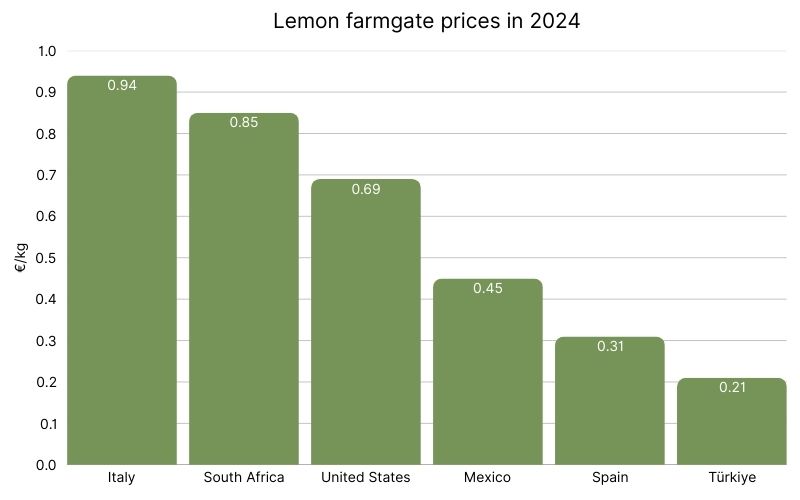
This chart compares the latest available lemon farmgate prices from the FAOSTAT database for major producing nations.
Wholesale prices
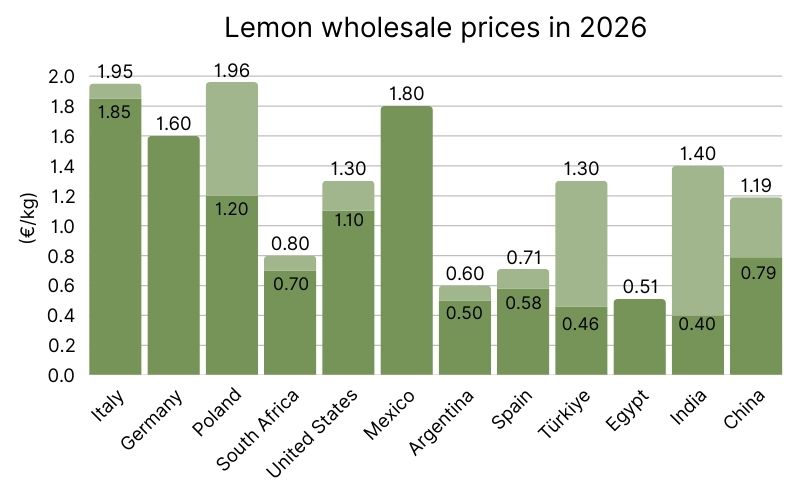
Wholesale prices in 2026 across major wholesale bulletins in different countries show notable variations, reflecting differences in production costs, market demand, and regional economic conditions.
Retail prices
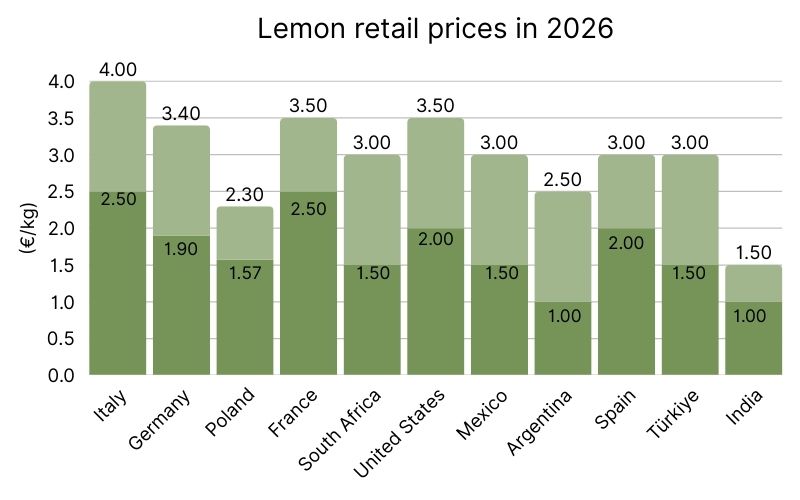
Average retail price ranges from leading supermarkets and stores across countries reveal how wholesale costs translate into what consumers actually pay in 2026.
Access real-time market intelligence for lemons on Wikifarmer's Fresh Price Insights
Demand drivers & market trends
Beyond fresh consumption, industrial demand is becoming a key growth engine:
- Lemon compounds market: Including D-limonene and linalool, valued at US $1.48 billion in 2026, with continued growth expected
- Food and beverage sector: Represents roughly half of industrial demand
- Clean-label trend: Rising consumer preference for natural ingredients is accelerating demand for citrus-based extracts
- Organic production: Increasing demand in premium markets
- Health-driven consumption: Functional beverages such as immunity shots and detox drinks are boosting lemon demand, particularly in the United States
Looking to buy or sell lemons? Check out the Wikifarmer Marketplace
Challenges facing the lemon sector
Climate and weather risks: Frosts, droughts, and extreme rainfall across Europe, Türkiye, and North Africa are reducing yields and affecting fruit quality.
Pest pressure: Thrips, mealybugs, and other pests can reduce yields by up to 10–18%, making integrated pest management essential.
Labour and structural constraints: Aging grower populations and labour shortages in key regions—including the EU, U.S., and Japan—are limiting production capacity.
Rising production costs: Increased energy, labour, and input costs are placing sustained pressure on grower margins.
Supply chain disruptions: Geopolitical tensions in key shipping routes have forced vessels to bypass the Suez Canal, increasing transit times, causing congestion at South African ports, and raising the risk of quality deterioration during transport.
Citrus greening (HLB): The spread of Huanglongbing continues to impact production in the United States and Mexico, increasing costs and reducing yields.
Trade policy and market access: Export performance is increasingly shaped by phytosanitary regulations and trade agreements, with compliance remaining critical for maintaining market access.
Outlook
The global lemon market is expected to grow moderately in the coming years. Key strategic priorities include:
- Climate-resilient production: Adoption of drought-tolerant rootstocks and precision agriculture tools
- Supply diversification: Greater reliance on emerging exporters such as Colombia and Peru
- Industrial expansion: Growth in natural extracts and clean-label ingredients
- Trade optimization: Strengthening compliance and access to key export markets
For growers, exporters, and agribusiness stakeholders, understanding these structural shifts will be essential to navigating the evolving lemon market in 2026 and beyond.
Sources
Citromax: The configuration of the international lemon market
USDA FAS: Citrus – World Markets and Trade, 2026
World Citrus Organisation: Global Citrus Outlook