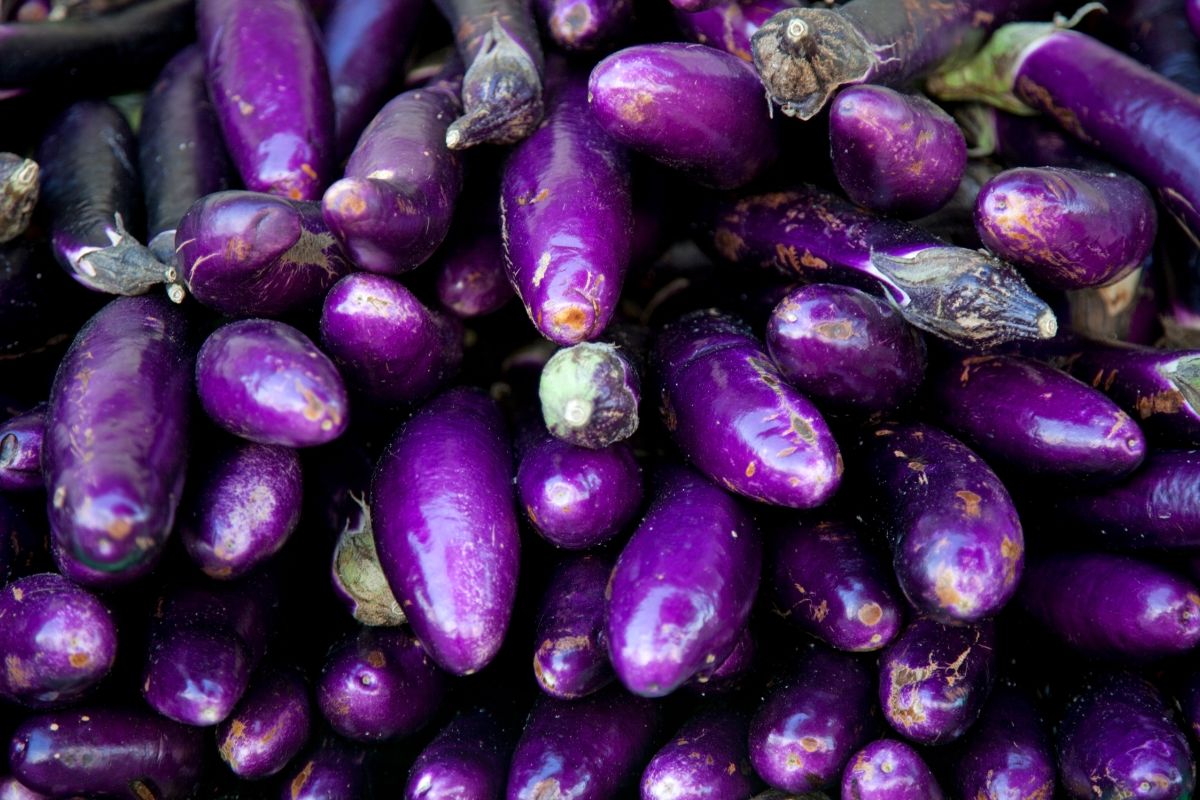
Eggplants, also known as aubergines, are one of the world’s most widely produced vegetables. They are a staple ingredient across Asia, the Mediterranean and the Middle East, appearing in iconic dishes like French ratatouille, Greek moussaka, and Levantine Baba ghanoush.
Eggplants are grown as an annual crop in temperate regions and as a semi-perennial in tropical climates. Botanically, they are classified as berries, although treated as vegetables in cooking because of their mild flavour and ability to absorb sauces and seasonings.
Global production
According to FAOSTAT, global eggplant production in 2024 was about 57.5 million tonnes, harvested from about 2.77 million hectares across more than 100 producing countries. The five largest producers — China, India, Egypt, Guinea and Türkiye — together account for about 89% of world output, one of the most concentrated supply structures of any major vegetable.
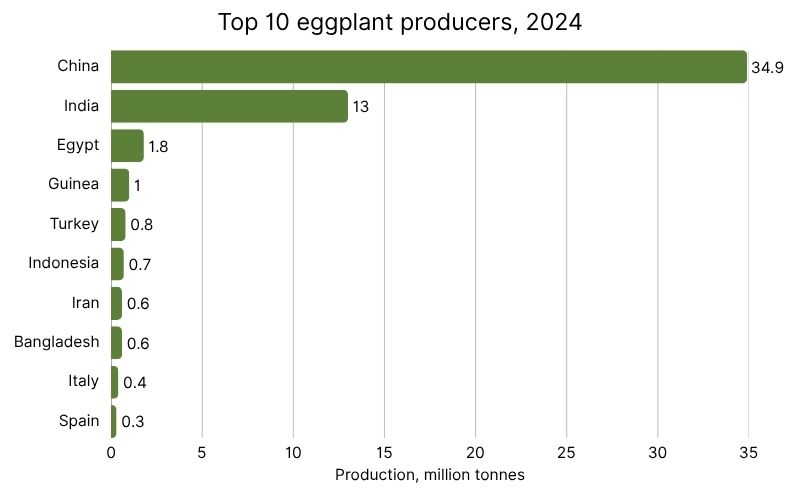
China alone produces roughly 35 million tonnes, about 61% of world production, while India contributes another 13 million tonnes, about 23%. Both countries consume the vast majority of their harvest domestically. China's production comes from a mix of open-field and protected cultivation, while India's crop is grown by millions of smallholders and marketed largely through the country's regulated mandi wholesale system.
Egypt anchors production in North Africa, Guinea has emerged as a notable West African producer, and Türkiye, Italy, Spain, and the Netherlands are the pivotal suppliers around the Mediterranean and into the European Union. Italy is the largest EU producer but consumes most of its 300,000 tons domestically.
Yield and productivity
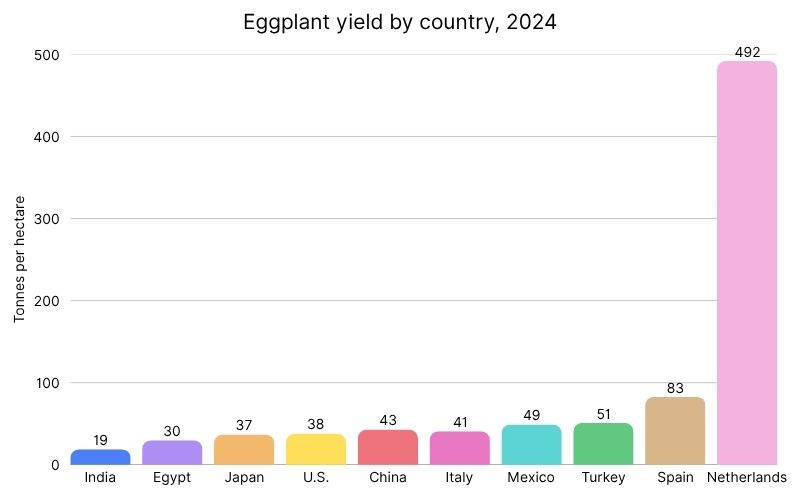
The world's largest producers do not achieve the highest yields. China and India lead on sheer hectares while posting mid-range yields (about 43 and 19 tonnes/ha, respectively). The most intensive systems are in the Netherlands, which records an extraordinary 492 tonnes/ha from year-round hydroponic greenhouses, and Spain, around 83 tonnes/ha. This yield gap is the clearest driver of the structural cost and price differences between commodity field-grown eggplants and premium protected-crop eggplants.
International trade
Eggplant production is mostly consumed at origin, and only about 1% of the world volume is internationally traded. Global exports of fresh or chilled eggplant were valued at about €581 million (US$629 million) in 2023 and €590 million (US$639 million) in 2024, up 16.3% from €483 million (US$541 million) in 2019.
Leading exporters
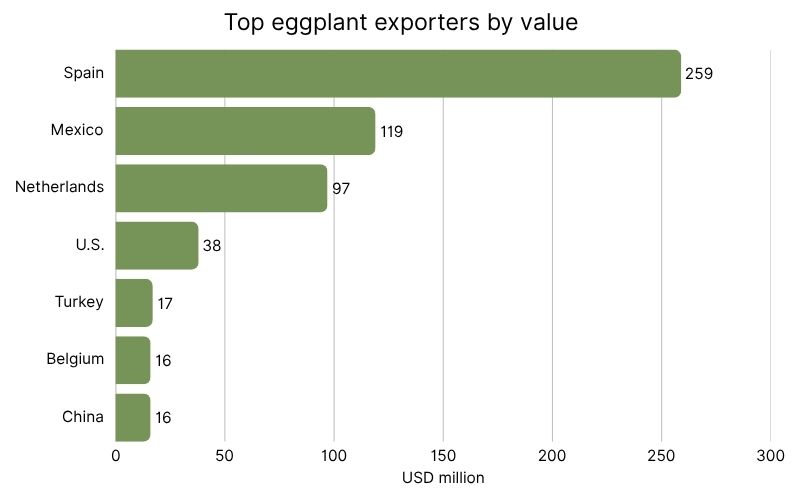
The five most valuable exporters — Spain, Mexico, the Netherlands, the United States and Türkiye — together earn about 79% of global export revenue.
In FAOSTAT’s 2024 data, Spain leads with €239 million (US$258.6 million) of exports, about 190,300 tonnes, ahead of Mexico at €110 million (US$119.4 M) and the Netherlands at €90 million (US$96.9 M). By continent, Europe accounted for about 60% of export value, North America about a quarter, and Asia roughly a tenth.
Leading importers
The United States is by far the largest importer, followed by Germany and France. The three together account for about 45–47% of global imports by both volume and value.
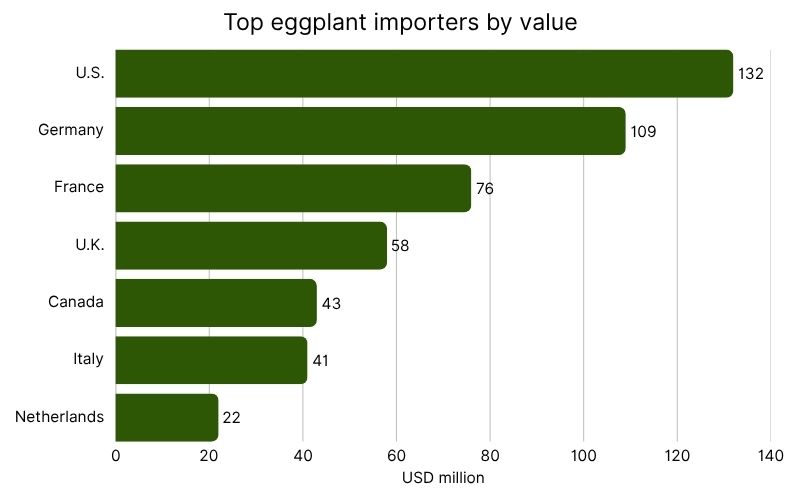
A small group of countries dominates both sides of the trade. Spain and the Netherlands supply almost the entire northern European eggplant market, with Spain leading in field-grown volume and the Netherlands in premium greenhouse fruit and re-exports.
In North America, Mexico is the principal supplier to the United States and Canada, while Honduras occupies an important niche supplying Chinese and Thai specialty varieties, and domestic production in Florida and Georgia supplements.
Prices
Eggplant prices are highly sensitive to seasonality, weather, production systems and variety. It is a highly perishable crop with limited storage life, too.
Farmgate prices
FAOSTAT's 2024 producer-price data show that growers received a median price of €670 per tonne across 44 reported countries. Prices ranged from around €150 to nearly €2,950 per tonne, highlighting the wide variation between production systems and markets.
Protected, high-value production commands the strongest returns. Japan recorded average farmgate prices of approximately €2,350 per tonne, while the Netherlands averaged around €980 per tonne. Major open-field producers reported lower prices, including Spain (€740/t), Mexico (€550/t), Türkiye (€465/t) and Indonesia (€450/t).
Wholesale prices
US terminal markets show how variety, origin, size grade and pack size drive prices. Chinese and Thai specialty types from Mexico and Honduras command premiums over standard globe eggplant from Florida or Georgia.
|
Market and date |
Product and origin |
Price |
|
Atlanta (May 2026) |
Mexico Chinese medium-large, 30 lb carton |
€44–45 |
|
Philadelphia (Jun 2026) |
Honduras Chinese medium, 30 lb carton |
€37 |
|
Philadelphia (Jun 2026) |
Honduras Thai small, 40 lb carton |
€33 |
|
New York (Dec 2025) |
Honduras Chinese med-lg, 30 lb carton |
€33 |
|
New York (Dec 2025) |
Netherlands Sicilian 175–225 g, 5 kg carton |
€28–30 |
|
Atlanta (May 2026) |
Florida medium, 1 1/9 bu (wrapped) |
€23–25 |
|
Philadelphia (Jun 2026) |
Florida medium, fair quality, 1 1/9 bu |
€12–14 |
Retail prices
Retail prices are well above farmgate values due to grading, packaging, transport, refrigeration, spoilage and retailer margins. In the United States, eggplants usually sell for €1.00–3.00 per kilogram during the main season. In the United Kingdom, prices usually range from €3.65 to €5.45 per kilogram in major supermarkets.
Pricing factors
Several factors determine eggplant prices throughout the supply chain:
- Seasonality: Prices typically decrease during peak harvests and rise during the off-season period.
- Production system: Greenhouse-grown eggplants command higher prices than open-field-grown eggplants due to higher production costs and more consistent quality.
- Variety and grade: Chinese, Thai and other specialty varieties typically command premiums over standard globe eggplants.
- Origin and logistics: Long-distance and counter-seasonal shipments have higher transport and handling costs.
- Input costs: Labour, fertilizer, water and energy prices heighten production costs, especially in greenhouse operations.
Demand and consumption
Consumption is highest where production is highest: domestically in China and India, and in the Mediterranean, including Italy, Spain, Türkiye, and Egypt. Eggplants are popular in plant-based, vegetarian diets, an important demand driver. Demand for organic and pesticide-free eggplants is rising in North America and Europe, opening premium niches for exporters.
Market Outlook
The global eggplant market is expected to continue growing gradually but steadily over the next few years, supported by its established use in various cuisines and vegetarian diets, the expansion of greenhouse capacity, and the strengthening of trade networks. However, this market is under pressure from climate volatility, the spread of pests and diseases, and energy costs associated with protected cropping. The price gap between field-grown and greenhouse fruit, as well as commodity and specialty fruit, is likely to persist.
Looking ahead, competitive advantage will increasingly depend on efficient water use, resilient cultivars, protected cultivation, effective cold-chain logistics and the ability to adapt to changing consumer preferences. Exporters that can consistently deliver high-quality specialty varieties, organic certification and reliable year-round supply could get stronger returns.