


Co-author: Helen Onyeaka
Introduction
Sustainability in the food industry means that consumption and production must satisfy consumers' economic, environmental, and social needs and demands. It seeks to facilitate the sustainable production, processing, and consumption of sustainable food regarding its impacts on the environment, which is socially acceptable and can be sustainably marketed [1]. United Nations Sustainable Development Goal 2 or SDG 2 ‘Zero Hunger’ aims to end hunger, ensure food access, and promote proper agriculture. This goal is critical in the global attempt to establish and fortify sustainable food systems under different adversities.
Furthermore, the UN is committed to the development of a world without hunger by the year 2030. However, hunger has risen since 2015 due to conflicts, climate change, and inequality [2]. By 2022, about 735 million people, which is nearly 9.2 per cent, suffered from chronic hunger, an increase from 2019. In 2022, about 2.4 billion individuals are moderately to severely food insecure [2]. Eradication of extreme hunger and malnutrition is still a challenge and coheres people to backwardness forming a poverty trap. Hunger and malnutrition lead to less productive individuals who are also more vulnerable to diseases and hence can barely change their status by making more money and getting better livelihoods [3].
The Potential of Algae in Food Production and Sustainable Production Practices with Chlorella vulgaris
Chlorella vulgaris is a microalgae that contains elevated quantities of proteins, vitamin B12 and Iron, Zinc and have various other uses in food production. With a protein profile that competes with that of soybeans and beef, Chlorella vulgaris spp. also contains all the B-complex vitamins and Vitamin C, Vitamin E and various minerals such as iron, magnesium and calcium, all of which are important for the body. Its essential fatty acid contents help the heart and brain health while its cell wall, rich in fibre, aids in digestion [4].
Chlorella vulgaris contains a high amount of antioxidants, which decrease the level of free radicals and inflammation in the body and improve immunity. It is also applied in food products as an ingredient in the preparation of dishes, in specially formulated nutritional supplements, and as a possible meat substitute. When grown in a controlled environment, it reduces the consumption of water and has few pollutants while maintaining the highest quality yields. It has high photosynthesis and wastewater management efficiency, making it eco-friendly and appropriate for sustainable aquaculture [5].
In addition to the nutritional value of Chlorella vulgaris, the microorganism has the ability to grow without depleting any earth resource. It can quickly be grown in confined and controlled spaces and this can produce high outputs without requiring a huge area. Acutely versatile, this can be grown in bioreactors or water and harvested quite regularly. During photosynthesis, Chlorella vulgaris removes carbon dioxide from the air and, therefore, plays a role in the elimination of greenhouse gases from the air. The species’ capacity to thrive in either freshwater or brackish water conditions lowers the pressure on water resources, which is especially helpful for regions with poor availability of freshwater [6].
Compared to conventional methods, Chlorella vulgaris needs a smaller amount of land because of its high reproduction rate, and it can be cultivated in fresh or slightly salty water, which lowers the water demand. It also employs minimal nutrient inputs to maximize food intake, subsequently cutting on the use of fertilizers hence minimizing the problem of agricultural pollution and its consequences [7]. Also, unlike traditional crops, which in most cases require pesticide and herbicide applications, Chlorella vulgaris is a naturally hardy plant and does not require these chemicals for protection. This makes its farming process a little less destructive to the environment and more eco-friendly and sustainable. This benefit enhances Chlorella vulgaris's ability to produce food and presents its nutritional advantage, sustainability, and efficiency of resources [8].
Chlorella vulgaris-Based Flour: A Nutritious Alternative and Environmental and Economic Benefits.
In regard to its uses as food, Chlorella vulgaris goes through a process of drying and milling into a fine powder. This conversion results in flour with a high amount of protein, vitamins, iron and zinc, and even essential fatty acids with the addition of antioxidants and chlorophyll. The special characteristics of Chlorella vulgaris flour are its high protein profile and the content of essential amino acids and micronutrients. Thus, it can be considered a promising natural ingredient for food enrichment [9].
Chlorella vulgaris cultivation occupies a small space as compared to other crops and also has a small effect on emissions of greenhouse gases. Organized growth and proficiency in CO2 sequestration in regards to its impact on the environment [10]. Chlorella vulgaris can grow in nutrient-rich water recycling wastewater, and this has an added advantage that decreases the use of fresh water in irrigation. Chlorella vulgaris in aquaculture environments works as a filter and even, in many cases, acts as a nutrient-regenerated organism. It improves water quality, fish health, immune and growth systems or rates, and survival or reproduction rates of aquatic animals and benefits both the environment and the fish [11].
Chlorella vulgaris can be economically viable as it has low input demand and high output, and through this, farmers can increase profits per hectare and water. The primary markets or uses of Chlorella vulgaris-based products are healthy and ecological foods since consumers are shifting towards healthier food choices. Through this demand, the producers can benefit from it to generate other kinds of economic opportunities and be part of the solution to the current problems in food production and distribution [12].
Chlorella vulgaris’s Role in Achieving Zero Hunger
Chlorella vulgaris spp. can significantly tackle food security issues. For instance, Chlorella vulgaris minutissima and Chlorella vulgaris singular species were identified to have the potential to remove heavy metals from wastewater [13]. Chlorella vulgaris reduces the instances of contaminated water, especially with heavy metals, thereby contributing to clean water systems that are fundamental in sustainable farming.
Being environmentally friendly, Chlorella vulgaris contains amino acids, vitamins, and minerals in its composition. It can be grown for its edible parts and, therefore, can be used as a source of food, hence making it a good substitute for ordinary crops. Supplementation of Chlorella vulgaris in human diets can improve human nutrition since malnutrition is prevalent in several parts of the world. It usually grows very fast and does not demand inputs and other production resources; hence, it could help expand food production [4].
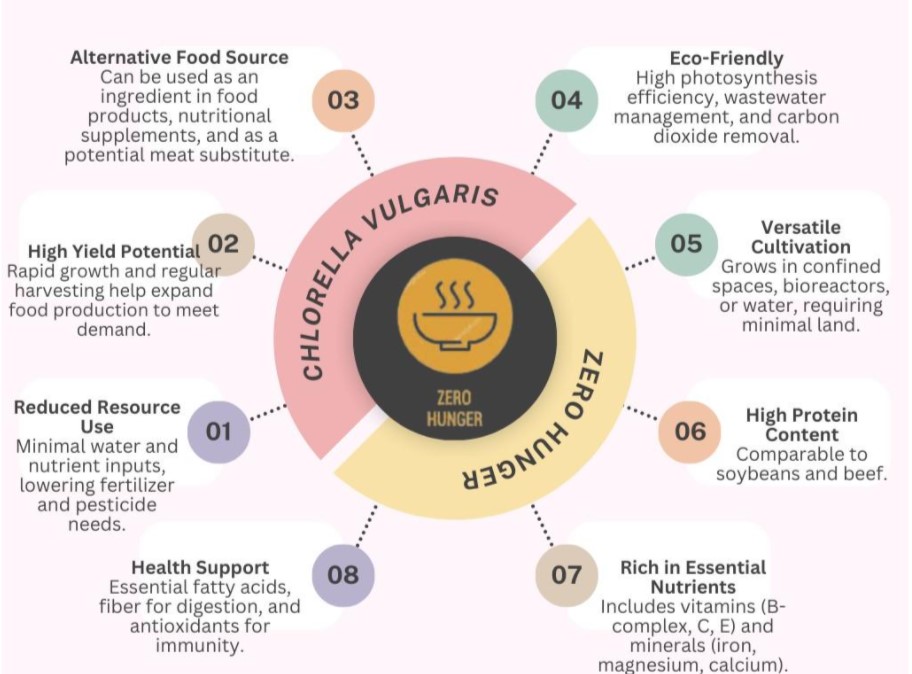
Figure 1: The role of Chlorella vulgaris in achieving Zero hunger (Adapted by author).
SDG 2 (Zero Hunger) calls for agronomic transformation that entails the producer, the consumer, and the policy maker. Due to its high metabolic variability and positive reaction to natural conditions, Chlorella vulgaris can be considered prospective for developing innovative food chains. Current research focuses on Chlorella vulgaris application in food, agriculture and waste management.
Conclusion
Among the sustainable food sources, Chlorella vulgaris occupies a quite significant place regarding its nutritional value, impact on the environment, and cost-effectiveness. By adapting to various environments and enhancing carbon uptake and water quality, it holds a positive role in realising UN SDG 2 (Zero Hunger), which aims to achieve food security by 2030). Therefore, acceptance and implementation of Chlorella vulgaris and such futuristic food production technologies are inevitable to feed the fast-growing population and enhance food production methods. By promoting such practices, we can contribute to the improvement of the health of the planet and the availability of healthy and nutritious food for everyone.
References
- Fanzo, J., Rudie, C., Sigman, I., Grinspoon, S., Benton, T. G., Brown, M. E., Covic, N., Fitch, K., Golden, C. D., Grace, D., Hivert, M. F., Huybers, P., Jaacks, L. M., Masters, W. A., Nisbett, N., Richardson, R. A., Singleton, C. R., Webb, P., & Willett, W. C. (2022). Sustainable food systems and nutrition in the 21st century: a report from the 22nd annual Harvard Nutrition Obesity Symposium. The American Journal of Clinical Nutrition, 115(1), 18–33. Sustainable food systems and nutrition in the 21st century: a report from the 22nd annual Harvard Nutrition Obesity Symposium — The American Journal of Clinical Nutrition
- United Nations (UN) (2024) Goal 2: Zero Hunger. Goal 2: Zero Hunger — UN Sustainable Development Goals
- Tchonkouang, R. D., Onyeaka, H., & Miri, T. (2023). From waste to plate: Exploring the impact of food waste valorisation on achieving zero hunger. Sustainability, 15(13), 10571. From Waste to Plate: Exploring the Impact of Food Waste Valorisation on Achieving Zero Hunger — Sustainability
- Bito, T., Okumura, E., Fujishima, M., & Watanabe, F. (2020). Potential of Chlorella vulgaris as a Dietary Supplement to Promote Human Health. Nutrients, 12(9), 2524. Potential of Chlorella as a Dietary Supplement to Promote Human Health — Nutrients
- Aly, S. M., ElBanna, N. I., & Fathi, M. (2024). Chlorella vulgaris in aquaculture: challenges, opportunities, and disease prevention for sustainable development. Aquaculture International, 32(2), 1559-1586. Chlorella in aquaculture: challenges, opportunities, and disease prevention for sustainable development — Aquaculture International
- Estevam, B. R., Pinto, L. F. R., Filho, R. M., & Fregolente, L. V. (2023). Growth and Metabolite Production in Chlorella vulgaris sp.: Analysis of Cultivation System and Nutrient Reduction. BioEnergy Research, 16(3), 1829-1840. Growth and Metabolite Production in Chlorella sp.: Analysis of Cultivation System and Nutrient Reduction — BioEnergy Research
- Luzzi, S. C., Gardner, R. G., & Heins, B. J. (2024). The Use of Chlorella vulgaris species to Remove Nutrients from Dairy Wastewater to Produce Livestock Feed. Sustainability, 16(4), 1382. The Use of Chlorella species to Remove Nutrients from Dairy Wastewater to Produce Livestock Feed — Sustainability
- Park, Y. J., Park, J., Truong, T. Q., Koo, S. Y., Choi, J., & Kim, S. M. (2022). Effect of Chlorella vulgaris vulgaris on the Growth and Phytochemical Contents of “Red Russian” Kale (Brassica napus var. Pabularia). Agronomy, 12(9), 2138. Effect of Chlorella vulgaris on the Growth and Phytochemical Contents of “Red Russian” Kale (Brassica napus var. Pabularia) — Agronomy
- Marzec, A., Kramarczuk, P., Kowalska, H., & Kowalska, J. (2023). Effect of type of flour and microalgae (Chlorella vulgaris vulgaris) on the rheological, microstructural, textural, and sensory properties of vegan muffins. Applied Sciences, 13(13), 7632. Effect of Type of Flour and Microalgae (Chlorella vulgaris) on the Rheological, Microstructural, Textural, and Sensory Properties of Vegan Muffins — Applied Sciences
- Ru, I. T. K., Sung, Y. Y., Jusoh, M., Wahid, M. E. A., & Nagappan, T. (2020). Chlorella vulgaris vulgaris: A perspective on its potential for combining high biomass with high value bioproducts. Applied Phycology, 1(1), 2-11. Chlorella vulgaris : a perspective on its potential for combining high biomass with high value bioproducts — Applied Phycology
- Babakhani, A., & Zahmatkesh, F. (2024). Microalgae and Cyanobacteria Are Potential Sources of Food in the Future. In: Kurniawan, T.A., Anouzla, A. (eds) Algae as a Natural Solution for Challenges in Water-Food-Energy Nexus. Environmental Science and Engineering. Springer, Singapore. Microalgae and Cyanobacteria Are Potential Sources of Food in the Future — Environmental Science and Engineering
- Dragone, G. (2022). Challenges and opportunities to increase economic feasibility and sustainability of mixotrophic cultivation of green microalgae of the genus Chlorella vulgaris. Renewable and Sustainable Energy Reviews, 160, 112284. Challenges and opportunities to increase economic feasibility and sustainability of mixotrophic cultivation of green microalgae of the genus Chlorella — Renewable and Sustainable Energy Reviews
- Pachouri, V., Chandramauli, A., Singh, R., Gehlot, A., Priyadarshi, N., & Twala, B. (2024). Removal of contaminants by Chlorella vulgaris species: an effort towards sustainable remediation. Discover Sustainability, 5(1), 19. Removal of contaminants by chlorella species: an effort towards sustainable remediation — Discover Sustainability