

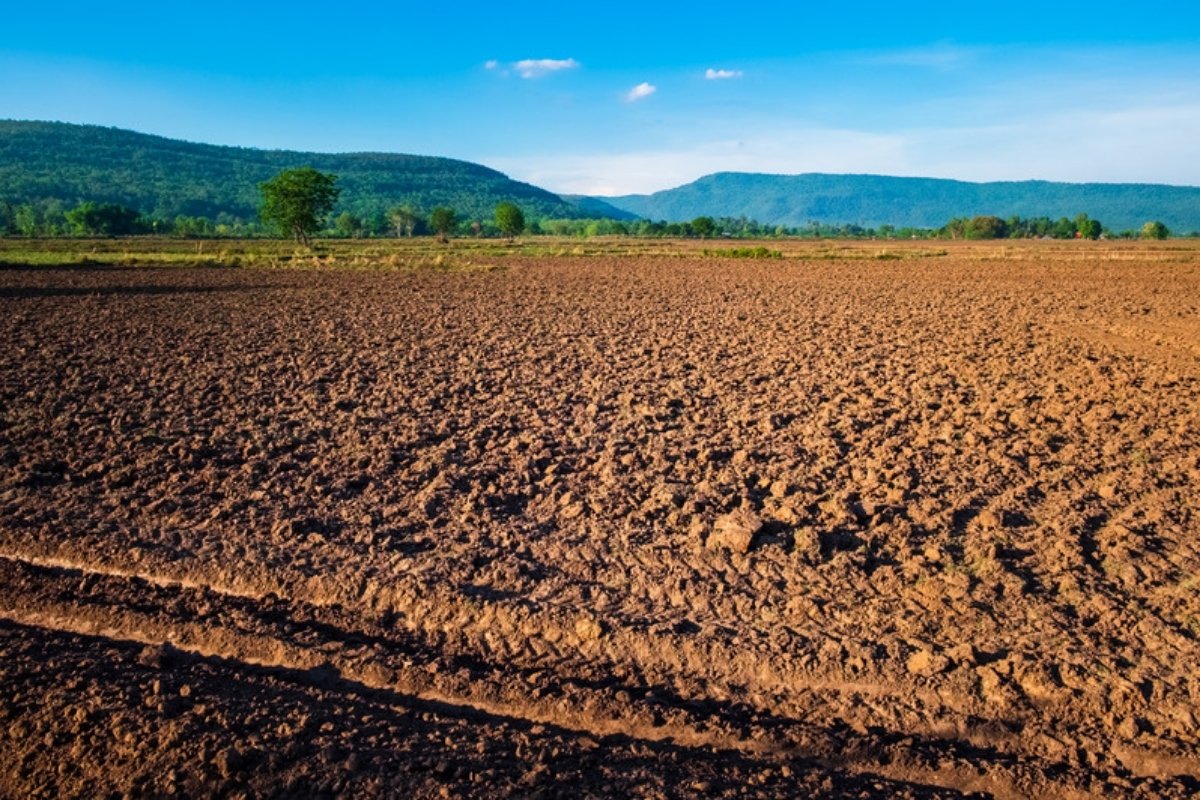
At a NASA grid point in the northern Free State, in South Africa's maize belt, only 2.6 mm of rain fell from 1 to 30 October 2026, against a 1991 to 2020 average of 49.0 mm, or about 5% of normal, while the mean temperature was about 2.3 °C above normal, according to a Wikifarmer analysis of NASA data. In the data going back to 1991 it was the second driest 1 to 30 October period after that of 2019, and the US Department of Agriculture (USDA) says the continued lack of rain has begun to limit soil moisture for early planting in the eastern corn belt. Planting in the Free State starts in November according to the GEOGLAM crop calendar, and, according to planting intentions released by the Crop Estimates Committee (CEC), the country's commercial farmers intend to plant 12.4% less maize area this season than last.
No day from 1 to 30 October brought even 1 mm in the northern Free State
At the NASA POWER grid point at 27.5°S 27.0°E, in the northern Free State, 22 of the 30 days from 1 to 30 October had no rain at all and the highest daily value was 0.75 mm, on 11 October, so no day brought even 1 mm. The mean temperature over the period was 23.0 °C, against a 1991 to 2020 average of 20.6 °C, and the maximum temperature passed 35 °C on 3 days, with a high of 35.6 °C on 18 October. The 90 days to 30 October, by contrast, brought 140.7 mm, above the average of 69.1 mm, because September, with 111 mm, and to a lesser extent August were wet at the same point.
This year's 1 to 30 October period was the second driest in data going back to 1991
From 1991 to 2026, over the same 1 to 30 October window, only 2019 was drier at this point, with 0.7 mm, while the next driest after 2026 were 2015, with 9.4 mm, and 2020, with 10.9 mm. With a mean temperature of 23.0 °C, this year's period was also the third warmest, after those of 2015 and 2022.
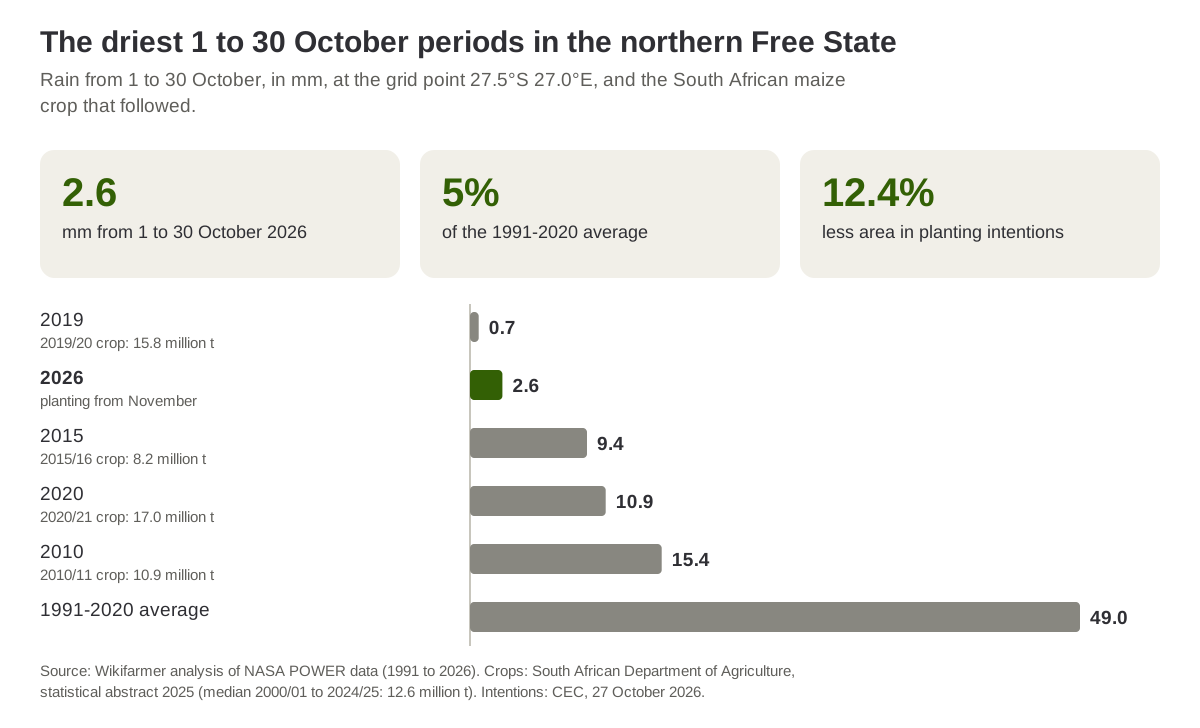
Source: Wikifarmer analysis of NASA POWER daily data, grid point 27.5°S 27.0°E, 1991 to 2026.
USDA says the lack of rain has begun to limit soil moisture in the eastern belt
In its Weekly Weather and Crop Bulletin of 27 October, USDA says dry conditions continued across nearly all of South Africa's production areas, with isolated showers of 10 to 50 mm only along the southern coastline, and that warm to hot weather persisted across the Maize Triangle, with daytime highs reaching roughly 37 to 43 °C in parts of the eastern corn belt. According to the same bulletin, the continued lack of rainfall has begun to limit soil moisture for early planting in the eastern corn belt, while the western corn belt remains a few weeks away from planting and has more time to recover if rains return. A week earlier, in the bulletin of 20 October, USDA said temperatures averaged 2 to 7 °C above normal across much of the country and that the combination of heat and limited rain had further reduced soil moisture reserves ahead of corn planting in eastern production areas, keeping concerns about early crop establishment in Limpopo, Mpumalanga and KwaZulu-Natal.
Planting in the Free State starts in November according to GEOGLAM
In the GEOGLAM crop calendar for Free State maize, planting falls in November, ripening in March and April and the end of the season in May, so the dry October comes before planting. In the forecast of the European Centre for Medium-Range Weather Forecasts (ECMWF) run at 00:00 UTC on 2 November, the grid point in the northern Free State gets 7.6 mm over ten days, to 11 November, with highs of up to 32.4 °C. For the coming months, the South African Weather Service (SAWS) gives below-normal rainfall as the dominant category over much of the country in its October issue, as described in SAWS's seasonal forecast for a dry summer.
Farmers intend to plant 12.4% less maize area
According to the intentions to plant released by the CEC on 27 October, commercial farmers intend to plant 2.387 million hectares of maize for the 2027 crop, 337,000 ha or 12.4% less than the 2.724 million hectares of the past season. Most of the cut is in white maize, at 1.370 million hectares, 18.2% less, while intentions for yellow maize stand at 1.017 million hectares, 3.1% less. In the Free State intentions are 1.080 million hectares, against 1.215 million in 2026, and in North West 429,500 ha, against 605,000. For sunflower seed, by contrast, the expected area is 824,600 ha, 44.6% more than last season. The CEC notes that the intentions are mainly based on a non-probability survey and that various factors can still influence them up to planting time.
Two of four dry 1 to 30 October periods from 2000 to 2024 were followed by a smaller crop
From the 2000/01 season to the 2024/25 season, the 1 to 30 October period brought 20 mm or less at the same point four times, in 2010, 2015, 2019 and 2020, although in 2020 almost 14 mm more fell on 31 October. According to the South African Department of Agriculture's statistical abstract, total maize production in the seasons that followed was 10.9 million tonnes in 2010/11 and 8.2 million tonnes in 2015/16, below the median of the 25 seasons of 12.6 million tonnes, but 15.8 million tonnes in 2019/20 and 17.0 million tonnes in 2020/21, above it. A dry spell in October has therefore not on its own meant a small crop, and 2015/16 was a season with a moderate to strong El Niño according to GEOGLAM, while according to SAWS a strong El Niño is under way this year.
The first official area estimate is due on 27 January
For farmers in the Free State and North West, the rain of the coming weeks bears directly on planting, while for buyers of white and yellow maize in southern Africa the planting intentions are the first official figure for the 2027 crop. The CEC will release its preliminary estimate of the area planted to summer grains for 2027 on 27 January 2027, and the picture may change with the rain of November and December.
Frequently asked questions
How much rain fell in October in South Africa's maize belt?
At the NASA grid point in the northern Free State, 2.6 mm fell from 1 to 30 October 2026, against a 1991 to 2020 average of 49.0 mm, and no day brought even 1 mm.
How rare is such a dry spell in October?
In the data going back to 1991, only the 1 to 30 October period of 2019 was drier at the same point, with 0.7 mm.
When is maize planted in the Free State?
According to the GEOGLAM crop calendar, planting in the Free State takes place in November. USDA noted on 27 October that the western corn belt was still a few weeks away from planting.
How much maize area will be planted?
According to the planting intentions released by the CEC, commercial farmers intend to plant 2.387 million hectares, 12.4% less than last season, with the largest cut in white maize.
Does a dry October mean a small crop?
Of the four 1 to 30 October periods with 20 mm or less at the same point from 2000 to 2024, two were followed by a crop below the median, 2010/11 and 2015/16, and two by a crop above it, 2019/20 and 2020/21.
Important notes
Wikifarmer computed the October rain and temperature from NASA POWER daily data for the grid point at 27.5°S 27.0°E, with a resolution of about half a degree and 1991 to 2020 averages for the same days. The data describe a grid cell, not a station, and the latest available day was 30 October. The descriptions of the weather in the production areas come from USDA's Weekly Weather and Crop Bulletins of 20 and 27 October 2026. The rain forecast is ECMWF's, run of 00:00 UTC on 2 November. The planting intentions are the CEC's, of 27 October 2026, and production in past seasons comes from the Department of Agriculture's 2025 statistical abstract, with 2024/25 preliminary. All October comparisons refer to the 1 to 30 October period of each year, and mean temperature is the average of daily maximum and minimum. The comparison with past crops shows coincidences, not causes, and the article does not estimate the 2027 crop or prices.
Sources
- NASA Langley Research Center. POWER, Prediction of Worldwide Energy Resources, daily data, accessed 23 October and 2 November 2026.
- U.S. Department of Agriculture. (2026, 27 October). Weekly Weather and Crop Bulletin.
- U.S. Department of Agriculture. (2026, 20 October). Weekly Weather and Crop Bulletin.
- GEOGLAM Crop Monitor. Crop calendars, accessed 23 October 2026.
- European Centre for Medium-Range Weather Forecasts. Open data, IFS 0.25°, run of 2 November 2026, 00:00 UTC.
- South African Weather Service. (2026). Seasonal Climate Watch, November 2026 to March 2027, October 2026 issue.
- GEOGLAM Crop Monitor. (2026, 16 October). Special Report, El Niño 2026-2027, Regional Outlooks.
- Crop Estimates Committee. (2026, 27 October). Summer crops, intentions to plant 2027, and area planted and ninth production forecast 2026.
- Department of Agriculture, Land Reform and Rural Development. (2025). Abstract of agricultural statistics 2025.