



Introduction: The Urgent Need for Sustainable Food Safety Solutions
In the 21st century, food safety and sustainability represent two of the most critical worldwide challenges influencing crop production, processing, packaging, distribution, and food consumption (Balan, 2024; UNEP, 2021). The extent of food loss and waste within the food value chain is concerning. Around 1.3 billion tonnes of food are annually lost or wasted globally (Marimuthu et al., 2024; FAO, 2021). This inefficiency contributes around 10% of global greenhouse gas emissions, adversely affecting the environment and incurring financial expenses (Singh et al., 2021). Perishable foods, such as minced beef, characterised by elevated moisture content and nutrient density, deteriorate and oxidise rapidly, resulting in spoilage and waste, even when refrigerated (Mohammadi et al., 2020).
Rethinking Packaging: From Plastics to Biodegradable and Intelligent Solutions
This event exemplifies the significance of identifying packaging solutions that simultaneously prolong shelf life, ensure food safety, and fulfil environmental objectives. Although single-use, petroleum-based plastic packaging offers short-term convenience, it remains in the environment for centuries, potentially resulting in enduring environmental issues such as microplastic pollution, soil degradation, and health risks to humans via the food chain (UNEP, 2021). To address these issues, it is essential to alter our conceptualisation of packaging to ensure it is biodegradable, antimicrobial, and intelligent. This will help reduce waste, make consumers safer, and have less of an effect on the environment.
Limitations of Traditional Food Packaging Technologies
A study of modern food packaging systems shows both progress and limitations. Traditional technologies such as vacuum packaging and modified atmosphere packaging are widely used in meat processing, as they effectively slow down oxidative reactions and the growth of microorganisms (Mohammadi et al., 2020). Still, these systems rely heavily on cold chains, which in many developing nations are not always stable because of the problems with infrastructure and energy (Kaur & Watson, 2024). Also, traditional packaging often uses synthetic preservatives and barrier layers made from non-renewable petroleum.
These not only exacerbate pollution, but they also face increased consumer opposition as people seek more natural and clean-label food products (Iversen et al., 2022). From an economic point of view, the high rate of product damage caused by poor packing or breaks in the cold chain directly costs farmers and processors money, while also hurting customer trust and brand reputation (Kaur & Watson, 2024). The intersection of sustainability, safety, and consumer perception creates an opening for new smart and biodegradable packaging solutions to change the way agrifood supply chains work, benefiting farmers, merchants, and consumers.
Advances in Biodegradable Polymer Packaging: The Role of Chitosan and Nanocomposites
There has been a lot of research and development on biodegradable polymers in the last few years. One of these is chitosan, a chitin derivative that comes mostly from crustacean shells. Chitosan has become popular since it comes from renewable sources and has natural antibacterial properties that inhibit the growth of spoilage and pathogenic microorganisms (Garavand et al., 2022). Because it has cationic qualities, it interacts with negatively charged bacterial cell membranes, which weakens them and stops their metabolic operations. This helps in prolonging the shelf life of perishable foods (El-Beltagi et al., 2025).
Chitosan films, on the other hand, have a few drawbacks, such as not being strong enough and letting water vapour through too easily. This could make them less effective when stored in humid conditions (Garavand et al., 2022). Using nanocomposite reinforcement with naturally occurring minerals like montmorillonite nano clay has been a significant step forward in solving these problems. Montmorillonite makes packing films stronger and better at keeping moisture and oxygen out, slowing oxidative processes and microbial activity (Kechagias et al., 2025). These improvements show that biodegradable packaging materials can work as well as or even better than regular plastics, and they also ease worries about how long they will stay in the environment.
Natural Antibacterial Agents: Enhancing Eco-Friendly Packaging Performance
Adding natural antibacterial agents, such as essential oils, to packaging makes it better for the environment. Researchers have studied cinnamon essential oil (CEO) because it contains cinnamaldehyde, a powerful antioxidant and antimicrobial (Shu et al., 2024). Using it directly in food packaging is not straightforward because it is volatile and has a strong smell that could change the smell and taste of the food. Researchers have come up with nanoencapsulation and intercalation methods to combine CEO with polymer matrices or layered nanoclays.
This makes controlling when the CEO is released easier and reduces bad organoleptic effects (Omidian et al., 2025). This controlled release ensures that the food stays antibacterial for a long time while keeping its taste and smell, which meets safety and consumer acceptability standards. A complex, all-purpose packaging solution based on the principles of the circular economy uses renewable resources and makes it easier for the packaging to break down after use. This can be achieved by combining chitosan-based biopolymers with nano clay reinforcements and essential oils that are sealed in.
Smart Packaging: Real-Time Spoilage Detection with Natural Color Indicators
In addition to making food last longer, smart packaging technologies are changing the way customers and supply chain personnel keep track of and talk about how fresh food is. Anthocyanins from the Butterfly Pea Flower (Clitoria ternatea) are natural pigments that can change colour depending on the pH (Vidana et al., 2021). These anthocyanins change colour when the pH level changes. For instance, they change from blue in neutral pH to pink under acidic conditions.
This makes them useful for checking for spoilage in real time. When minced beef goes bad, it makes volatile basic nitrogenous compounds, especially ammonia, which raises the pH in the packaging area. Adding anthocyanins to the packaging matrix creates a visual freshness signal that lets customers judge the quality of the product without opening the box (Salgado et al., 2021).
This feature can help people avoid eating contaminated food, lower the risk of foodborne infections, and reduce waste by providing a correct, up-to-date estimate of shelf life, rather than relying solely on fixed-date labelling. Figure 1 depicts the colour changes of anthocyanin-based indicator films about meat deterioration and emphasises the composition of the multilayer packaging film, which comprises a chitosan matrix, montmorillonite nanoclay, encapsulated essential oils, and an indicator patch. This innovation gives farmers and food processors a robust mechanism to improve supply chain transparency and distinguish their products in increasingly competitive marketplaces.
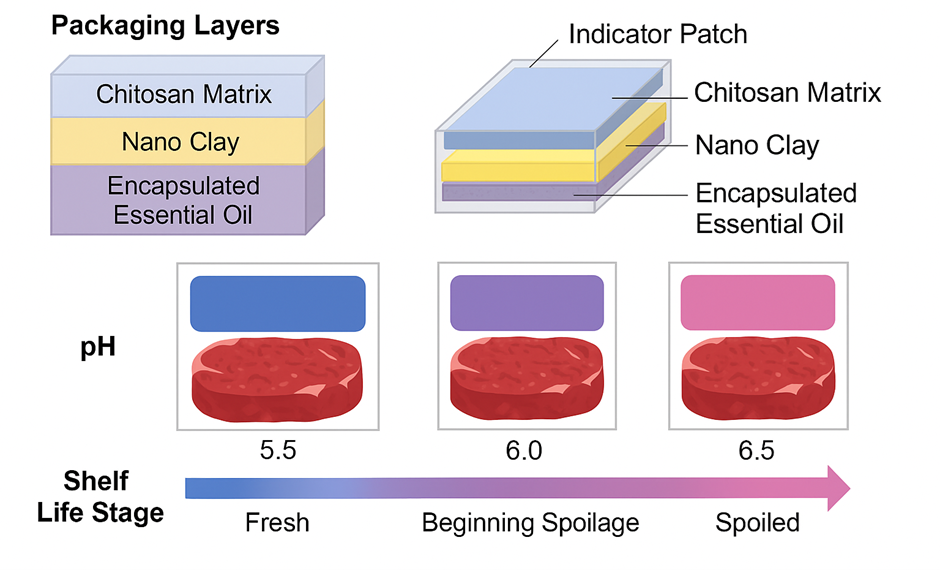
Figure 1: Colour Transition of Anthocyanin-Based Indicator Films and Multilayer Biodegradable Packaging Structure for Real-Time Meat Spoilage Detection
Challenges and Regulatory Barriers to Commercializing Smart Biodegradable Packaging
Nonetheless, transitioning these technologies from laboratory prototypes to industrial applications presents significant obstacles. Although nanocomposite films and essential oil-infused biopolymers exhibit superior antibacterial and mechanical properties in controlled experiments, empirical evidence from actual meat storage and distribution environments remains scarce (Khan et al., 2021). Secondly, the long-term stability and reliability of anthocyanin-based pH indicators must be assessed under actual cold chain variations, which frequently encompass swings in humidity, temperature, and light exposure (Vidana et al., 2021).
Third, EU Regulation (EC) No 1935/2004 and the U.S. FDA's Code of Federal Regulations Title 21 are two examples of regulatory frameworks that control food contact materials. These frameworks enforce stringent restrictions on migrating active agents and nanoparticles into food products. As a result, packaging developers must conduct strict safety and migration tests to ensure they follow the rules, which could raise development costs and delay commercialisation. To get beyond these problems, researchers, package makers, food producers, and regulators need to work together to improve designs to be more commercially viable while also protecting public health and the environment.
Practical Adoption: Economic Considerations and Training for Farmers
There are many problems that farmers and people in the food supply chain will have to deal with when they really use biodegradable and smart packaging technology. Initially, producers must assess the compatibility of new packaging technologies with their current processing and storage facilities. Active packaging films may exhibit distinct sealing qualities compared to standard polyethylene films, requiring sealing temperature or pressure modifications to prevent leaks (Khaleel et al., 2024). Secondly, cost analysis is essential; although biodegradable smart packaging may initially incur more expenses than traditional plastics, the potential for less spoilage, longer distribution capabilities, and enhanced consumer confidence can mitigate these costs over the medium to long term.
Farmers can also explore cooperative purchasing models, where producer groups jointly invest in advanced packaging solutions to benefit from economies of scale (Grashuis, 2018; Staatz, 1989). Third, it is essential to train personnel on the correct interpretation of freshness indicators, ensuring that all actors in the chain, from processing staff to retail workers, understand how to respond to colour changes and other intelligent packaging signals to prevent unnecessary waste or safety incidents. Practical experience from countries such as the Netherlands demonstrates intelligent packaging adoption's economic and environmental benefits.
For instance, Wageningen University & Research, in collaboration with Dutch retailers and the Food Waste Free United foundation, observed that food waste in supermarkets decreased from around 2.9 % of procurement volume in 2018 to 1.4 % by 2023 for fresh meat and fish products, an approximate 50 % reduction in retail-level losses in just five years, with smart packaging innovations cited as a key contributing factor (based on targeted stock management, dynamic pricing, and freshness monitoring) (Wageningen University and Research, 2024).
Broader Impacts: Policy Alignment and the Future of Food Packaging
Finally, the sustainability implications of adopting biodegradable and smart packaging systems extend beyond environmental gains. These technologies align with broader policy frameworks such as the European Green Deal and the United Nations Sustainable Development Goals, particularly SDG 12 (Responsible Consumption and Production) and SDG 13. From a theoretical perspective, the diffusion of innovation model (Tahir, 2020) suggests that early adopters of disruptive packaging innovations, often innovative farmers and processors, can gain competitive advantages through differentiation, brand reputation, and access to sustainability-oriented markets, such as eco-label or premium “green” retail segments. Moreover, integrating such packaging systems within farm-to-fork strategies enhances traceability and resilience, which are increasingly critical in a global food system exposed to climate variability, pandemic disruptions, and shifting consumer expectations.
References
Balan, I. M., Trasca, T. I., Iancu, T., Belc, N., Radulov, I., and Tulcan, C. (2024). Food safety in the sustainable food industry. In Smart food industry: The blockchain for sustainable engineering (pp. 218-239). CRC Press.
El-Beltagi, H. S., Abdel-Haleem, M., Al Saikhan, M. S., Shalaby, T. A., Mohamed, A. A., and Khedr, E. H. (2025). Antibacterial coatings: pioneering solutions for maintaining fruit quality and prolonging storability. The Journal of Horticultural Science and Biotechnology, 1-25.
El-Beltagi, H. S., Abdel-Haleem, M., Al Saikhan, M. S., Shalaby, T. A., Mohamed, A. A., and Khedr, E. H. (2025). Antibacterial coatings: pioneering solutions for maintaining fruit quality and prolonging storability. The Journal of Horticultural Science and Biotechnology, 1-25.
FAO (2021). The State of Food and Agriculture: Making Agrifood Systems More Resilient. Rome: FAO
Garavand, F. et al. (2022). ‘A comprehensive review on the nanocomposites loaded with chitosan nanoparticles for food packaging’, Critical Reviews in Food Science and Nutrition, 62(5), pp. 1383‑1416.
Grashuis, J. (2018). Joint ownership by farmers and investors in the agrifood industry: an exploratory study of the limited cooperative association. Agricultural and food economics, 6(1), 24.
Iversen, L. J. L., Rovina, K., Vonnie, J. M., Matanjun, P., Erna, K. H., ‘Aqilah, N. M. N., ... and Funk, A. A. (2022). The emergence of edible and food-application coatings for food packaging: a review. Molecules, 27(17), 5604.
Kaur, R., and Watson, J. A. (2024). A scoping review of postharvest losses, supply chain management, and technology: implications for produce quality in developing countries. Journal of the ASABE, 67(5), 1103-1131.
Kechagias, A., Leontiou, A. A., Oliinychenko, Y. K., Stratakos, A. C., Zaharioudakis, K., Proestos, C., ... and Giannakas, A. E. (2025). Eugenol@ Montmorillonite vs. Citral@ Montmorillonite Nanohybrids for Gelatin-Based Extruded, Edible, High Oxygen Barrier, Active Packaging Films. Polymers, 17(11), 1518.
Khaleel, G., Sharanagat, V. S., Upadhyay, S., Desai, S., Kumar, K., Dhiman, A., and Suhag, R. (2024). Sustainable Approach Toward Biodegradable Packaging Through Naturally Derived Biopolymers: An Overview. Journal of Packaging Technology and Research, 1-28.
Khan, M. R., Di Giuseppe, F. A., Torrieri, E., and Sadiq, M. B. (2021). Recent advances in biopolymeric antioxidant films and coatings for preservation of nutritional quality of minimally processed fruits and vegetables. Food Packaging and Shelf Life, 30, 100752.
Marimuthu, S., Saikumar, A., and Badwaik, L. S. (2024). Food losses and wastage within food supply chain: A critical review of its generation, impact, and conversion techniques. Waste Disposal & Sustainable Energy, 6(4), 661-676.
Mohammadi, A., Hosseini, S.M. and Hashemi, M. (2020). ‘Emerging chitosan nanoparticles loading‑system boosted the antibacterial activity of Cinnamomum zeylanicum essential oil’, Industrial Crops and Products, 155, p. 112824
Omidian, H., Cubeddu, L. X., and Gill, E. J. (2025). Harnessing nanotechnology to enhance essential oil applications. Molecules, 30(3), 520.
Salgado, P. R., Di Giorgio, L., Musso, Y. S., and Mauri, A. N. (2021). Recent developments in smart food packaging focused on biobased and biodegradable polymers. Frontiers in Sustainable Food Systems, 5, 630393.
Shu, C., Ge, L., Li, Z., Chen, B., Liao, S., Lu, L., ... and Qu, M. (2024). Antibacterial activity of cinnamon essential oil and its main component of cinnamaldehyde and the underlying mechanism. Frontiers in pharmacology, 15, 1378434.
Singh, S., Gaikwad, K.K. and Lee, Y.S. (2021). ‘Biodegradable active packaging and the circular economy: current status and future challenges’, Journal of Cleaner Production, 294, p. 126363.
Staatz, J. M. (1989). Farmer cooperative theory: Recent developments.
Tahir, U. (2020). ‘Advantages of Diffusion of Innovation Theory’, CMI. Available at: Advantages of Diffusion of Innovation Theory [Accessed: 23 July 2025].
UNEP (2021). From Pollution to Solution: A Global Assessment of Marine Litter and Plastic Pollution. Nairobi: UNEP
Vidana Gamage, G. C., Lim, Y. Y., and Choo, W. S. (2021). Anthocyanins from Clitoria ternatea flower: Biosynthesis, extraction, stability, antioxidant activity, and applications. Frontiers in Plant Science, 12, 792303.
Wageningen University and Research (2024). Food waste in supermarkets down to 0.89%. 12 September. Available at: Wageningen University & Research [Accessed: 23 July 2025].
Further reading
Smart Packaging Application in Bakery Products
Smart Packaging Functionality and Benefits
How to Reduce Food Waste with Food Packaging?
Potential risks of food packaging plastic waste on human health and the environment