Introduction
Pig welfare is a critical concern in modern livestock farming, with tail biting, stress, and infections posing significant challenges. These issues affect animal health and lead to economic losses for farmers. Recent advancements in research and technology have provided innovative solutions to monitor and improve pig welfare. This article explores key findings from multiple studies, focusing on tail biting, stress biomarkers, environmental enrichment, and precision farming technologies.
Tail Biting: Causes, Early Detection, and Prevention
What is Tail Biting in Pigs?
Tail biting is a multifactorial issue influenced by environmental, nutritional, and social factors. It occurs when pigs, unable to satisfy their natural exploratory behaviors, redirect their frustration toward pen mates, leading to injuries and infections (Valros, 2024) (Figure 1). Tail biting is categorized into three types: two-stage, sudden-forceful, and obsessive, with the latter being particularly destructive (Heseker et al., 2024).
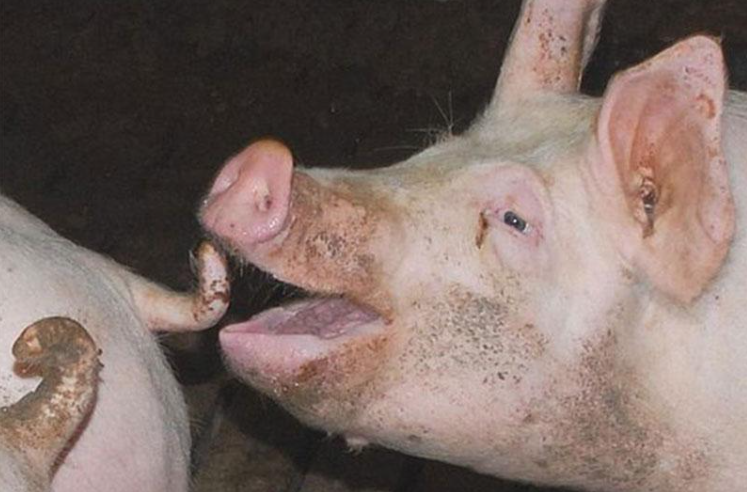
Figure 1. A pig biting another's tail which often leads to injuries and infections
Source: Adapted from
Tail lesion scoring system
Figure 2 below shows a tail lesion scoring system for pigs, crucial for assessing welfare in intensive farming. Tail biting, a common issue in pig production, leads to health and economic losses, necessitating standardized scoring for early intervention (European Commission, 2008). Scores 0–3 categorize lesion severity, with necrosis (score 3) indicating tissue death, often linked to infection risks. Complete tail loss (CL) is scored separately, reflecting chronic welfare issues (AVMA, 2020). LES and SEV aggregate scores to quantify lesion prevalence and severity. Such systems align with the EU’s emphasis on animal welfare monitoring (vom Brocke et al., 2019).

Figure 2. Tail lesion scoring system for pigs
|
Score |
Description |
Additional Notes |
|
0 |
No visible lesion |
- |
|
1 |
Skin perforated with reddish discoloration, no loss of skin |
Mild lesion |
|
2 |
Skin perforated with reddish discoloration and loss of skin (dented skin) |
Severe lesion |
|
3 |
Skin perforated with brownish or blackish discoloration and loss of skin (dented skin) |
Necrosis (includes any lesion with obvious brownish/blackish discolouration) |
|
CL |
Complete loss of tail up to tail base with perforated or healed skin surface |
Complete tail loss (scored independently of lesion scores 0 to 3) |
|
LES |
Any lesion (lesion scores 1, 2, or 3 and/or complete loss of tail (CL) present |
Combined score for any tail lesion |
|
SEV |
Medium to severe lesion (lesion score 2 or 3 and/or complete loss of tail (CL)) |
Combined score for severe tail lesions |
|
Adapted from vom Brocke et al. (2019) |
||
Environmental Factors
The housing environment plays a significant role in the occurrence of tail biting. A major risk factor is the lack of enrichment materials that allow pigs to perform natural behaviors like rooting and exploration. Schrøder-Petersen and Simonsen (2001) highlighted the increased risk of tail biting in the absence of enrichment. Providing manipulable materials like straw, hay, wood shavings, or even ropes and plastic elements can help redirect the pigs' attention and reduce biting behavior. Kauselmann et al. (2021) found that plant-based enrichment materials can influence exploration behavior in pigs. However, Lahrmann et al. (2018) suggest that early intervention with enrichment can be particularly effective in preventing outbreaks.
Inadequate space allowance can also contribute to stress and increase the likelihood of tail biting. Higher stocking densities can lead to increased competition for resources and more negative social interactions. Poor ventilation and air quality can cause respiratory issues and general discomfort (Mutimaamba and Gadzama, 2024). potentially triggering tail biting. Similarly, inconsistent temperature can stress pigs and increase the risk (Taylor et al., 2012). Rosvold et al. (2024) investigated the effects of different rooting materials on finishing pigs and suggested that providing such materials can positively influence behavior and welfare.
Management Factors
Several aspects of farm management can influence the risk of tail biting. Insufficient feeding space can lead to competition and frustration, potentially escalating into biting behavior. D'Alessio et al. (2023) compared single- and double-spaced feeders and their impact on damaging behavior. Insufficient feeding space is highlighted as a potential contributing factor to tail biting. Nutritional imbalances might also play a role, although the exact mechanisms are still being researched. Sudden changes in diet could also be a contributing factor.
Poor health status can make pigs more irritable and prone to being bitten or becoming biters. Weaning stress, a significant event in a pig's life, can also increase the risk of abnormal behaviors like tail biting.
Pig-Related Factors
Individual pig characteristics and social dynamics within the pen can also be important. Hoy et al. (2020) conducted ethological investigations on the perpetrators and victims of tail-biting in weaner pigs. Munsterhjelm et al. (2025) reported that tail status at both individual and pen levels affects tail-biting victimization in pigs over the finishing period. Wilder et al. (2020) used network analysis to study group structure and its potential effects on tail posture and biting.
The Debate Around Tail Docking
In many countries, a common practice to prevent tail biting is tail docking, the partial removal of the tail in piglets. While this can reduce the severity of tail lesions if biting occurs, it is a painful procedure and raises animal welfare concerns. Several sources indicate a move towards phasing out routine tail docking in the EU. Finland, for instance, is one of the few countries where tail docking is forbidden. Valros (2021) reviewed pig production features in Finland. They suggested several factors, including larger space allowance, manipulable materials, good animal health, and motivated producers, contributing to the successful rearing of non-docked pigs.
The European Food Safety Authority (EFSA) has also provided scientific opinions on the risks associated with tail biting and possible means to reduce the need for tail docking. Commission Recommendation (EU) 2016/336 provides guidelines on applying the Council Directive 2008/120/EC regarding measures to reduce the need for tail docking.
Creating a Supportive Environment: Housing and Enrichment
Given the move towards reducing or eliminating tail docking, providing an environment that minimizes the risk of tail biting is crucial.
Early Detection and Prevention
Early detection of tail biting is crucial for timely intervention. Studies have shown that changes in tail posture, such as a shift from curly to hanging tails, can serve as early indicators of tail biting (Drexl et al., 2022). Automated systems, such as optical flow and scream detection, have been developed to monitor pig behavior and detect tail-biting events before they escalate (Larsen et al., 2020; Heseker et al., 2024).
Environmental Enrichment and Pig Welfare
The Importance of Enrichment
Environmental enrichment is essential for promoting natural behaviors and reducing stress in pigs (Figure 3). Studies have shown that providing enrichment materials, such as straw, hay, or ropes, can significantly reduce harmful behaviors like tail biting and aggression (Rosvold et al., 2024) by satisfying pigs' natural rooting and chewing behaviors (Rosvold et al., 2024). A study by Lahrmann et al. (2018) found that early intervention with enrichment materials, such as straw and haylage, can prevent tail biting outbreaks in weaner pigs.
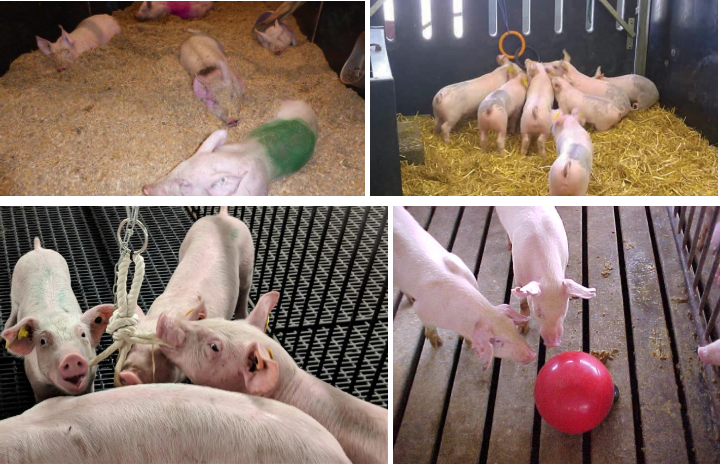
Figure 3. Providing adequate environmental enrichment, such as straw, ropes, balls, toys, or other manipulable materials, can reduce frustration and stress, thereby lowering the risk of tail biting in pigs
Source:
https://www.wur.nl/en/show/facilitating-natural-behaviour-in-alternative-housing-system-promotes-resilience-in-pigs.htm
Tailoring Enrichment to Pig Needs
Weaning is one of the most stressful phases in pig production, often leading to aggression, injuries, and reduced welfare due to mixing unfamiliar litter and sudden changes in environment and diet (Kuri et al., 2024). Environmental enrichment is a proven method to mitigate these challenges by encouraging natural behaviors and reducing harmful interactions. A study conducted on a commercial pig farm in Slovenia involved 363 piglets from 35 litters (Kuri et al., 2024). Piglets were weaned at 28–35 days and divided into ten groups, with five control and five test groups.
In the control groups, one toy (a red plastic biting ring) and one piece of spruce wood were provided per pen, regardless of the number of litter (Figure 4). The number of enrichment objects in the test groups was adjusted to the number of mixed litters, with one toy and one piece of wood provided per litter (Kuri et al., 2024). The study demonstrated that adjusting the amount of enrichment material based on the number of mixed litters in weaner pens significantly improved piglet welfare. Piglets in enriched pens showed fewer injuries and engaged in more positive behaviors, such as exploration and play.
 and an example of the test pen.PNG)
Figure 4. Enrichment objects (toys, wood) and an example of the test pen.
Adapted from Kuri et al. (2024).
Stress and Infection Monitoring: The Role of Saliva Biomarkers
Novel Biomarkers for Stress and Infection
Traditional methods of monitoring pig health, such as blood sampling, are invasive and stressful. Saliva biomarkers, such as oxytocin and procalcitonin, offer a non-invasive alternative for assessing stress and infection levels in pigs (Valros et al., 2022).
- Oxytocin: Higher levels of oxytocin are associated with reduced stress, particularly in control pigs compared to those with tail-biting lesions (Valros et al., 2022).
- Procalcitonin: Elevated levels of procalcitonin in pigs with tail-biting lesions indicate systemic infections, highlighting the link between tail-biting and bacterial infections (Valros et al., 2022).
Implications for Welfare Monitoring
Saliva biomarkers enable farmers to monitor pig health and welfare in real time, allowing for early intervention and improved management practices (Cerón et al., 2022).
Precision Livestock Farming: Leveraging Technology for Welfare Management
Automated Monitoring Systems
Emerging technologies, collectively known as precision livestock farming (PLF), offer new tools for monitoring pig behavior and welfare (Figure 5). Technologies, such as RFID sensors and optical flow systems, enable continuous monitoring of pig behavior and health. These technologies can detect early signs of stress, illness, or tail biting, allowing for timely interventions (VILT vzw et al., 2025). Liakos et al. (2018) reviewed machine learning in agriculture, including potential applications in animal welfare. Norton et al. (2019) discussed building 'digital representations' to bring animals closer to the farmer. Heseker et al. (2024) explored detecting tail biters by monitoring pig screams.
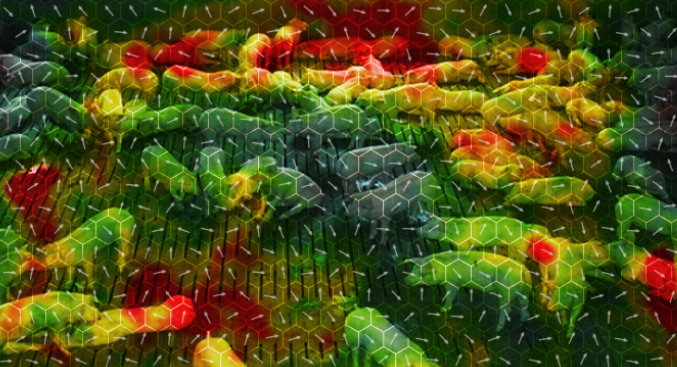
Figure 5. Leveraging Technology for Pig Welfare Management
Source: adapted from https://www.wur.nl/en/project/creating-resilience-in-pigs-through-artificial-intelligence-curly-pig-tail.htm
Machine Learning and AI
Machine learning models, such as Nonlinear Autoregressive Neural Networks with Exogenous Inputs (NARX), have been developed to predict tail biting outbreaks with high accuracy (Drexl et al., 2024). These models analyze data on tail posture, water consumption, and environmental factors to identify at-risk pens (Figure 6). For example, the CuRly Pig TAIL project at Wageningen University & Research aims to enhance pig resilience through AI-powered monitoring systems. By combining computer vision and deep learning, the project seeks to detect early signs of declining resilience, such as changes in tail posture and group dynamics (Figure 6).
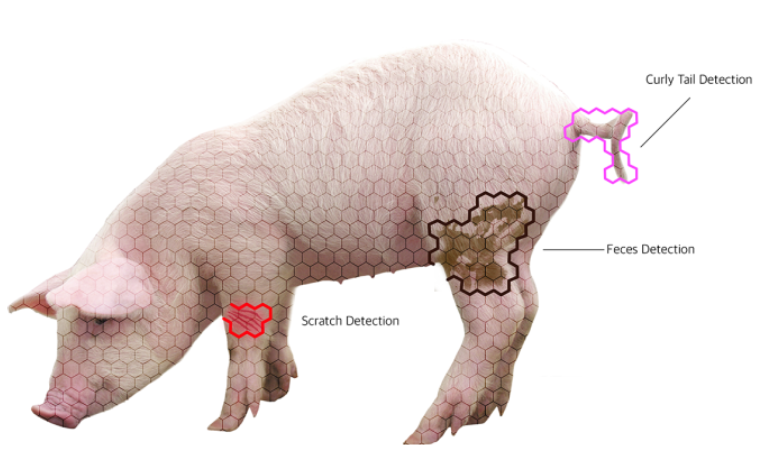
Figure 6. Leveraging AI to detect tail changes earlier than a farmer. Tail posture and intactness can be used as a primary indicator of resilience in pigs.
Source: adapted from https://www.wur.nl/en/project/creating-resilience-in-pigs-through-artificial-intelligence-curly-pig-tail.htm
Breeding for Resilience: Genetic Approaches to Welfare
Genetic Selection for Resilience
Resilience refers to pigs' ability to cope with and recover from stressors. Breeding programs that focus on resilience traits, such as deviations in body weight, can reduce the incidence of tail biting, lameness, and mortality (Gorssen et al., 2024). By selecting resilient pigs, farmers can improve animal welfare, reduce the need for medications, and enhance productivity. This approach aligns with consumer demands for ethical and sustainable farming practices (Gorssen et al., 2024).
Conclusion
Preventing tail biting requires a holistic approach that considers all aspects of pig housing, management, and the animals themselves. By focusing on creating a stimulating and comfortable environment, implementing best management practices, and continuously monitoring pig welfare, farmers can significantly reduce the incidence and severity of tail biting (Valros, 2024). For instance, environmental enrichment, such as providing straw or hay, has been shown to satisfy pigs' natural rooting and chewing behaviors, thereby reducing harmful behaviors like tail biting (Rosvold et al., 2024). Additionally, precision livestock farming technologies, such as RFID sensors and optical flow systems, enable continuous monitoring of pig behavior and health, allowing for early detection of stress or illness (VILT vzw et al., 2025). These technologies can identify changes in tail posture or feeding patterns, which serve as early indicators of tail biting, enabling timely interventions (Drexl et al., 2022; Heseker et al., 2024).
Learning from successful examples in countries with non-docking policies, such as Finland, can further enhance these efforts. Finnish pig producers have demonstrated that providing larger space allowances, partly slatted flooring, and manipulable materials can effectively reduce tail biting without resorting to tail docking (Valros, 2022). Advances in saliva biomarkers, such as oxytocin and procalcitonin, also offer non-invasive methods to monitor stress and infection levels in pigs, providing real-time insights into their welfare (Valros et al., 2022). By integrating these innovations into farm management practices, farmers can improve animal welfare, reduce economic losses, and meet the growing demand for sustainable livestock production. Ultimately, prioritizing pig welfare not only aligns with ethical considerations but also contributes to healthier, more productive, and economically sustainable pig farming operations.
References
- American Veterinary Medical Association [AVMA] (2020). Welfare implications of pigtail docking. American Veterinary Medical Association (AVMA)
- European Commission (2008). Pig Welfare. Retrieved from Animal Welfare Farm: Pigs — European Commission, Food Safety
- Cerón, J. J., López-Arjona, M., & Escribano, D. (2022). Saliva biomarkers in animal health and welfare: A review of recent advances. Research in Veterinary Science, 153, 49–56. Novel saliva biomarkers for stress and infection in pigs: Changes in oxytocin and procalcitonin in pigs with tail-biting lesions — Research in Veterinary Science
- D’Alessio, R. M., Mc Aloon, C. G., Correia-Gomes, C., Hanlon, A., & O’Driscoll, K. (2024). Evaluation of a scheme to identify risks for tail biting in pigs. PLoS ONE, 19(8), e0305960. Evaluation of a scheme to identify risks for tail biting in pigs — PLOS ONE
- Drexl, V., Dittrich, I., Haase, A., Klingelhöller, H., Diers, S., & Krieter, J. (2022). Tail posture as an early indicator of tail biting - a comparison of animal and pen level in weaner pigs. Applied Animal Behaviour Science, 252, 105654. Tail posture as an early indicator of tail biting - a comparison of animal and pen level in weaner pigs — Applied Animal Behaviour Science
- European Food Safety Authority. (2007). Scientific Report on the risks associated with tail biting in pigs and possible means to reduce the need for tail docking considering the different housing and husbandry systems. EFSA Journal, 5(11), 611. The risks associated with tail biting in pigs and possible means to reduce the need for tail docking considering the different housing and husbandry systems - Scientific Opinion of the Panel on Animal Health and Welfare — EFSA Journal
- Gorssen, W., Winters, C., Meyermans, R., Chapard, L., Hooyberghs, K., Depuydt, J., Janssens, S., Mulder, H., & Buys, N. (2024). Breeding for resilience in finishing pigs can decrease tail biting, lameness, and mortality. Genetics Selection Evolution, 56(48). Breeding for resilience in finishing pigs can decrease tail biting, lameness and mortality — Genetics Selection Evolution
- Heseker, P., Bergmann, T., Lieboldt, M.-A., Traulsen, I., Kemper, N., Probst, J., & Scheumann, M. (2024). Exposing tail biters by automatic scream detection. Smart Agricultural Technology, 9, 100582. Exposing tail biters by automatic scream detection — Smart Agricultural Technology
- Hoy, S., Engel, D., Jans-Wenstrup, I., & Hoy, J. (2020). Ethological investigations on the perpetrators and victims of tail biting in weaner pigs. Livestock Science, 231, 103879. Ethological investigations on the perpetrators and victims of tail biting in weaner pigs — Livestock Science
- Kauselmann, K., Krause, E. T., Glitz, B., Gallmann, E., Schrade, H., & Schrader, L. (2021). Effect of plant-based enrichment materials on exploration in rearing and fattening pigs (Sus scrofa domesticus). Applied Animal Behaviour Science, 236, 105261.
- Kuri, N., Skok, J., Škorjanc, D., & Prevolnik Povše, M. (2024). Enrichments adjusted to the number of litters: Simple approach to improve the welfare of weaned piglets under farm conditions. Animals, 14(20), 2972. Enrichments Adjusted to the Number of Litters: Simple Approach to Improve the Welfare of Weaned Piglets under Farm Conditions — Animals
- Lahrmann, H. P., Hansen, C. F., D’Eath, R. B., Busch, M. E., & Forkman, B. (2018). Early intervention with enrichment can prevent tail biting outbreaks in weaner pigs. Livestock Science, 214, 272–277.
- Larsen, M. L. V., Pedersen, L. J., Edwards, S., Albanie, S., & Dawkins, M. S. (2020). Movement change detected by optical flow precedes, but does not predict, tail-biting in pigs. Livestock Science, 240, 104136. Movement change detected by optical flow precedes, but does not predict, tail-biting in pigs — Livestock Science
- Liakos, K., Busato, P., Moshou, D., Pearson, S., & Bochtis, D. (2018). Machine Learning in Agriculture: A Review. Sensors, 18(8), 2674.
- Mutimaamba, V.A., and Gadzama, I.U. (2024). Swine biosecurity: Essential practices for disease prevention and herd health. Wikifarmer. Retrieved from https://www.researchgate.net/publication/387270908_Swine_Biosecurity_Essential_Practices_for_Disease_Prevention_and_Herd_Health
- Munsterhjelm, C., Tuominen-Brinkas, M., Koskikallio, H., Heinonen, M., Ahlqvist, K., & Valros, A. (2025). Tail status at both individual and pen level affects tail biting victimisation in pigs over the finishing period. Animal, 19, 101428.
- Norton, T., Chen, C., Larsen, M. L. V., & Berckmans, D. (2019). Review: precision livestock farming: building ‘digital representations’ to bring the animals closer to the farmer. Animal, 13(11), 3009–3017.
- Rosvold, E. M., Ocepek, M., & Andersen, I. L. (2024). Effects of different rooting materials on behaviour and welfare of finishing pigs. Applied Animal Behaviour Science, 277, 106344.
- Schrøder-Petersen, D. L., & Simonsen, H. B. (2001). Tail biting in pigs. Veterinary Journal, 162(3), 196–210. Tail Biting in Pigs — The Veterinary Journal
- Taylor, N. R., Parker, R. M. A., Mendl, M., Edwards, S. A., & Main, D. C. J. (2012). Prevalence of risk factors for tail biting on commercial farms and intervention strategies. Veterinary Journal, 194(1), 77–83. Prevalence of risk factors for tail biting on commercial farms and intervention strategies — The Veterinary Journal
- Valros, A., López-Martinez, M. J., Munsterhjelm, C., López-Arjona, M., & Cerón, J. J. (2022). Novel saliva biomarkers for stress and infection in pigs: Changes in oxytocin and procalcitonin in pigs with tail-biting lesions. Research in Veterinary Science, 153, 49–56. Novel saliva biomarkers for stress and infection in pigs: Changes in oxytocin and procalcitonin in pigs with tail-biting lesions — Research in Veterinary Science
- VILT vzw, Maselyne, J., KU Leuven, & ILVO. (2025). Sensors can monitor pig health and welfare. Retrieved from Sensoren Kunnen Gezondheid en Welzijn Varkens Monitoren
- Wageningen University & Research. (2022). Facilitating natural behaviour in alternative housing system promotes resilience in pigs. Retrieved from https://www.wur.nl/en/show/facilitating-natural-behaviour-in-alternative-housing-system-promotes-resilience-in-pigs.htm
- Wilder, T., Krieter, J., Kemper, N., & Büttner, K. (2020). The influence of tail posture on tail-biting network parameters in undocked weaner pigs. Livestock Science, 239, 104136. Movement change detected by optical flow precedes, but does not predict, tail-biting in pigs — Livestock Science