Introduction: Grape pomace and the future of sustainable feed
The growing global demand for animal protein, coupled with the environmental and economic challenges posed by large volumes of agro-industrial by-products, necessitates the exploration of sustainable alternative feed sources (Yashim et al., 2016; Yashim et al., 2017; Sirohi et al., 2020; Gadzama et al., 2025a,b). Grape pomace (GP) is a significant residue generated annually during winemaking which consist of grapes skins, seeds, pulp, and stalks, with considerable disposal issues due to its bulkiness and high-water content (Bordiga et al., 2019; Wang et al., 2024, Gadzama, 2025a). Improper management of this by-product can lead to environmental pollution and even attract disease-transmitting pests (Dwyer et al., 2014; Gadzama, 2025b). Recognizing this, researchers are increasingly focusing on valorizing GP by incorporating it into animal feed (Salami et al., 2019; Cebrián et al., 2024; Gadzama, 2025a,b,c,d,e).
Grape pomace is known to be a rich source of fiber, essential nutrients, and valuable bioactive compounds, including polyphenols and tannins, which possess antioxidant, antimicrobial, and anti-inflammatory properties (Yu & Ahmedna, 2013; Gadzama, 2025c). Concurrently, insect farming has emerged as a promising strategy for converting low-value organic substrates into highly nutritious biomass suitable for animal feed (Gadzama, 2025f; Gadzama et al., 2025c). This principle aligns with the circular economy (Salami et al., 2019; Ibarruri et al., 2021; Gadzama, 2024).
Studies have investigated the potential of using GP as a rearing substrate for insects such as black soldier fly larvae (Hermetia illucens) and Tenebrio molitor larvae (Renna et al., 2024; Montalbán et al., 2023). For instance, Renna et al. (2024) found that different grape pomace varieties can significantly affect black soldier fly larvae's growth performance and lipid composition. Molan et al. (2018) reported that aqueous extracts from grape pomace, particularly seeds, exhibited ovicidal, larvicidal, and pupicidal activities against the housefly (Musca domestica).
This suggests the potential of GP as a natural insecticide component. However, it is important to note that the chemical composition and the resultant effects of GP can vary greatly depending on the grape variety, processing methods, and environmental factors (Yang et al., 2022; Cebrián et al., 2024; Gadzama, 2025d). Furthermore, using single substrates like GP alone may not always optimize larval performance compared to formulated diets due to specific nutritional requirements of the insects (Montalbán et al., 2023).
This highlights the importance of understanding how different grape pomace types influence insect development and nutritional profile to maximize the valorization potential (Hassan et al., 2019; Sinrod et al., 2023). The purpose of this review is to evaluate the efficacy of GP as an insect feed substrate. It is hoped that these investigations will contribute to developing sustainable waste management solutions and producing valuable, nutrient-rich feed ingredients for insect farming.
Nutritional value and benefits of grape pomace
Grape pomace is a promising substrate for insect rearing due to its high content of bioactive compounds, including polyphenols, dietary fibers, and essential fatty acids (Renna et al., 2024; Gadzama, 2025a,b; Montalbán et al., 2023; Zuffi et al., 2025). These components not only support the growth and development of insects but also enhance the nutritional profile of the resulting insect biomass (Renna et al., 2024). Black soldier fly larvae (BSFL) reared on grape pomace exhibit significant growth rates and favourable fatty acid profiles, which are beneficial for producing high-quality insect meal and oil (Renna et al., 2024).
Research and applications of grape pomace as insect feed
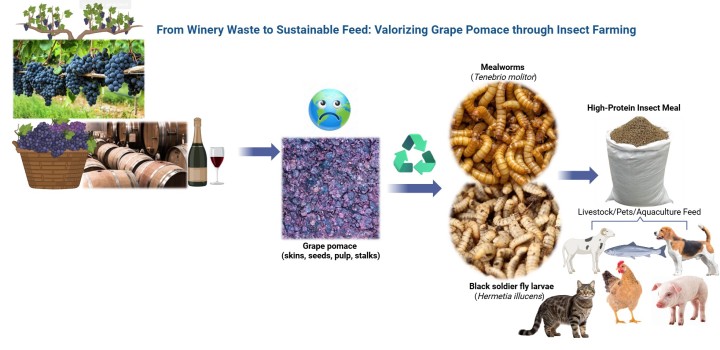
Studies have demonstrated the feasibility of using grape pomace as a substrate for various insect species, including the black soldier fly and mealworm larvae. Research indicates that grape pomace (GP) has variable effects on insect growth, nutritional composition, and survival rate, depending on the species, life stage, and dosage (Ribeiro et al., 2022; Montalbán et al., 2023; Renna et al., 2024) These findings hold significant implications for sustainable agriculture, particularly in waste valorization and insect farming for feed or pest management.
Effects of grape pomace on Tenebrio molitor (mealworms)
For Tenebrio molitor (mealworms), Montalbán et al. (2023) reported that GP inclusion at 100% reduced larval growth and dry matter digestibility (52.60%) but increased protein content (50.71%) while lowering fat levels (24.13%). Similarly, Kröncke et al. (2023) observed reduced weight gain in larvae fed GP-supplemented diets, though fatty acid profiles improved (e.g., elevated α-linolenic acid). Brai et al. (2023) corroborated these trends, noting that GP inclusion enhanced antioxidant activity without affecting survival. These results suggest that moderate GP supplementation (25–50%) may balance growth performance with nutritional benefits, though higher doses impair digestibility and feed conversion ratios (FCR).
Effects of grape pomace on Hermetia illucens (black soldier fly larvae)
In contrast, Hermetia illucens (black soldier fly larvae, BSFL) exhibited species-specific responses. Renna et al. (2024) found that GP from specific grape varieties (e.g., Becuet) enhanced growth rates (4.4 mg/day) and fatty acid profiles, including conjugated linoleic acid (CLA) isomers. However, Ribeiro et al. (2022) reported high mortality (0–12.8% survival) and poor bioconversion efficiency in BSFL reared on GP, likely due to anti-nutritional compounds like tannins or substrate recalcitrance. This discrepancy highlights the importance of optimizing GP variety, moisture content, and processing methods for different insect species.
Effects of grape pomace in pest management
Grape pomace also shows promise in pest management. Nieto et al. (2019) demonstrated that anaerobic soil disinfestation with GP reduced pupal survivorship in Delia radicum (cabbage maggot) and Musca domestica (housefly). Similarly, Molan et al. (2018) found that GP extracts inhibited housefly egg hatching (100% at 150 µg/mL) and larval development, comparable to synthetic insecticides. These findings position GP as a potential eco-friendly alternative for pest control, reducing reliance on chemical pesticides.
Environmental and economic impact of grape pomace
Utilizing grape pomace as a feed substrate for insects addresses several environmental and economic challenges. Firstly, it helps mitigate the environmental burden associated with the disposal of grape pomace, which can pose significant ecological risks if not managed properly (García-Lomillo et al., 2017; Alberici et al., 2020). Secondly, it contributes to the circular economy by transforming agricultural waste into valuable feed resources, thereby reducing reliance on conventional feedstocks and promoting sustainable agricultural practices (Renna et al., 2024; Ribeiro et al., 2022; Zuffi et al., 2025).
Broader agricultural implications of grape pomace
The broader agricultural context highlights GP’s dual role: as a low-cost feed supplement in insect farming and a tool for integrated pest management. However, challenges remain, such as balancing growth trade-offs and standardizing dosages. For farmers, GP could lower feed costs while enhancing insect protein quality, though species-specific tolerances must be considered. For scientists, these studies emphasize the need for further research into GP’s bioactive compounds (e.g., polyphenols, tannins) and their mechanisms of action.
Conclusion
Grape pomace valorization aligns with global efforts to reduce agro-industrial waste and develop sustainable protein sources. Traditionally, grape pomace has been utilized in animal nutrition to enhance antioxidant capacity, immune function, and growth performance, while also reducing feeding costs and alleviating feed resource shortages. However, its potential as a feed substrate for insects such as the black soldier fly (Hermetia illucens) and mealworms (Tenebrio molitor) larvae is gaining attention due to the increasing interest in sustainable and circular agricultural practices.
But its integration into insect farming systems requires optimization of inclusion levels, substrate processing, and selection of suitable insect species. For instance, intermediate grape pomace doses (25–50%) in T. molitor diets showed manageable trade-offs (Montalbán et al., 2023), whereas black soldier fly larvae struggled even with modified substrates (Ribeiro et al., 2022). While its effects vary across insect species, optimized use could support sustainable livestock feed production and reduce environmental burdens from winery by-products.
Further reading:
- Grape pomace in cattle
- Grape pomace in small ruminants
- Grape pomace in poultry
- Grape pomace in pigs
- Grape pomace in rabbits
References
- Alberici, N., Fiorentini, C., House, A., Dordoni, R., Bassani, A., & Spigno, G. (2020). Enzymatic Pre-Treatment of Fruit Pomace for Fibre Hydrolysis and Antioxidants Release. CET Journal-Chemical Engineering Transactions, 79.
- Bordiga, M., Travaglia, F., & Locatelli, M. (2019). Valorisation of grape pomace: an approach that is increasingly reaching its maturity–a review. International Journal of Food Science & Technology, 54(4), 933-942.
- Brai, A., Vagaggini, C., Pasqualini, C., Poggialini, F., Tarchi, F., Francardi, V., & Dreassi, E. (2023). Use of distillery by-products as Tenebrio molitor mealworm feed supplement. Journal of Insects as Food and Feed, 9(5), 611–623.
- Cebrián, M., García-Roldán, A., Ibarruri, J., Zufía, J., & Jauregi, P. (2024). Biorefinery approach for an integrated valorisation of grape pomace in distilleries. Biomass Conversion and Biorefinery, 1-12.
- Dwyer, K., Hosseinian, F., & Rod, M. (2014). The Market Potential of Grape Waste Alternatives. Journal of Food Research, 3(2), 91. The Market Potential of Grape Waste Alternatives — Journal of Food Research
- Gadzama, I. U. (2025a). How grape pomace enhances cattle growth & sustainable impact. Wikifarmer. Retrieved from https://www.researchgate.net/publication/391837356
- Gadzama, I. U. (2025b). Grape pomace in sheep Diets: Sustainable livestock feed strategy. Wikifarmer. Retrieved from https://www.researchgate.net/publication/391739467
- Gadzama, I. U. (2025c). Grape pomace as a natural feed additive for sustainable poultry production. Wikifarmer. Retrieved from ResearchGate publication 391772790
- Gadzama, I. U. (2025d). Grape pomace in pig diets: Benefits for growth, health & sustainability. Wikifarmer. Retrieved from https://www.researchgate.net/publication/391807272
- Gadzama, I. U. (2025e). Grape pomace in rabbit diets: Effects on growth, health, & meat quality. Wikifarmer. Retrieved from https://www.researchgate.net/publication/391854626
- Gadzama, I. U. (2025f). Black soldier fly larvae as animal feed. Bulgarian Journal of Animal Husbandry, 62(1), 48-64.
- Gadzama, I. U. (2024). Influence of rearing substrate on black soldier fly larvae nutritional value for animal feed. Wikifarmer. Available online: https://www.researchgate.net/publication/383121796
- Gadzama, I. U., Ray, S., Méité, R., Mugweru, I. M., Gondo, T., Rahman, M. A., Redoy, M. R. A., Rohani, M. F., Kholif, A. E., Salahuddin, M., & Brito, A. F. (2025a). Chlorella vulgaris as a Livestock Supplement and Animal Feed: A Comprehensive Review. Animals, 15(6), 879.
- Gadzama, I. U., Hoffman, L. C., Holman, B. W. B., Chaves, A. V., & Meale, S. J. (2024b). Effects of supplementing a feedlot diet with microalgae (Chlorella vulgaris) on the performance, carcass traits and meat quality of lambs. Livestock Science, 288, 105552.
- Gadzama, I. U., Mugweru, I. M., Makombe, W. S., Madungwe, C., Hina, Q., Omofunmilola, E. O., Panuel, P., Olanrewaju, T. J., & Ray, S. (2025c). Improving poultry production with black soldier fly larvae. Acta Scientific Agriculture, 9(1), 60–77. Available online: https://www.researchgate.net/publication/387579596
- García-Lomillo, J., & González-SanJosé, M. L. (2017). Applications of Wine Pomace in the Food Industry: Approaches and Functions. Comprehensive reviews in food science and food safety, 16(1), 3–22.
- Hassan, Y. I., Kosir, V., Yin, X., Ross, K., & Diarra, M. S. (2019). Grape pomace as a promising antimicrobial alternative in feed: A critical review. Journal of Agricultural and Food Chemistry, 67(35), 9705-9718.
- Ibarruri, J., Cebrián, M., & Hernández, I. (2021). Valorisation of fruit and vegetable discards by fungal submerged and solid-state fermentation for alternative feed ingredients production. Journal of Environmental Management, 281, 111901.
- Kröncke, N., Neumeister, M., & Benning, R. (2023). Near-infrared reflectance spectroscopy for quantitative analysis of fat and fatty acid content in living Tenebrio molitor larvae to detect the influence of substrate on larval composition. Insects, 14(2), 114.
- Montalbán, A., Martínez-Miró, S., Schiavone, A., Madrid, J., & Hernández, F. (2023). Growth Performance, Diet Digestibility, and Chemical Composition of Mealworm (Tenebrio molitor L.) Fed Agricultural By-Products. Insects, 14(10), 824.
- Molan, A.-L., Balasim, M. Q., & Al-Bayati, N. Y. (2018). Insecticidal activity of grape pomaces from two grape cultivars against the housefly (Musca domestica L.) under laboratory conditions. Tropical Life Sciences Research, 29(2), 89–102.
- Nieto, D. J., Letourneau, D. K., Toyama, L., Bryer, J. A., Slay, C., Muramoto, J., & Shennan, C. (2019). Assessing anaerobic soil disinfestation as a control tactic for Delia radicum (Diptera: Anthomyiidae) in California Brussels sprouts. Environmental Entomology, 48(3), 633–640.
- Renna, M., Gasco, L., Livorsi, L., Mele, M., Conte, G., Meneguz, M., & Lussiana, C. (2024). Growth performance, proximate composition and fatty acid profile of black soldier fly larvae reared on two grape pomace varieties. Animal, 18(8), 101240.
- Ribeiro, N., Costa, R., & Ameixa, O. M. C. C. (2022). The influence of non-optimal rearing conditions and substrates on the performance of the black soldier fly (Hermetia illucens). Insects, 13(7), 639.
- Salami, S. A., Luciano, G., O'Grady, M. N., Biondi, L., Newbold, C. J., Kerry, J. P., & Priolo, A. (2019). Sustainability of feeding plant by-products: A review of the implications for ruminant meat production. Animal Feed Science and Technology, 251, 37-55.
- Sirohi, R., Tarafdar, A., Singh, S., Negi, T., Gaur, V. K., Gnansounou, E., & Bharathiraja, B. (2020). Green processing and biotechnological potential of grape pomace: Current trends and opportunities for sustainable biorefinery. Bioresource Technology, 314, 123771.
- Sinrod, A. J. G., Shah, I. M., Surek, E., & Barile, D. (2023). Uncovering the promising role of grape pomace as a modulator of the gut microbiome: An in-depth review. Heliyon, 9, e20499.
- Wang, C., You, Y., Huang, W., & Zhan, J. (2024). The high-value and sustainable utilization of grape pomace: A review. Food Chemistry: X, 24, 101845.
- Yang, C., Han, Y., Tian, X., Sajid, M., Mehmood, S., Wang, H., & Li, H. (2022). Phenolic composition of grape pomace and its metabolism. Critical Reviews in Food Science and Nutrition, 63(23), 6144–6161.
- Yashim, S.M., Gadzama, I.U. and Fwangtu, I.P. (2016). Comparative Evaluation of Nutritive Value of Cowpea (Vigna unguiculata) and Groundnut (Arachis hypogaea) Haulms in the Diets of Red Sokoto Goats. Adamawa State University Journal of Agricultural Science, 4(1): 134 – 144.
- Yashim, S. M., Gadzama, I. U., & Anene, D. O. (2017). Nutrient utilization and carcass characteristics of weaner rabbits as influenced by differently processed rattle box (Crotalaria retusa) leaf meal. Journal Animal Production Research, 29(1), 210-218.
- Yu, J., & Ahmedna, M. (2013). Functional components of grape pomace: Their composition, biological properties and potential applications. International Journal of Food Science and Technology, 48(2), 221–237.
- Zuffi, V., Puliga, F., Mercatante, D., Rodriguez-Estrada, M. T., Sanchez-Cortes, S., Zambonelli, A., & Francioso, O. (2025). Conversion of grape pomace into fungal biomass: a study of Pleurotus cultivation for a sustainable agro-residue management. Chemical and Biological Technologies in Agriculture, 12(1), 22.