Introduction: Importance of nutrition for modern sows
Nutrition is crucial in ensuring that modern sows reach their genetic potential for reproduction (Campos et al., 2012). The nutritional requirements of today's gestating and lactating sows and their litters have evolved significantly. Genetic advancements have led to the development of feed-efficient, fast-growing, leaner pigs. However, this progress has also introduced new challenges in feeding these modern sows.
Providing an adequate supply of nutrients, particularly amino acids and energy, is essential to optimize reproductive performance and maintain the sow's body reserves throughout her productive life. Moreover, diets must be tailored to promote nutritional welfare and comfort for the animals while minimizing the environmental impact of methane emissions. Achieving this requires a precise adjustment of both the feeding levels and the feed's composition based on the sows' performance levels.
Basic feeding strategies for sows to maximize productivity
The primary goals of sow feeding programs include:
- Maximizing pigs per litter
- Optimizing piglet birth weight and uniformity
- Increasing the number of litters per sow annually
- Maximizing lactation yield
- Enhancing sow longevity and lifetime productivity
To achieve these goals, it is important to minimize condition losses during lactation and support fat recovery during gestation. This can be done by maximizing nutrient intake throughout the lactation period. Diets should be carefully balanced to ensure that all nutrients are provided in the appropriate proportions to meet nutritional requirements and maintain energy balance.
If an elevated level of backfat is desired during gestation, research suggests that high-lean reproductive females may be administered a slightly deficient amino acid diet. This approach could serve to moderate the escalation in lean tissue deposition, encourage fat accumulation, and potentially enhance the longevity of the sow. The feeding regimen for the sow is predicated upon the targeted body condition and the specific stage of production. These feeding strategies are meticulously crafted to deliver the appropriate nutrient levels at optimal times, thereby fulfilling the sow’s daily nutritional requirements. It is advisable to provide a minimum of five well-formulated sow diets. The practical considerations of administering diverse diets invariably pose challenges. Alternatively, the fundamental sow diets may be supplemented with 'top-dressing' additives to satisfy their daily nutritional needs.
Recommended diets for sows
Flush diet: stimulating ovum development before mating
Short-term, high-level feeding (flushing) after weaning until mating will increase the quality of the oocytes in breeding animals. Flush-feeding gilts and sows have been shown to increase plasma levels of follicle-stimulating hormone (FSH) and the pulse frequency of luteinizing hormone (LH), suggesting that it enhances oocyte quality (size and uniformity) by stimulating the secretion of gonadotropins Kim, S. W. (2010).
Important factors to consider
To optimize energy and nutrient intake before mating, it is essential to maintain a high feed intake level until the sow is serviced. Sows should be fed ad libitum from weaning to service. During this period, specialized flush feed must be used. The energy source in the diet should primarily come from carbohydrates, particularly starches and sugars. It is not advisable to use a standard lactation feed.
Incorporating dextrose into the flush diet can positively impact piglet vitality, with a recommended intake of at least 150 grams of dextrose per day for the sows. The ratio of essential amino acids to lysine should align with the recommendations for lactating sows. Additionally, it is advisable to adhere to the vitamin and mineral recommendations for lactating sows. Extra vitamins and minerals can also be included during the flush period. Research shows that higher levels of Vitamin A, Vitamin E, Vitamin B12, folic acid, cobalt, and chromium can positively influence reproduction.
Gestation diets: supporting sow and litter growth
Gestation diet 1: Backfat stimulating diet (lower amino acid to energy ratio)
Proper feeding of gestating animals directly benefits lactation performance and piglet vitality. Gestating sows must receive enough amino acids and energy to support body maintenance, body recovery from previous lactation, and foetal and mammary gland growth (especially during the last trimester). During gestation, sufficient body reserves must be accumulated to compensate for eventual nutritional deficits that may occur in the following lactation period. During the first six weeks of gestation (0-45 days), the sow uses most of the feed for maintenance and to regain lost condition.
Sows can lose on average 2-4 mm of backfat (measured at the P2 position), during lactation. Depending on the sow’s condition at weaning, the desired feed level of the individual sow must be determined after mating. On day 84, the sow should have regained adequate body condition, weight, and backfat; so that the feed surplus can be used for piglet growth. It is recommended to feed a minimum of two gestation diets. Feeding two gestation diets offers the possibility to better meet the daily demands of the gestating sows, but also offers the possibility to further enhance sow productivity and longevity. Fed after insemination (day 5 of pregnancy) till day 84 of gestation or fed to older parity sows. Advantages of backfat stimulating diets are better coverage around the shoulders before farrowing to prevent shoulder sores. More reserves to be used for milk production.
Gestation diet 2: Late gestation diet to improve piglet birth weights
Fed from day 85 till day 110 of gestation or fed to first parity sows. Gestation diets have a higher amino acid-to-energy ratio. Improvement in piglet birth weights. It can also be fed as a single gestation diet to young sows (<3rd parity
Transition Diet
Fed during the transition period between gestation and lactation (from day 110 of gestation till 2-3 days after farrowing). The transition from late gestation to lactation is crucial for the sow and her offspring; because colostrum is being synthesized prepartum, nutrients are reallocated from the conceptus to the mammary tissue, massive mammary and foetus growth occurs, and milk production is initiated. The period around farrowing is also critical for the sow because she needs to cope with numerous changes such as moving from a group to an individual pen, changes in diets, and the birth of piglets (Eskildsen et al.,2020).
These environmental and nutritional changes can influence the parturition process, which includes the initial start-up of milk production. The process of parturition is energetically demanding, and a larger litter size may increase those energy demands. If the energy demand of the sow during farrowing is not met it might result in reduced contractions of the uterus increasing the risk of asphyxia and stillbirth.
Main advantages of a transition diet
- Improved start-up of the milk production in the sow.
- Reduce constipation around farrowing.
- Lower risk of mastitis, metritis agalactia (MMA), and udder congestion.
- Improved transition between the lower nutrient-dense gestation diet to the higher nutrient-dense lactation diet.
- Improved piglet vitality and survivability Langendijk, P. (2021).
Normally, when changing to a higher-density lactation feed, the feed quantity is reduced to prevent unnecessary pressure on the udder (MMA). The lower quantity and reduced fibre inclusions in the feed can result in constipation. Constipation and reduced intestinal transit times allow the formation of endotoxins and gram-negative bacterial growth. Endotoxins are responsible for the reduced formation of prolactin as well as the stimulation of the immune system. This reduces milk production (dysgalactica) and increases the risk of mastitis. Constipation could also lead to the narrowing of the birth channel and more stillborn piglets because of a prolonged parturition process. Feeding a high-fibre diet during the transition phase could prevent constipation around farrowing.
Lactation diet: Maximizing feed intake and milk yield
Fed for the duration of the lactation period. For a sow to achieve a high rate of milk production, the appropriate amount of nutrients must be available. If the dietary supply of nutrients is insufficient to support milk synthesis, the sow will mobilize her maternal body tissues, or "milk off her back". With leaner genotypes, the number of reserves available is rather limited; therefore, nutrient intake to support her needs is of utmost importance.
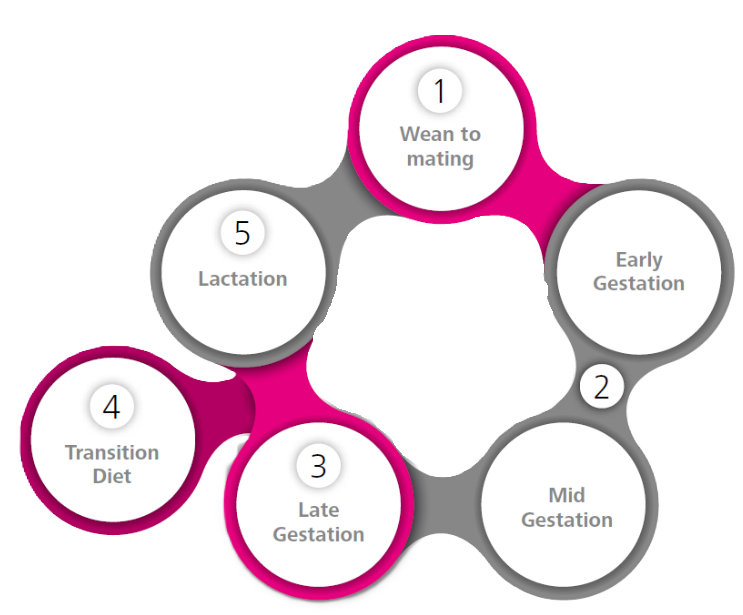
Fig 1. The recommended five sow diets
Conditions and assumptions for sow nutrition recommendations
To obtain the maximum productive potential from it, it is fundamental to manage the sow's body condition, optimize the daily amount of feed offered, and supply the correct dietary requirement levels during all stages of production. Understanding the different factors that affect nutrient requirements and feed intake can assist in developing a successful sow feeding program.
The feeding advice for the show is based on the following basic assumptions:
- Dry mash diet.
- Controlled feed program.
- Conventional health.
- Optimal housing conditions.
- Thermal neutral conditions.
Most commercial pig diets are either maize-soybean-based or wheat bran-maize-soybean-based. Pigs fed well-balanced wheat-barley-soybean-based diets can perform as well as those fed corn-soybean diets, and the main difference is the minimal energy levels reachable when using these two different feed sources. The dietary recommendations for sows in this manual consider these differences by providing a minimum and maximum level for each nutrient. The minimum nutrient levels represent the wheat, barley-soybean markets, and the maximum ones represent the corn-soybean markets. However, sows' daily nutrient requirements are similar, independent of any market or available raw materials Kim, S. W., 2010).
References
- Campos, P. H. R. F., Silva, B. A. N., Donzele, J. L., Oliveira, R. F. M., & Knol, E. F. (2012). Effects of sow nutrition during gestation on within-litter birth weight variation: a review. Animal, 6(5), 797-806.
- Eskildsen, M., Krogh, U., Sørensen, M., Kongsted, A., & Theil, P. (2020). Effect of reduced dietary protein level on energy metabolism, sow body composition, and metabolites in plasma, milk, and urine from gestating and lactating organic sows during temperate winter conditions. Livestock Science, 240, 104088.
- Kim, S. W. (2010). Recent advances in sow nutrition. Revista Brasileira de Zootecnia, 39, 303-310.
- Langendijk, P. (2021). Latest advances in sow nutrition during early gestation. Animals, 11(6), 1720.