
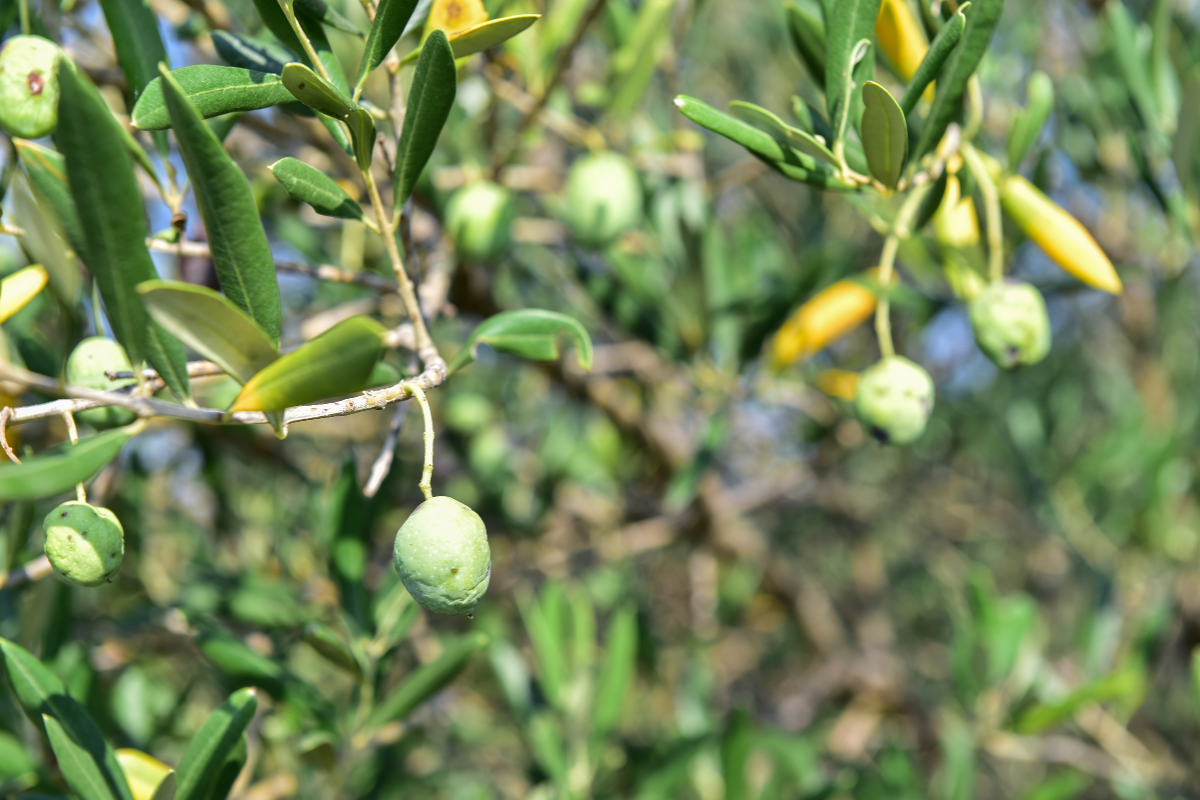
Most fruit flies avoid unripe fruit and lay their eggs in ripe fruit, which supports larval development far better. The olive fly is an exception. It preferentially uses unripe, green olives, and that ability lets it complete several generations before ripe fruit is even available.
The explanation does not lie in the insect itself. It lies in a bacterium living inside it.
The chemical defence of unripe fruit
An unripe olive is a hostile place. It carries high levels of phenolic compounds, chief among them oleuropein, the principal phenolic glycoside of the green olive.
Oleuropein acts as an anti-nutrient. It inhibits the development of insects attempting to feed on the fruit, and combined with the generally limited nutrient availability of green olives it makes unripe fruit a difficult habitat. On top of that, the proteins present are in non-hydrolysed form, meaning they are hard to use.
The bacterium that changes the terms
Unlike related fruit flies, the olive fly associates with a single bacterium, Candidatus Erwinia dacicola, regarded as an obligate, co-evolved symbiont.
This is not a passing occupant. It is maintained exclusively within four large caeca of the larval midgut and cannot proliferate anywhere else, neither inside the fruit nor in laboratory culture. Other bacteria found in olive flies occur in small numbers and are considered secondary.
Its role is specific. It counteracts the inhibitory effect of oleuropein, while also taking part in breaking down complex nitrogen compounds and supplying growth factors, covering the shortfalls of a nutrient-poor environment.
How it passes from mother to larva
Transmission is vertical, from mother to offspring, and the mechanism is strikingly simple.
As eggs leave the oviduct they pass through the terminal rectal tract, where the rectal sacs open and bacterial masses are deposited on the eggshell surface. When the larva breaks the eggshell to emerge, at the micropylar area, it ingests the bacteria.
Every new generation therefore receives its symbiont at the moment of hatching, without having to find it in the environment.
The experiment that proved it
The relationship was confirmed experimentally in a clean way. Females were treated with antibiotics, producing larvae without the symbiont.
Egg viability was unaffected. The larvae hatched normally and fed actively. They failed, however, to complete development inside unripe fruit. Larvae that retained the bacterium completed their cycle normally in the same fruit.
The distinction that emerges is critical. In ripe fruit, larval development proceeds independently of the bacteria. The symbiont is essential only for unripe fruit, precisely where the plant's chemical defence is strong.
What the insect gains
The advantage is one of timing, and it is considerable.
While other fruit flies wait for ripening before laying eggs, the olive fly starts early, as soon as the fruit carries enough flesh. It therefore completes several generations before ripe fruit becomes available, and reaches the ripening period with a population already multiplied.
From a management standpoint, this explains why infestation is not confined to the end of the season, and why monitoring has to begin early, from the moment fruit becomes susceptible.
A relationship measured in ages
The symbiont is not a recent discovery. It was first observed by Petri in 1909, although its identity remained contested for decades.
Genetic work shows the relationship is far older. A study of 54 olive fly populations across the distribution range of the olive tree identified three symbiont haplotypes. Symbiont diversity proved lower than that of its host, a signature of long-term co-evolution, and an east-west genetic differentiation was recorded across the Mediterranean basin.
What we have, then, is a tripartite relationship between insect, bacterium and fruit chemistry, in which no part makes sense without the other two.
What it means for control
This is where the subject stops being academic. Because the olive fly depends absolutely on a single symbiont, disrupting the symbiosis is being studied as a control strategy.
The approach is termed dysbiosis, and it targets the relationship rather than the insect. A larva without its symbiont cannot develop in unripe fruit, so the fly loses precisely the advantage that makes it so damaging.
This line of work remains at the research stage and is not an available field practice. It does show, though, how understanding a pest's biology can open routes that spraying logic never reaches.
Notes
The findings described come from experimental studies and do not translate into immediate field practice. Olive fly management today rests on trap monitoring, action thresholds and approved plant protection products, following local plant protection bulletins and in consultation with an agronomist.
Sources
- Ben-Yosef, M. et al. Symbiotic bacteria enable olive fly larvae to overcome host defences. Royal Society Open Science.
- Pavlidi, N. et al. Transcriptomic responses of the olive fruit fly Bactrocera oleae and its symbiont Candidatus Erwinia dacicola to olive feeding. Scientific Reports.
- The biogeographic patterns of the olive fly and its primary symbiont Candidatus Erwinia dacicola across the distribution area of the olive tree. Scientific Reports.
- The Journey of the Bacterial Symbiont Through the Olive Fruit Fly, Lessons Learned and Open Questions. Insects.
- Olive fruit fly rearing procedures affect the vertical transmission of the bacterial symbiont Candidatus Erwinia dacicola.