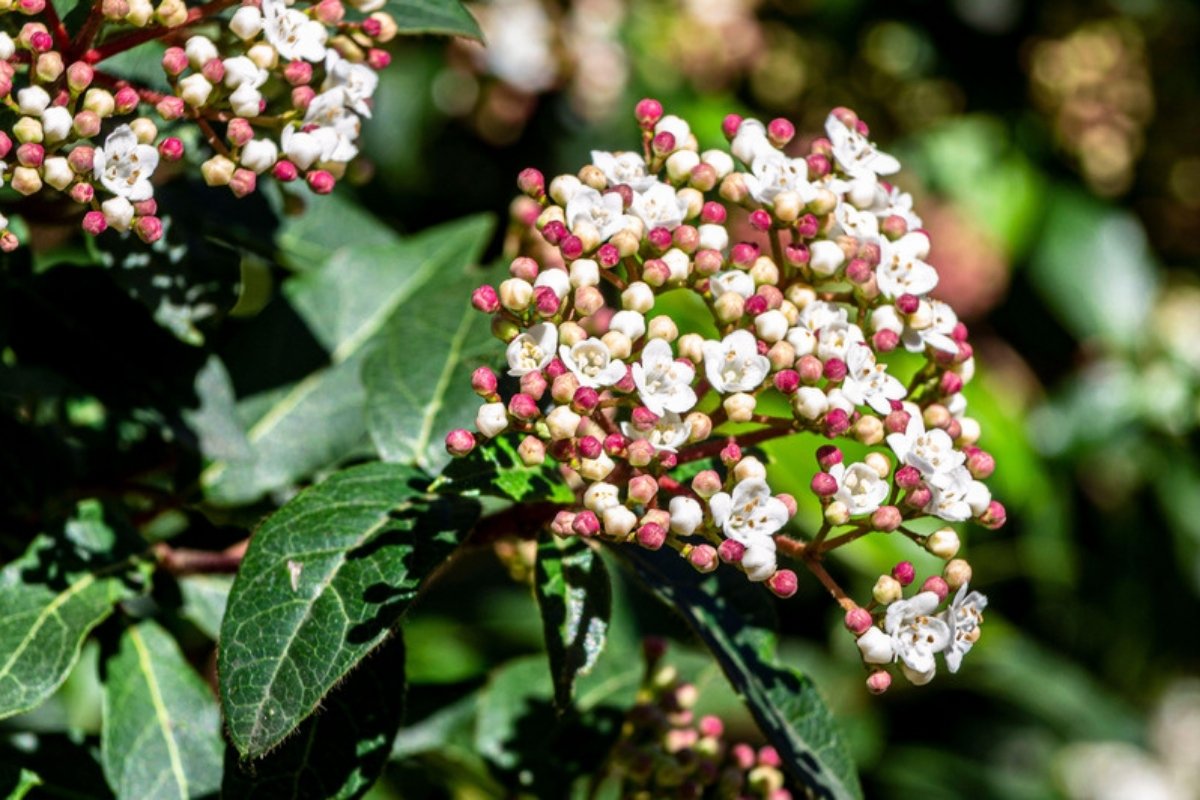
Viburnum is a large genus of evergreen and deciduous shrubs, and in Mediterranean gardens the most widely grown is laurustinus (Viburnum tinus), an evergreen shrub native to the Mediterranean region. It flowers from late winter into spring with small white flowers opening from pink buds, followed by blue-black berries. Evergreen viburnums are best planted in autumn or early spring, in sun or partial shade, in almost any well-drained soil, and once established they are fairly drought tolerant. Laurustinus is pruned after flowering, and it is one of the most reliable shrubs for a flowering hedge. This guide covers the best-known species and cultivars, when and where to plant, hedging, watering and feeding, pruning and why viburnum sometimes fails to flower, propagation from cuttings, growing in pots, and pests.
Popular viburnum species and cultivars
| Species or cultivar | Foliage | What sets it apart |
| Laurustinus (Viburnum tinus) | Evergreen | White flowers from pink buds, late winter to spring, and blue-black berries |
| 'Lucidum' (Viburnum tinus 'Lucidum', sold also as Viburnum lucidum) | Evergreen | Larger, glossier leaves and vigorous growth, popular for tall hedges |
| 'Eve Price' (Viburnum tinus) | Evergreen | Compact, for dense flowering hedges 1.5 to 1.8 m tall |
| Guelder rose (Viburnum opulus) | Deciduous | White spring flowers, in some cultivars rounded "snowballs", and glossy red berries |
| Sweet viburnum (Viburnum odoratissimum) | Evergreen | Fragrant white flowers in spring |
| Viburnum davidii | Evergreen | Low, about 90 cm, for ground cover and shady spots |
| Viburnum carlesii, Viburnum × burkwoodii | Deciduous or semi-evergreen | Strongly fragrant spring flowers |
According to the Royal Horticultural Society, laurustinus cultivars usually reach 1 to 2.5 m tall, depending on the cultivar. Because sizes vary so much, always check the plant label before buying, so the shrub has room for its eventual size.
How fast viburnum grows
Growth rate depends on the cultivar. RHS plant profiles give a compact laurustinus such as 'Ladybird' 2 to 5 years to reach its ultimate height of 1 to 1.5 m, 'Spirit' 5 to 10 years to reach 1.5 to 2.5 m, and 'Lisspurp' 10 to 20 years to reach a similar height. Regular watering in the first two years and a yearly mulch help young plants establish and grow steadily.
The right position and soil for viburnum
Most viburnums prefer an open, sunny site. Laurustinus grows in sun or partial shade, but flowers less in deep shade, while some species, such as Viburnum davidii, are happy in shadier spots. Laurustinus is not fussy about soil. It grows in chalk, clay, loam and sand, acid or alkaline, as long as the soil drains well, and it benefits from shelter from cold, drying winds.
When and how to plant viburnum
According to the RHS, evergreen viburnums are best planted in early spring or autumn, and deciduous viburnums, such as guelder rose, from autumn to early spring, as long as the ground is not very wet or frozen. In a Mediterranean climate, autumn is the best season, because winter rain helps the roots establish before the first summer. Avoid planting during hot, dry spells.
- Hole: twice as wide as the root ball and just as deep, with some compost mixed into the soil
- Placement: set the top of the root ball level with the surrounding soil
- Watering: water well straight after planting, to settle the soil around the roots
- Mulch: spread a layer of organic matter around the shrub, keeping it clear of the base of the stem
Growing a viburnum hedge
Laurustinus is one of the most dependable shrubs for a living hedge, because it keeps dense foliage all year, flowers in winter when few plants do, and tolerates clipping. The RHS recommends 'Eve Price' for dense flowering hedges 1.5 to 1.8 m tall, while 'Lucidum' is often chosen for taller hedges because it grows faster. Spacing between plants depends on the cultivar's eventual spread, as shown on the label.
Watering and feeding
Newly planted viburnums need regular watering for their first year or two, especially in dry spells. According to the RHS, evergreen viburnums are usually more drought tolerant and generally need no extra watering once established, while shallow-rooted deciduous species may need watering in summer when the soil dries out. In hot Mediterranean summers, a deep watering during long droughts helps even established plants.
Most garden soils need little or no feeding. A 5 cm layer of compost or well-rotted manure in early spring is enough, with a mulch-free circle around the base of the plant to prevent rot. Too much nitrogen produces leaves at the expense of flowers.
When to prune viburnum
According to the RHS, laurustinus is pruned every year after flowering, to control its height and shape. In Mediterranean climates, where it flowers into spring, that means pruning in late spring. A light shaping trim can also be done in late summer or early autumn, but it removes part of the next flush of flowers, because the winter buds are already forming by then.
Other species need less. Guelder rose and Viburnum davidii need little or no pruning but tolerate hard renovation pruning when they get old, while Viburnum carlesii and Viburnum plicatum need little or none. Before any spring pruning, check the shrub for active birds' nests, and wait if you find one.
Why viburnum won't flower
- Pruning at the wrong time: pruning in autumn or winter removes buds that have already formed
- Too much shade: in deep shade, laurustinus flowers little or not at all
- Too much nitrogen: heavy feeding pushes leaves rather than flowers
- A young plant: newly planted or moved shrubs usually need a year or two to establish before flowering well
Growing viburnum from cuttings
Most viburnums can be grown from cuttings, at different times of year depending on the species:
- Semi-ripe cuttings, from mid-summer to autumn, for laurustinus, Viburnum davidii, Viburnum × burkwoodii and guelder rose. They root best somewhere warm and humid, ideally in a heated propagator
- Softwood cuttings, from late spring to mid-summer, for deciduous species, dipped in rooting compound and kept warm and humid
- Hardwood cuttings, from late autumn to winter after leaf fall, for deciduous species such as guelder rose. They are 10 to 15 cm long and pencil-thick
Growing viburnum in pots
According to the RHS, smaller, scented viburnums are ideal in patio containers. Choose compact cultivars such as 'Eve Price', in a large pot well wider than the root ball, with drainage holes and good potting mix. Pots dry out much faster than garden soil, so water more often, especially in summer, without leaving water standing in the saucer.
Pests and problems
Viburnums are generally trouble-free shrubs, but a few pests target particular species:
- Viburnum beetle: larvae and adults eat holes in the leaves of laurustinus and guelder rose
- Viburnum whitefly and viburnum scale: mainly on laurustinus
- Aphids: mainly on guelder rose and Viburnum carlesii
- Fungal leaf spot and honey fungus, a root-rotting fungus, can affect all viburnums
In some laurustinus cultivars, young leaves emerge reddish and turn green as they mature, which is a natural trait.
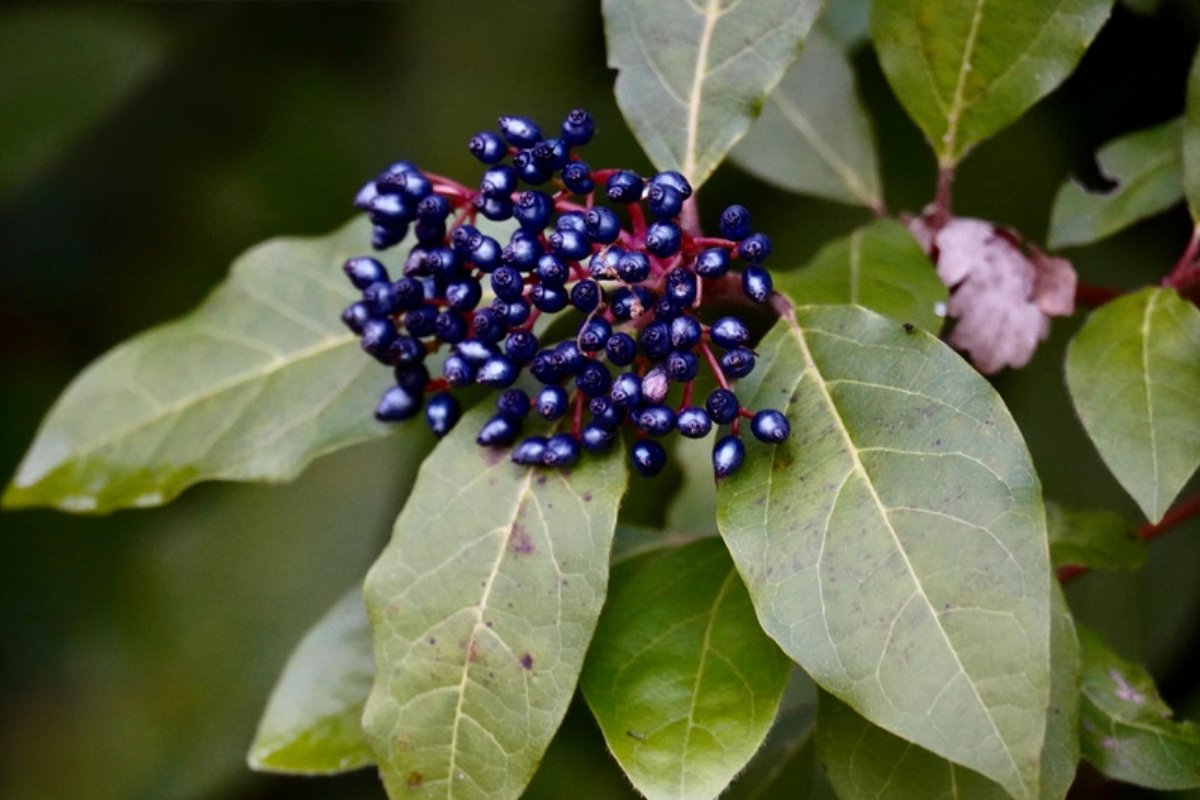
Viburnum berries are ornamental and should not be eaten, but birds feed on them in winter
Drawbacks to know about
Viburnum is easy to grow, but it has a few drawbacks. Laurustinus and guelder rose attract the viburnum beetle, which can leave foliage looking ragged. Some species grow large, so they need space or regular pruning. The berries are ornamental and should not be eaten, although they are a valuable winter food for birds, and the shrubs offer shelter and nesting sites for wildlife and food for pollinators.
Frequently asked questions
When should viburnum be pruned
Laurustinus is pruned after flowering, which in Mediterranean climates means late spring. A light shaping trim in early autumn is possible but removes part of the next flowering.
When is the best time to plant viburnum
Evergreen viburnums are planted in autumn or early spring, and deciduous ones from autumn to early spring. In Mediterranean climates, autumn is best.
Do viburnums prefer sun or shade
Most prefer sun, and laurustinus grows in sun or partial shade but flowers less in deep shade. Viburnum davidii is one of the species that does well in shadier spots.
How tall does viburnum grow
Laurustinus cultivars usually reach 1 to 2.5 m. As a hedge, 'Eve Price' is easily kept at 1.5 to 1.8 m.
Why is my viburnum not flowering
Usually because of pruning at the wrong time, which removes the buds, too much shade, too much nitrogen, or because the plant is still young.
Are viburnum berries edible
No. The berries are ornamental and should not be eaten, although they are a valuable food source for birds in winter.
Important notes
For persistent pest or disease problems, a local agronomist can help with an accurate diagnosis, and any treatment should use only registered products, following the label.
References
- Royal Horticultural Society, How to grow viburnum.
- Royal Horticultural Society, Viburnum tinus Spirit ('Anvi').
- Royal Horticultural Society, Viburnum tinus Secret Village ('Lisspurp').
- Royal Horticultural Society, Viburnum tinus 'Ladybird'.