Applications for Greece's new farm Improvement Plans, the Schedia Veltiosis, with public funding of EUR 263.5 million, did not open on 6 October as the original call from the Ministry of Rural Development and Food had set. An amending decision moved the start to 10 November 2026 and the deadline to 3 February 2027 at 13:00, because the information system was not ready to accept applications, according to Agronews, which notes that a further delay cannot be ruled out. Many reports still carry the original date.
The call was announced by minister Margaritis Schinas and Argyro Zerva, secretary general for EU resources and infrastructure, and for the first time activates three interventions of Greece's CAP Strategic Plan 2023-2027 together: farm modernisation, water saving and renewable energy. Applications are submitted online through the Integrated Information System for State Aid, OPSKE, and the call and its legal framework are published on agrotikianaptixi.gr.
What the call funds
The call covers a wide range of investments. They include building, extending and modernising farm buildings and facilities, buying new machinery and equipment, establishing plantations, beekeeping vehicles and, where provided for, buying land. It also funds water-saving investments, renewable energy production and storage for the farm's own needs, the processing and reuse of farm and livestock waste and by-products, and the studies directly linked to the investments.
Eligible expenses are those incurred after 1 June 2026, provided that spending made before the application does not exceed 80% of the approved amount.
Support reaches 70% for water and energy
The basic support rate is 50% for every expense and rises depending on the type of investment.
| Type of expense | Support rate |
| General rate for every expense | 50% |
| New plantings | 50%, 60% for young farmers |
| Cutting-edge technology equipment | 60% |
| Equipment that reduces fertiliser use and pesticide dispersal | 60% |
| Buildings and equipment for livestock and beekeeping farms | 60% |
| Energy saving and renewable energy production | 70% |
| Reducing irrigation water use | 70% |
Young farmers receive an extra 10 percentage points, with a ceiling of 70% in every case. The increase applies to young farmers as well as to farmers aged up to 40 with more than five years of professional experience or appropriate training.
The subsidised budget reaches EUR 750,000
The maximum subsidised budget depends on the type of investment and the applicant. For competitiveness investments it reaches EUR 200,000 for individuals and companies and EUR 400,000 for collective schemes, and for investments mainly in livestock facilities EUR 400,000 and EUR 500,000 respectively. For water saving the limits are EUR 150,000 and EUR 250,000, and for renewable energy EUR 200,000 and EUR 500,000.
A single investment plan covering all three interventions can reach EUR 750,000 for individuals and companies and EUR 1.25 million for collective schemes, while for biogas plants on livestock farms the ceiling is EUR 2.5 million.
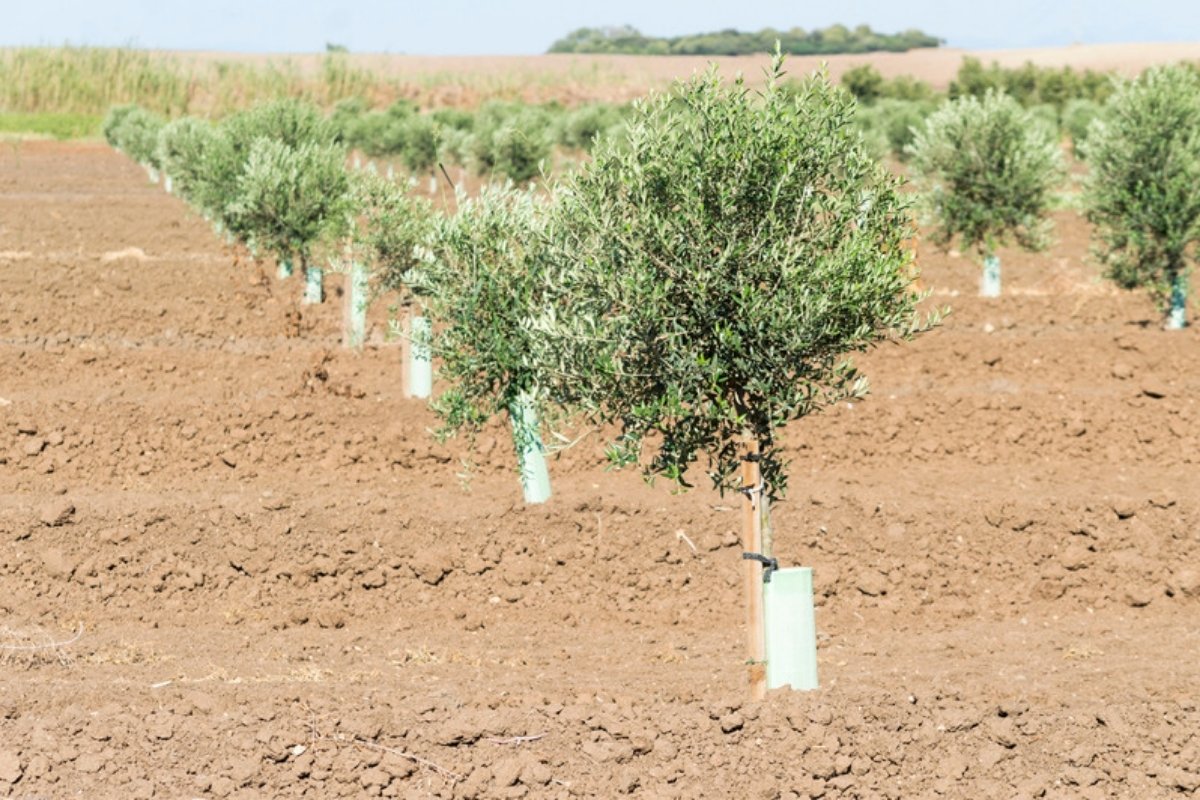
New olive plantings are eligible up to EUR 1,000 per stremma, with support of 50%, or 60% for young farmers
Reasonable costs set how much each purchase can receive
The call sets maximum reasonable costs for many expenses. A tractor is eligible up to EUR 145,000, higher than in the previous call, soil cultivation implements up to EUR 55,000 in total and multi-purpose cultivation machinery up to EUR 70,000. For new plantings, the maximum eligible cost is EUR 1,000 per stremma for olive trees, equivalent to EUR 10,000 per hectare, EUR 1,500 per stremma for vines and EUR 3,900 per stremma for kiwifruit.
The October amendment also added reasonable costs for fencing, EUR 25 per metre for fencing with a concrete base and EUR 12 per metre for simple fencing, while total spending on plantation fencing cannot exceed EUR 6,000. Studies are also capped, for example at EUR 1,500 for designing livestock facilities and EUR 2,000 for a water-saving study.
Who can apply
Eligible applicants are professional farmers and collective schemes. Applicants who received payments under the Improvement Plans calls of 2017 and 2021 and have not completed their investment plan are excluded, as are those who have been paid under the 2023 call. Applicants seeking support only for irrigation or renewable energy are exempt from that exclusion, provided they have completed their 2023 plan. Applications are assessed comparatively against predefined criteria and ranked by score.
Loans from the Agricultural Entrepreneurship Fund
Alongside the Improvement Plans, the Agricultural Entrepreneurship Fund is launching three financial instruments with public funding of EUR 160 million, which through the banks are expected to create a loan portfolio of about EUR 365 million, according to Agronews.
The first is the Agri-food Sector Guarantee Fund of the Hellenic Development Bank, worth EUR 250 million, offering loans from EUR 25,000 to EUR 3.5 million for liquidity or investment in primary production and processing, with a 4% interest rate subsidy for up to four years. It is expected to start in October, with ten banks having expressed interest. Later in the year it will be followed by the Agricultural Entrepreneurship Small Loans Fund II, a EUR 95 million portfolio of loans from EUR 10,000 to EUR 50,000 over one to eight years, half of each loan interest-free.
The third instrument, the Young Farmers Guarantee Fund, with a EUR 20 million portfolio, is due to start by January. It targets new farmers aged up to 40, with loans from EUR 10,000 to EUR 50,000 combined with a start-up grant of up to EUR 40,000, so total support can reach EUR 90,000 per beneficiary.
Frequently asked questions
When do applications for the Improvement Plans open
On 10 November 2026, with a deadline of 3 February 2027 at 13:00, after an amendment to the original call, which had set 6 October as the start date. A further delay cannot be ruled out.
How much funding does the call have
Public funding of EUR 263.5 million for three interventions of the CAP Strategic Plan, namely farm modernisation, water saving and renewable energy.
What is the support rate
Support starts at 50% for every expense and rises to 60% for advanced technology equipment, for equipment that reduces fertiliser and pesticide use and for livestock and beekeeping investments, and to 70% for energy and water-saving investments. Young farmers receive an extra 10 percentage points, with a ceiling of 70%.
How much support is there for buying a tractor
The eligible cost of a tractor can reach EUR 145,000, higher than in the previous call.
How much support is there for planting olive trees
The maximum eligible cost is EUR 1,000 per stremma, or EUR 10,000 per hectare, with support of 50%, or 60% for young farmers.
Can I apply if I received money from a previous Improvement Plans call
That depends on whether you have completed the previous investment plan and on the type of new investment. The exclusion rules for the 2017, 2021 and 2023 calls are set out in detail in the call and are worth going through with your farm consultant.
Important notes
Application dates have already changed once and may change again, so check the call and its amendments on agrotikianaptixi.gr before taking any step. This article summarises the main terms of the call and does not replace the full text or the advice of a farm consultant. The figures for the Agricultural Entrepreneurship Fund loans reflect the plans announced so far, and their terms will be finalised by the participating banks.
Sources
- Agronews. (2026). Applications for the Improvement Plans moved to 10 November. Amending decision, 7 October 2026.
- Agronews. (2026). Applications for the Improvement Plans start on 6 October. Terms of the call and ministry announcement, 8 September 2026.
- Ministry of Rural Development and Food. (2026). Call for expressions of interest for the Improvement Plans, ADA ΡΘΗΟ4653ΠΓ-ΧΙ7. September 2026.
- Agronews. (2026). October HDB loans with a 4% interest subsidy, interest from 10 banks. 1 October 2026.
- Proto Thema. (2026). Margaritis Schinas, Improvement Plans of EUR 263.5 million and loans of EUR 365 million. September 2026.