
Since 10 March, food control authorities in every EU member state have had access to TraceMap, an AI tool built by the European Commission's health directorate to speed up investigations into food fraud, contaminated products and foodborne outbreaks. It links operators and products across two EU systems: the Alert and Cooperation Network, which holds the rapid alerts on food and feed and the cases of the Agri-Food Fraud Network, and TRACES, which holds commercial documents and health certificates for traded goods.
Before the tool, tracing a product across borders required physical documents and direct exchanges between national authorities, according to the Commission's announcement as reported on the day of the launch. A pilot version was used in the recall of infant formula made in China with contaminated arachidonic acid (ARA) oil.
The tool builds the trace map and the inspectors decide
When a member state flags a problem, TraceMap automates the mapping of where a product came from and where it went, using graph technology and search to find connections between operators and products. A presentation by the directorate in June described the result as the "semi-automated building of traceability maps" and claimed that investigations shrink "from weeks to hours/days", without giving measured figures.
The Commission says the aim is for authorities to spend less time gathering information and more time verifying data, assessing risks and enforcing standards. The tool therefore prepares the map, while the decision on a recall, a check or a penalty stays with the national inspectors who use it.
The EU network logged 1,755 notifications of possible fraud in 2025
In 2025 the Alert and Cooperation Network handled 10,490 notifications, according to its annual report. Of these, 1,755 were cases that potentially resulted from intentional actions, 713 sent through the network for administrative assistance and 1,042 through the rapid alert system. The report puts the fall in such cases compared with 2024 at 47% in one place and 46% in another. The report groups oils under fats and oils and does not mention olive oil separately.
EU auditors found olive oil checks applied unevenly
The European Court of Auditors examined the control system for olive oil in a special report published in January. Member states should carry out one conformity check per 1,000 tonnes of olive oil. The auditors found that Spain has carried out far fewer category checks than required since 2020, and that Greece has done fewer than required in every year except 2023.
Between 2018 and 2023, 14% of checks found a non-conforming label and 32% a non-conforming category, meaning the oil did not meet the category on the label. Physico-chemical analyses confirmed compliance in 93% of cases, against 68% for the organoleptic assessment by a tasting panel. The auditors could attribute around one third of the category non-conformities clearly to the degradation of the oil.
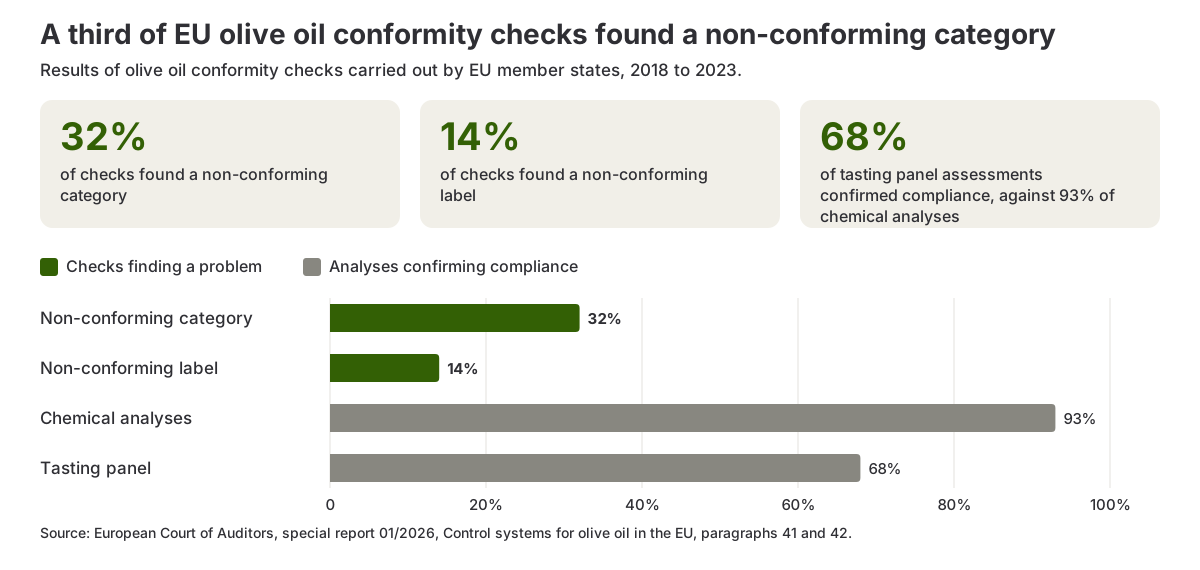
Results of olive oil conformity checks in the EU, 2018 to 2023. Source: European Court of Auditors, special report 01/2026.
Spain and Italy have fully developed risk analyses to decide which oils to check, while those of Greece and Belgium are general and leave out potentially relevant criteria. Spain and Italy also keep electronic registers of every movement of olives and olive oil, and at the time of the audit Greece said it was working on a digital system for the mandatory declarations. The report does not mention AI or the EU alert system.
Most olive oil the EU imports comes from Tunisia
The EU imports the equivalent of around 9% of its annual olive oil production, and Tunisia supplied 75% of the volume imported between the 2019/2020 and 2023/2024 harvest years, followed by Türkiye with 7.8%, according to the auditors. None of the member states they visited explicitly considered imported oil in their risk analyses for pesticides and other contaminants. Greece introduced olive oil checks at its border control posts only in 2024, and in Italy no consignments were checked at the main entry points for olive oil in 2023 and 2024.
From September 2027, risk analysis at EU customs will be able to use AI systems under the new customs code, which also asks the customs data hub to draw on the food and feed alert system.
Four points an olive oil importer or exporter can check
- Documents: the commercial documents and health certificates in TRACES are part of the data the tool links, so their accuracy decides what an inspector sees on a trace map.
- Category: the category on the label has to hold in both the chemical analysis and the tasting panel, and part of the failures came from degraded oil, so storage and the time before sale matter too.
- Origin: the auditors could not confirm the origin of four oils that came from more than one member state or mixed EU and non-EU oil, so blends need records that show where each part came from. Blending and false labels are known forms of olive oil fraud.
- Imports: checks on imported oil at border posts were rare in two of the four member states the auditors visited, and the auditors recommend that guidance on contaminant checks consider imports explicitly.
Sources
- European Commission, Directorate-General for Health and Food Safety. (2026). TraceMap: Using AI to strengthen food safety and tackle food fraud. DG SANTE newsroom, 16 March 2026.
- Eunews. (2026). Food safety, the EU presents TraceMap, the AI against fraud and contaminated food. 10 March 2026.
- European Commission, Directorate-General for Health and Food Safety. (2026). TraceMap presentation to the Market Advisory Council. Brussels, 12 June 2026.
- European Commission. (2026). Alert and Cooperation Network annual report 2025. Directorate-General for Health and Food Safety.
- European Court of Auditors. (2026). Control systems for olive oil in the EU: a comprehensive framework, but unevenly applied. Special report 01/2026.