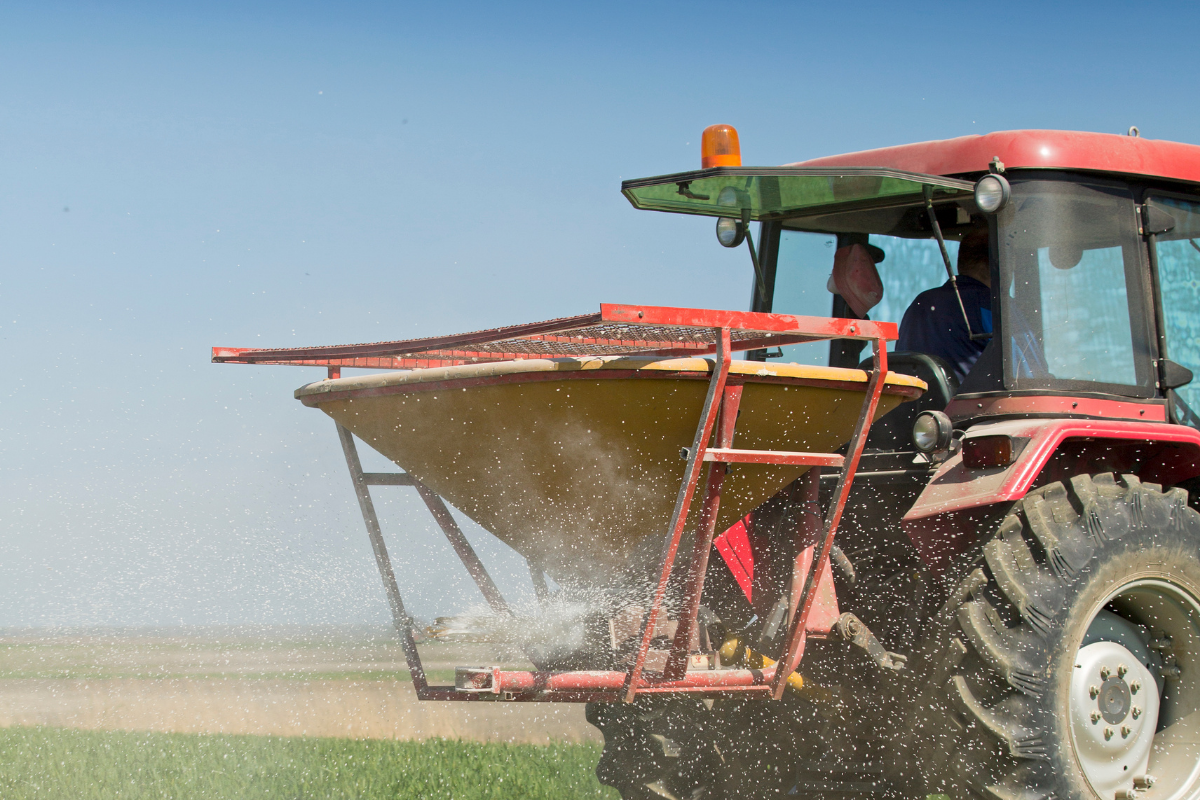
The Danish parliament passed the country's fertilisation law on 3 September by 119 votes to 34, ending a summer of tractor demonstrations and setting up a change in how agricultural nitrogen is governed. From 1 January 2027, Denmark replaces its current system of rules, applied field by field, with a model based on calculated emissions, in which the amount of nitrogen a farm may release depends on the environmental condition of the water body it drains into.
The shift is a change of principle rather than of stringency alone. Under field-level regulation, a farmer complies by following the application rules for each parcel. Under an emissions-based system, compliance is measured by how much nitrogen is calculated to reach the aquatic environment. Denmark is the first EU member state to make that move at national scale, which is why the law matters well beyond its borders.
What the law changes
The legislation, known in Danish as gødskningsloven and introduced as bill L5, sets the legal basis for regulating nutrient and greenhouse gas emissions from agriculture and forestry. It combines nitrogen limits with the conversion of agricultural land and other environmental measures, and includes a mechanism that operates in both directions. Regulation becomes stricter if environmental targets are not reached, and requirements can be relaxed if reductions exceed expectations.
The law implements part of the 2024 Agreement on a Green Denmark, the green tripartite agreement negotiated between government, farming organisations and environmental groups. That agreement enjoys the support of parties holding 128 of the 179 seats in the Folketing, which is why a rebellion within one governing party was never going to stop the bill. Danish authorities have framed the rules as contributing to obligations under EU legislation on water quality, nitrates and Natura 2000 protected areas.
Marine scientists have welcomed the outcome. The think tank Tænketanken Hav called the law an important measure against nitrogen pollution and oxygen depletion in Danish fjords and coastal waters, with chief biologist Mads Christoffersen describing it as a step towards restoring marine ecosystems affected by the oxygen depletion repeatedly recorded in Danish inland waters.
Why farmers objected
About 3,000 farmers and food industry representatives gathered in Odense on 31 August at a protest meeting organised by Landbrug og Fødevarer. Bæredygtigt Landbrug brought roughly 300 tractors to Christiansborg Palace Square to coincide with the bill's second reading. Several agricultural representatives suspended their participation in the local green tripartite groups that are supposed to plan implementation.
The objection was less about the principle of reducing nitrogen than about sequence and distribution. The final limits and implementation details will not be completed until later in the autumn, which means Danish farmers are sowing the crops that will be governed by the new system without knowing the rules that will apply to them. The burden also falls unevenly, since a farm's allowance will depend on the condition of its receiving water body rather than on a national standard, so two farms with identical practices can face different limits.
Fruit and vegetable growers argued they would be hit hardest, with some facing the prospect of buying additional land to meet requirements for how much area must be set aside. Parliament responded before the final vote by exempting vegetable producers for one year, leaving them under current rules until 1 January 2028, while the minister for nature and animal welfare, Christian Rabjerg Madsen, asked an expert committee to re-examine the technical basis for the regulations affecting them.
The political cost
Five of Venstre's 18 MPs voted against the law even though the party supported it, and some local party figures resigned or left. Søren Gade, elected in western Jutland, was the most outspoken, saying he could not support legislation he considered insufficiently grounded and potentially damaging to farmers and rural areas. Peter Juel-Jensen, elected on Bornholm, announced his opposition on the grounds of what the law would mean for agriculture on the island.
The split matters because Venstre has deep historical roots in Danish farming communities and helped negotiate the very agreement it is now implementing. Party leader Troels Lund Poulsen has argued that staying inside the green tripartite is the only way to influence how the transition is carried out. The dispute inside the party mirrors the one outside it, turning less on whether agriculture should cut nitrogen than on how fast and how evenly.
Every EU member state works under the same nitrates rules
Every EU member state operates under the same obligations of the Nitrates Directive and the Water Framework Directive that Denmark cites as justification. Greece, Italy, Spain, and others have designated nitrate-vulnerable zones where fertiliser use is already restricted by practice-based rules. Denmark is now running an experiment to determine whether regulating the outcome works better than regulating the practice, and the results will be visible to every agriculture ministry in Europe.
An outcome-based system rewards farms that improve efficiency rather than simply comply with an application ceiling, thereby placing a premium on measures that raise nitrogen use efficiency in cropping systems, from split applications and precision placement to catch crops. It also requires a model capable of estimating what actually leaves a field, which is where the technical dispute in Denmark sits, since the pathways involved in nutrient leaching and run-off vary with soil type, rainfall and management in ways that are difficult to capture in a single calculation.
Denmark has settled the legal basis. Whether the model can allocate limits that farmers accept as fair, and whether the fjords recover on the timetable the law assumes, will be tested from January 2027.
Sources
- NordiskPost. (2026). Denmark has passed its controversial new fertiliser law. 5 September 2026.
- The Copenhagen Post. (2026). Danish Parliament passes controversial nitrogen law. 3 September 2026.
- The Copenhagen Post. (2026). Folketing exempts vegetables from 2027 nitrogen rules. 1 September 2026.
- NordiskPost. (2026). Denmark's fertilisation law has divided the Venstre party. 1 September 2026.
- Daily Northern. (2026). Farmers protest new nitrogen rules as minister stands firm. 31 August 2026.