


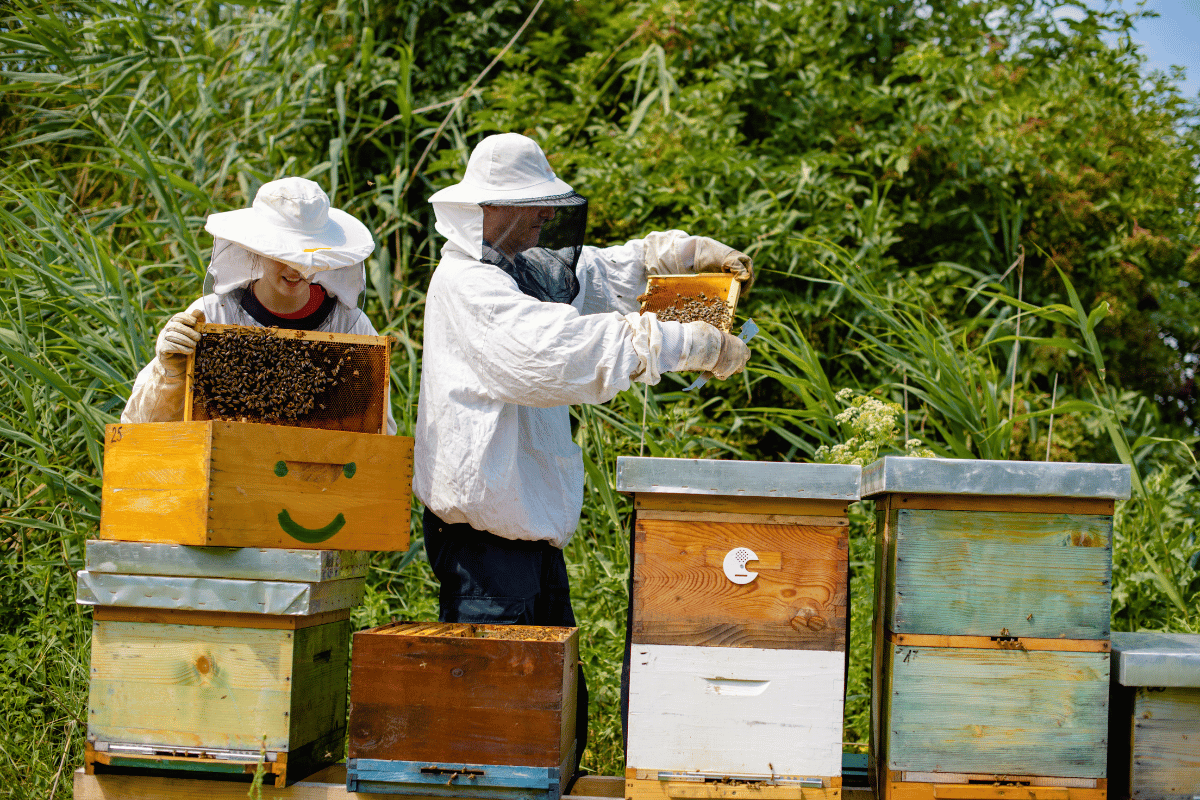
A small-scale beekeeper's experience in Northern Luzon, Philippines
The Philippines remains a net importer of honey, bringing in the majority of its supply from Australia, China, and other Asian suppliers (UN Comtrade, 2023). Domestic production, scattered across smallholder operations with limited data collection, falls well short of national demand. In the Cordillera Administrative Region of Northern Luzon, where vegetable terraces stretch above 1,000 meters elevation, small-scale beekeepers are beginning to fill that gap. This article draws on direct experience managing 15 to 20 colonies of Apis mellifera in the Cordillera highlands, covering production data, management methods, economic realities, and the particular challenges of tropical mountain beekeeping.
The Cordillera environment and its effect on bees
The Cordillera highlands sit between 1,000 and 1,500 meters above sea level, with temperatures averaging 16 to 26 degrees Celsius (60 to 78 degrees Fahrenheit). Two seasons define the beekeeping calendar: a dry period from November through May, when flowering peaks and colonies build surplus stores, and a heavy monsoon from June through October, when persistent rain limits foraging flights and can confine bees to the hive for days at a time.
This altitude range creates a foraging environment quite unlike lowland tropical apiaries. The cooler temperatures reduce brood-rearing pressure during wet months, and the floral composition shifts toward montane species such as tree ferns, Benguet pine (Pinus kesiya) resin sources, and wild sunflower (Tithonia diversifolia), which blooms heavily along roadsides and forest margins from December to February. The result is a honey with a darker amber color and a more complex flavor profile than lowland varieties, characteristics that have growing appeal among consumers willing to pay premium prices for single-origin products.
One detail worth noting for beekeepers considering highland sites: the temperature swings between day and night in Cordillera can exceed 10 degrees Celsius. These fluctuations affect ventilation management inside the hive and can cause condensation problems in poorly insulated boxes, particularly during the transition months of October and November.
Honey yields and production cycles
Under favorable dry-season conditions, colonies produce approximately 15 to 25 kilograms (33 to 55 pounds) of honey per colony per year. Strong colonies can yield 8 to 12 kilograms per major nectar flow, with two primary harvest windows aligning with the December-to-February and March-to-May blooming periods.
For context, these figures sit within a wide global range. According to FAO data, the global average honey yield per hive varies from under 10 kilograms in parts of sub-Saharan Africa to over 30 kilograms in temperate regions of Europe and North America. Cordillera yields are roughly on par with those reported in comparable highland zones in Ethiopia and Nepal, where altitude and monsoon seasonality create similar constraints on foraging days and nectar availability.
Extended monsoon periods can reduce production by 30 to 50 percent. In 2022, a particularly prolonged rainy season in Benguet Province cut some operations to barely 8 kilograms per colony. Colony survival rates in the highlands average 80 to 90 percent annually, which compares favorably to reported losses in temperate regions. The United States, for instance, reported annual colony losses of 48 percent for the 2022-2023 season (Bee Informed Partnership, 2023), driven largely by Varroa destructor and pesticide exposure, problems that are present but less severe in the Cordillera's relatively isolated mountain environment.
Hive management in a tropical mountain setting
The operation uses Apis mellifera housed in standard 10-frame Langstroth hives. The choice of hive equipment matters more than it might seem in a highland tropical setting: wooden hives absorb moisture during the monsoon, so many local beekeepers have started coating exterior surfaces with a mixture of propolis-infused beeswax or food-grade sealant to extend hive life.
Inspections follow a biweekly schedule during the dry season and shift to monthly during the rains, when opening hives risks chilling brood and introducing moisture. During dry-season inspections, the primary focus is on assessing colony health, checking queen performance, and evaluating honey supers. During the monsoon, inspections center on food stores and signs of stress.
Supplemental feeding with sugar syrup is provided during nectar dearth periods, typically from August through October when natural forage is scarce. A 1:1 sugar-to-water ratio is used during nectar stimulation in early dry season, shifting to a heavier 2:1 ratio during emergency feeding in the wet months.
Queen replacement occurs every one to two years. In practice, most requeening happens through natural supersedure rather than purchased queens, since commercial queen-rearing operations in the Philippines are concentrated in the Visayas and Mindanao lowlands, and shipping queens to mountain provinces remains difficult and expensive. Some highland beekeepers have started small-scale queen rearing from their best-performing colonies, selecting for traits such as hygienic behavior and reduced swarming tendency.
Moisture control is a persistent concern. Harvested honey is maintained below 20 percent moisture content to prevent fermentation, a threshold that requires careful timing of harvest. A refractometer reading above 18.5 percent is typical for well-capped frames in the Cordillera dry season, but frames pulled too early during transitional weather can test above 21 percent, making them unsuitable for bottling without further dehumidification. The Codex Alimentarius standard for honey sets the moisture limit at 20 percent, and the Philippine National Standard (PNS/BAFPS 01:2000) aligns with this threshold, so consistent control during extraction and storage is essential.
The Philippine honey market and where highland honey fits
The Philippines imported an estimated USD 2 to 3 million worth of honey in 2023, primarily from Australia, with additional volumes from China and New Zealand (UN Comtrade). Domestic honey production remains fragmented, with most producers selling through informal channels, roadside stalls, and social media marketplaces.
Highland honey from the Cordillera occupies an interesting position. Its darker color and distinctive floral notes set it apart from the lighter lowland honey that dominates the Philippine market. In recent years, origin-specific labeling has gained traction among Filipino consumers, mirroring a global trend: the EU's revised honey labeling rules (Directive 2024/1438), which took effect in June 2024, now require the specific country of origin on blended honey, a regulation that has pushed premiums higher for traceable single-origin products worldwide.
For highland beekeepers, the economics break down roughly as follows. Retail honey prices in Cordillera markets range from PHP 600 to PHP 1,200 per kilogram (approximately USD 10 to 21), depending on the season, packaging, and buyer. With a colony producing 15 to 25 kilograms per year and annual maintenance costs of approximately PHP 3,000 to 5,000 per colony (including sugar feed, equipment repair, and transport), gross margins per colony run between PHP 5,500 and PHP 25,000. A 15-colony operation thus generates between PHP 82,500 and PHP 375,000 (USD 1,450 to 6,600) in annual gross income from honey alone, before accounting for the beekeeper's own labor.
These figures explain why most highland beekeepers, myself included, treat beekeeping as a complementary livelihood rather than a standalone enterprise, a pattern consistent across Southeast Asian smallholder beekeeping. The real multiplier is pollination services: the Cordillera is one of the Philippines' most important vegetable-producing regions, and honeybee colonies placed near strawberry, chayote, and legume fields provide pollination benefits that are difficult to quantify in cash terms but visible in improved fruit set and yield quality.
Challenges facing highland beekeepers
Several constraints limit the expansion of beekeeping in Northern Luzon.
Prolonged monsoons and climate variability. The monsoon season has become less predictable in recent years. Typhoon frequency in Northern Luzon has not changed significantly, but the distribution of rainfall within the wet season has shifted, with more intense rainfall events interspersed with dry spells that confuse colony buildup timing. The PAGASA (Philippine Atmospheric, Geophysical and Astronomical Services Administration) climate projections for the Cordillera indicate a 5 to 15 percent increase in wet-season precipitation by 2050 under moderate emissions scenarios (PAGASA, 2022). For beekeepers, this means adapting hive placement, strengthening hive stands against flooding, and possibly shifting harvest calendars.
High humidity and disease pressure. The combination of warmth and moisture creates favorable conditions for fungal brood diseases, particularly chalkbrood (Ascosphaera apis). Varroa mite infestations are present but tend to be managed more easily than in temperate climates, partly because the shorter brood-rearing pauses during monsoon reduce mite reproduction cycles. Still, vigilance remains essential, and access to diagnostic tools and treatments in remote highland communities is limited.
Equipment access and cost. Standard Langstroth equipment is manufactured primarily in the lowlands around Manila and Laguna. Transport costs to Cordillera provinces can add 20 to 30 percent to equipment prices. Foundation wax, smoker fuel, and extraction equipment are similarly difficult to source locally, pushing some beekeepers toward improvised solutions that can compromise honey quality and hive hygiene.
Competition from imported honey. Cheap imported honey, often blended or adulterated, undercuts domestic producers on price. The Philippine Bureau of Customs does not currently apply rigorous authenticity testing on imported honey, a gap that has been identified by the Department of Agriculture's Bureau of Animal Industry. The issue mirrors the global problem of honey adulteration, where C4 sugar syrups are added to extend volume.
Apis cerana and stingless bees: overlooked alternatives
A discussion of Philippine highland beekeeping would be incomplete without mentioning two other species with significant local potential. Apis cerana, the Asian honeybee, is native to the Cordillera and was managed in log hives by Indigenous Igorot communities long before Apis mellifera was introduced in the early twentieth century. These colonies produce smaller honey yields (typically 3 to 8 kilograms per year) but are better adapted to local conditions, more resistant to several pests, and require less management input. A handful of Cordillera beekeepers are now experimenting with managing Apis cerana alongside Apis mellifera, keeping the native bees in modified hives that allow frame inspection while preserving the colony's natural comb-building behavior.
Stingless bees (Tetragonula species) also thrive in the Cordillera and produce a thin, tangy honey called "pot honey" that commands very high prices in local markets, sometimes exceeding PHP 3,000 per kilogram. Production volumes are tiny (often under one kilogram per colony per year), but the cultural significance and growing interest in biodiversity-positive farming make stingless bee meliponiculture a promising niche. Research groups in Malaysia and Brazil have published propagation protocols for tropical stingless bee species that Philippine beekeepers are beginning to adapt for local conditions.
What highland beekeepers need going forward
Scaling Cordillera beekeeping from a household sideline to a recognized regional product requires several concrete steps.
Training programs that combine classroom instruction with apiary mentoring are the most immediate need. The Department of Agriculture's Agricultural Training Institute runs periodic beekeeping seminars, but coverage in highland provinces remains thin. Farmer cooperatives that pool resources for equipment purchases, bulk packaging, and joint marketing could reduce per-colony costs and improve market access. A few cooperatives in Benguet and Mountain Province have started group honey sales to Manila-based organic food retailers, with early results showing a 15 to 20 percent price premium over individual roadside sales.
Quality control infrastructure matters too. Establishing a shared honey testing facility in the region, even a basic laboratory with a refractometer, HMF testing kit, and diastase activity measurement, would allow highland beekeepers to certify their product and differentiate it from adulterated imports. The Philippine National Standard for honey provides the testing framework; what is missing is local access to the equipment.
Finally, geographic indication or origin certification could position Cordillera highland honey alongside other Philippine specialty products like Benguet arabica coffee and Kalinga rice. The Philippines' Intellectual Property Office has a GI registry, and the case for highland honey, with its distinct floral profile, terroir-driven character, and connection to Indigenous agricultural traditions, is strong.
Conclusion
Beekeeping in the highlands of Northern Luzon is shaped by altitude, monsoon rhythms, and the realities of smallholder agriculture. Annual honey yields of 15 to 25 kilograms per colony are modest by global standards but meaningful as supplementary income in a region where farming margins are tight. The distinctive qualities of highland honey, its darker color, complex flavor, and connection to montane flora, give it a genuine competitive edge in an era when consumers and regulators alike are demanding traceability and authenticity.
The path forward runs through organization, quality standardization, and building recognition for highland honey as a specialty product worth knowing by name. For the region's beekeepers, that case starts in the apiary, with healthy colonies, clean harvests, and an honest relationship with the landscape that sustains both the bees and the people who keep them.
References
- Bee Informed Partnership. (2023). United States colony loss results (2022-2023). Bee Informed Partnership Annual Survey.
- Codex Alimentarius Commission. (2001). Revised Codex Standard for Honey (CODEX STAN 12-1981). FAO/WHO.
- FAO. (2024). FAOSTAT: Crops and livestock products. Food and Agriculture Organization of the United Nations.
- PAGASA. (2022). Observed and projected climate change in the Philippines. Philippine Atmospheric, Geophysical and Astronomical Services Administration.
- UN Comtrade. (2023). International trade statistics database. United Nations.
- Philippine Statistics Authority. (2024). CountrySTAT Philippines. PSA Open Data Portal.