Introduction
Stingless bees are a large group of bees, comprising the tribe Meliponini. They are among nature's smallest farmers, but their impact is huge. In East Africa, especially in Tanzania, the Hypotrigona gribodoi species is gaining recognition for improving farm productivity, nutrition, income, and even family unity. Unlike honeybees, stingless bees are safe, which makes them suitable for households and community projects.
Research shows that stingless bee honey contains significantly higher antioxidant levels than traditional honey, with enhanced antibacterial and anti-inflammatory properties that make it particularly valuable for medicinal applications. The therapeutic benefits stem from high concentrations of flavonoids, phenolic compounds, and unique sugars like trehalulose, which provides health benefits while being gentler on blood sugar levels.
Stingless Bees and Agroforestry
Agroforestry combines trees, crops, and sometimes livestock in a single system. Stingless bees fit perfectly in this setup because:
Through pollination they increase yields of fruits, vegetables, legumes, and other crops. Studies demonstrate that farms with diverse pollinator communities, including managed and wild species, see higher fruit set rates, more uniform crop size and quality, and better pollination resilience during challenging weather. Agroforestry systems can boost biodiversity by 30% since trees attract more birds, pollinators, and beneficial fungi.
Bees visit both farm crops and wildflowers, supporting environmental balance. Wild pollinators enhance fruit set of crops regardless of honeybee abundance, with this effect being particularly pronounced when native habitat is present near agricultural fields. Research from tropical agroforestry systems shows that beans planted in agroforestry plots had almost twice the abundance of insect pollinators, three times the species richness, and almost twice the visitation rates compared to non-agroforestry plots.
Agroforestry provides continuous forage, while bees ensure continuous pollination throughout the year. The phenological diversity in agroforestry systems ensures that pollinators have access to nectar and pollen over extended periods, supporting a wider range of bee species and helping maintain populations year over year.
Farmers in Arusha and Kilimanjaro have observed improved harvests of onion seeds when stingless bee colonies are kept close to farms. This aligns with findings that Canadian farmers who adopt agroforestry practices report up to 30% increased pollination rates and enhanced crop diversity, while studies across multiple systems show average yield increases of 15-25% in various crops, including barley, oats, and pulse crops.
Housing and Management
Stingless bees require proper housing to grow. At Green Heritage Organization demonstration plots in Arusha Region and Kilimanjaro, a model structure was built with 18 hives. Each hive produces about 3 kg of honey every 6 months, making a total of over 100 kg per year from one unit.
Following best practices from successful beekeeping operations, proper frame maintenance is essential for effective honey production. Frames should be inspected regularly for pests and diseases, as some pest spiders and geckos like attaching themselves to frames. The honey extraction process typically takes place during summer and autumn months, always after the major nectar production of plants in the area.
For stingless bees specifically, frequent cleanliness of the meliponary is crucial by dusting the hives, removing cobwebs, and ensuring that flight paths are clear. The normal indicator that a colony is doing fine is when the entrance feels succulent and fresh to the touch - if it's dry, there's cause for alarm.
Precautions for Hive Management
To keep colonies safe and productive:
Avoid ants: place hive stands in containers filled with water or used oil to block ants. This is critical because ants are among the major threats to stingless bee colonies, along with predators like lizards, birds, toads, and spiders.
Protect from wind: strong winds disturb bees and may cause them to leave, build shelters facing away from prevailing winds. Proper ventilation should be maintained to allow free circulation of air in and out of the hive to prevent stifling and suffocation of bees.
Avoid direct sunlight: too much heat forces colonies to abscond, partial shade under trees or simple roofing is best. Beekeepers can help by ensuring hives are well-insulated in winter, providing shade and water in summer, and reducing disturbances during extreme weather.
This low-cost approach is suitable for smallholder farmers, schools, and family backyards. Additional management includes planting flowers around the meliponary to attract bees for foraging, and using feeders placed 50m away with sugar solution during dry seasons.
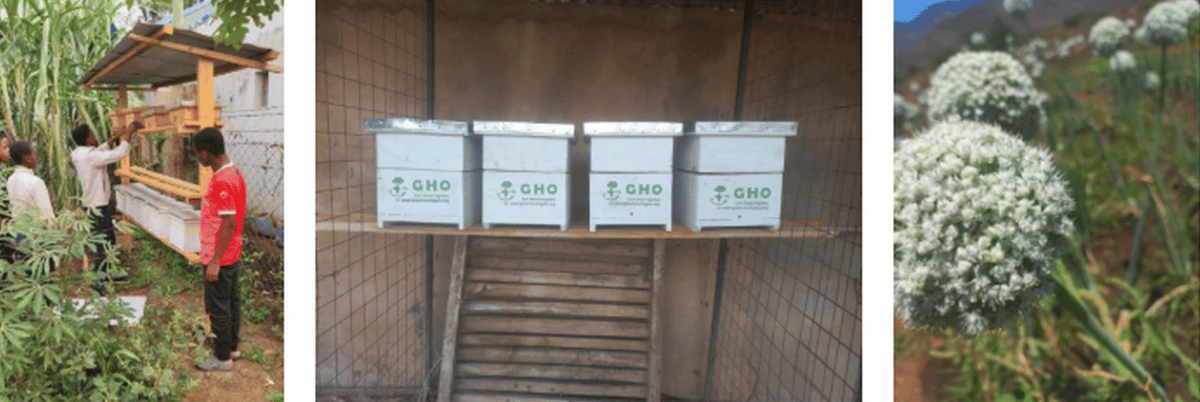
Youth participate in colony inspections under a simple roof structure (left), hives are protected within a constructed shelter (center), and stingless bees are actively pollinating onion flowers (right)
Family and Community Role
Stingless bees bring families together because they are safe for everyone.
Children's role: Kids can help keep a calendar, mark harvest dates, and remind parents to check the hives. This teaches responsibility and nature awareness. Beekeeping teaches kids about biology, ecology, and the environment through hands-on learning about bee life cycles, pollination processes, and honey production. Children who have regular access to nature exhibit better attention, reduced depressive symptoms, and improved cognitive and behavioral health.
Women's role: Mothers often take part in harvesting honey and processing it for home use or sale. The honey extraction process involves careful selection of frames that are ready to be harvested, typically when honeycombs contain honey and are sealed by bees on 75% or more of the frame surface.
Men's role: Fathers or guardians may construct hives and manage protection from pests and weather. Essential maintenance includes regular inspection for signs of pests, disease, or mold, and frequent cleaning to maintain hygiene.
Through this shared activity, stingless bees strengthen family bonds while passing ecological knowledge to the next generation. Project-based learning with bees can encourage critical thinking skills, problem solving, decision making, and inspire art and technology.
Livelihood and nutrition
Income: Stingless bee honey is rare and highly valued for its medicinal properties, often fetching higher prices than honeybee products. Even small harvests contribute to school fees, health care, or household needs. The high price of stingless bee honey is due to the high levels of flavonoids and polyphenols compared to Apis mellifera honey.
Nutrition: Honey provides natural sugars, vitamins, and minerals. Stingless bee honey contains significantly higher antioxidant properties than traditional honey, with antioxidants including flavonoids and phenolic compounds that are crucial for reducing oxidative stress and preventing cellular damage.
Health: Traditional uses include treating colds, stomach problems, and wounds. Stingless bee honey has proven antioxidant, antibacterial, anti-inflammatory, and natural moisturizing properties that aid in wound healing. The antibacterial properties can inhibit bacteria and pathogenic organisms at wounded areas and accelerate wound healing via epithelialization. Research shows anti-diabetic properties by lowering histopathological alterations, oxidative stress expression levels, and inflammation.
Conclusion
Stingless bees are good pollinators and also partners in family and community development. By integrating them into agroforestry, farmers secure better harvests, additional income, and improved household nutrition. At the same time, children and parents learn to work together in caring for the hives.
The experience from Green Heritage Organization demonstration plots in Arusha Region and Kilimanjaro proves that stingless beekeeping is both practical and impactful. Protecting colonies from ants, wind, and direct sun ensures their survival, while structured housing of multiple hives guarantees steady production. Following proper management practices, including regular hive inspection, pest and disease control, and seasonal feeding with sugar syrups during dry seasons, maintains healthy and productive colonies.
Sources
Physiochemical, biological, and therapeutic uses of stingless bee honey