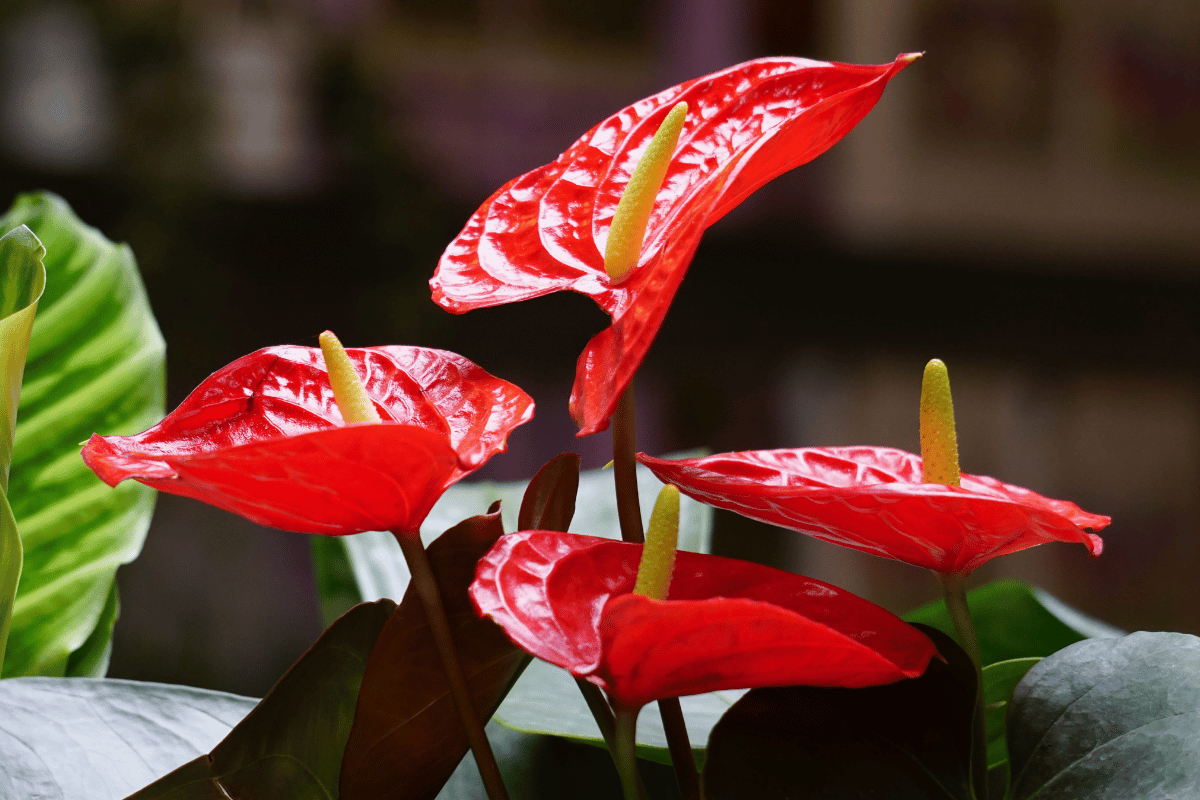
The anthurium is one of the most striking houseplants you can grow, with its glossy, almost waxy red "flowers" rising above heart-shaped, deep green foliage. It comes from the rainforests of Colombia and Ecuador, but with the right setup, it's quite happy in an ordinary home.
Most people know it as the flamingo flower or simply anthurium, after its botanical genus. The most widely grown species is Anthurium andraeanum. Still, the genus Anthurium contains over 800 species, making it one of the largest genera in the family Araceae, alongside well-known houseplants like the peace lily (Spathiphyllum) and the Swiss cheese plant (Monstera deliciosa).
This guide covers everything you need to grow an anthurium successfully at home, including detailed solutions to the two most common problems people run into: yellowing leaves and a plant that won't flower.
What anthurium symbolizes
In the language of flowers, the anthurium is best known as a symbol of hospitality. That's why it's often given as a housewarming gift or to welcome new neighbors. Its glossy, heart-shaped form and exceptionally long-lasting blooms (often several weeks each) have made it a natural fit for that meaning in Western culture.
It's also associated with abundance, prosperity, and joy thanks to its bold, cheerful appearance. The spathe color adds another layer of meaning.
- Red: love, passion, intensity
- White: purity, peace, welcome
- Pink: femininity, gentleness, care
- Orange and yellow: energy, joy, friendliness
The name itself is Greek in origin. It comes from the words anthos (flower) and oura (tail), a reference to the long central spike (the spadix) that resembles a small tail at the center of the "bloom".
What the "flower" really is
What looks like a flower isn't actually one. It's a modified leaf-like structure called a spathe (the heart-shaped red, pink, or white part), and the real, tiny flowers are arranged along the upright central spike, called the spadix.
The spathe can be red, pink, white, orange, purple, or green, depending on the cultivar, and the spadix is usually yellow, white, or cream. The same anatomy is found in the peace lily and other members of the Araceae family.
Each spathe lasts several weeks, and a healthy anthurium can bloom almost continuously throughout the year, producing new spathes in cycles of roughly 3 months.
Popular varieties
The genus Anthurium includes over 800 species, but only a handful are widely grown as houseplants.
Anthurium andraeanum: the classic flamingo flower with large, glossy red spathes, now also available in white, pink, orange, salmon and rarer colours. Holds the Royal Horticultural Society's Award of Garden Merit
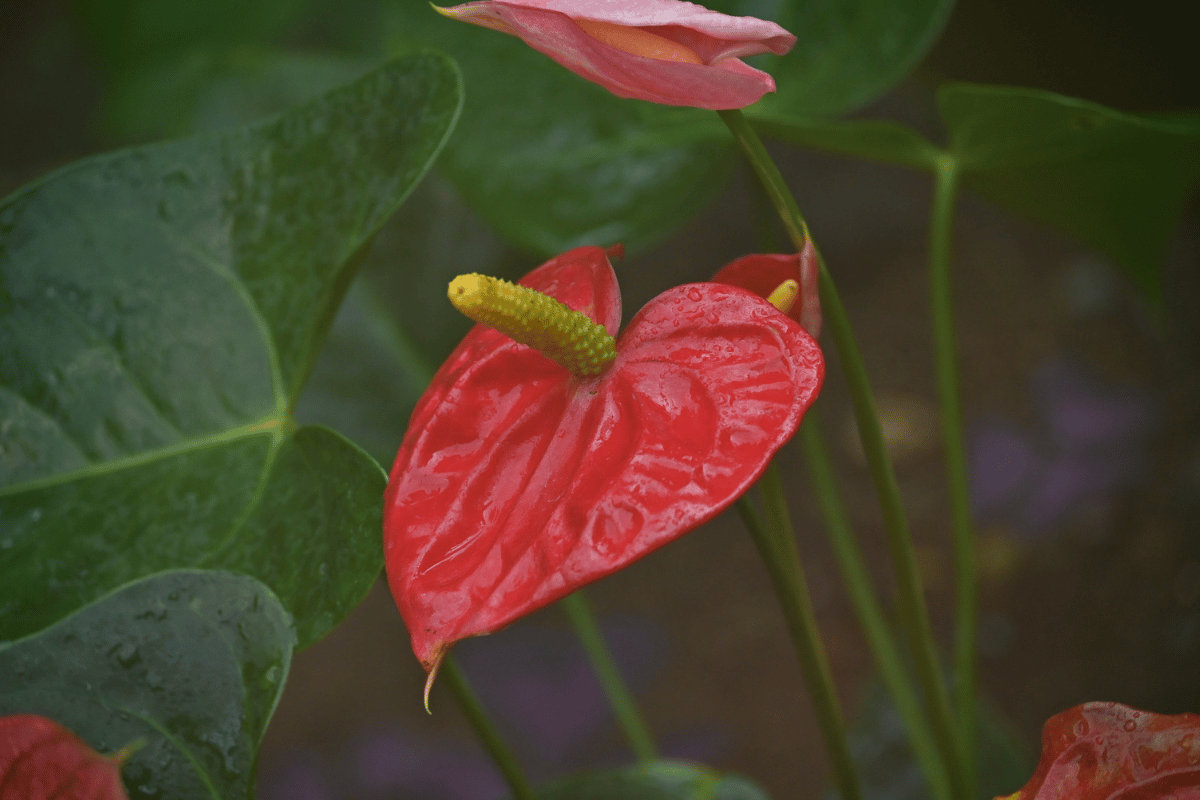
Anthurium scherzerianum (pigtail anthurium): similar to andraeanum but easily told apart by its curly, corkscrew-like spadix
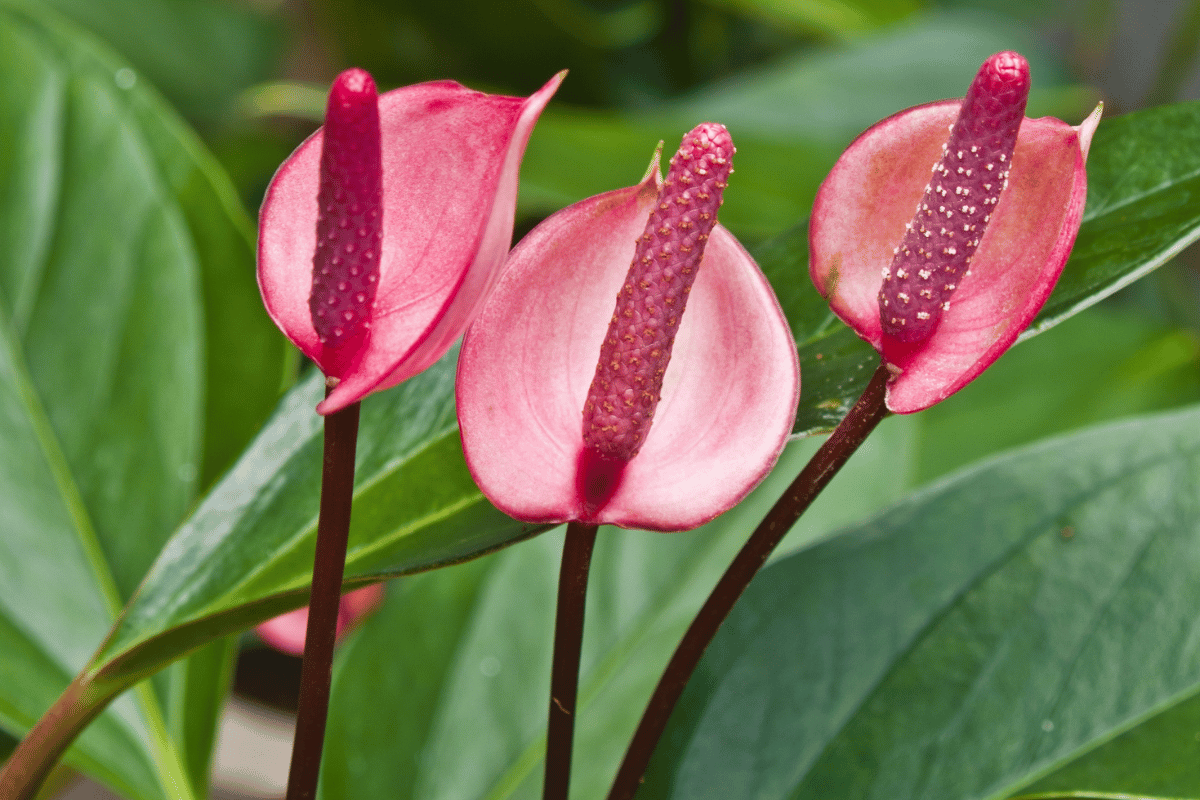
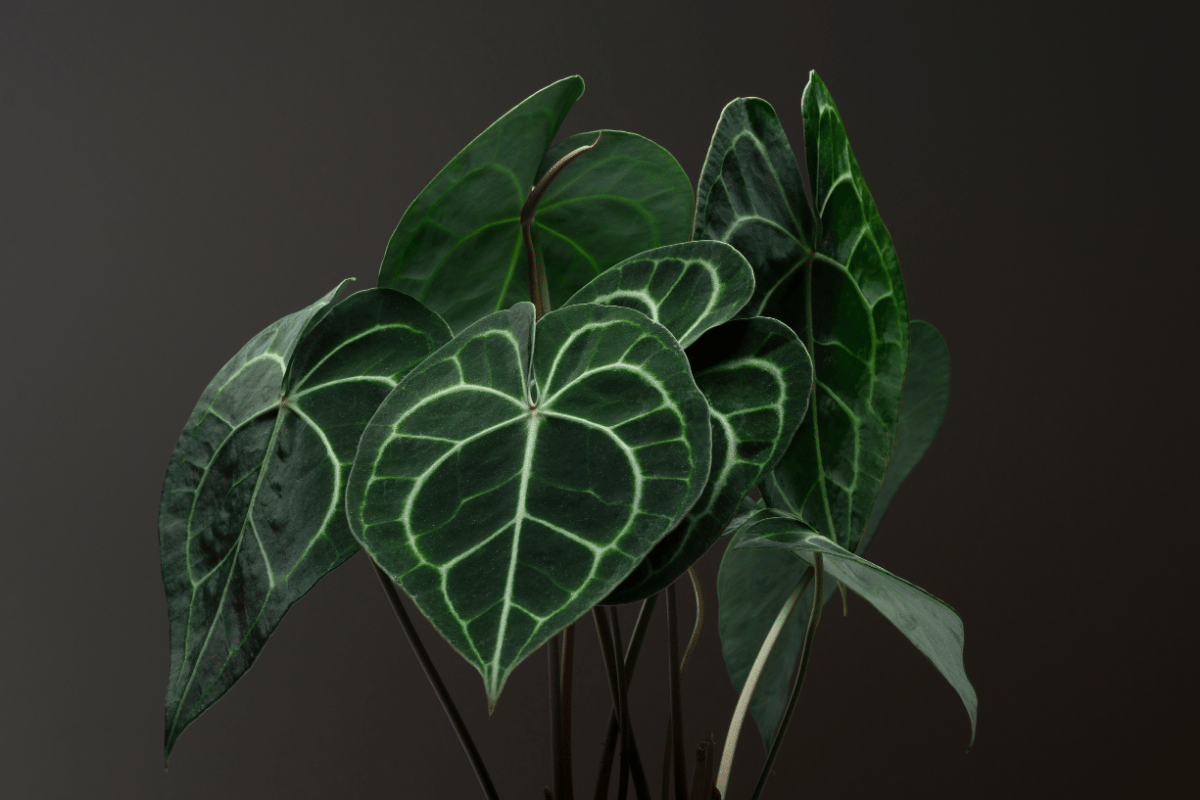
Anthurium crystallinum: grown mainly for its huge, dark green leaves with striking silver veins rather than for the flowers.
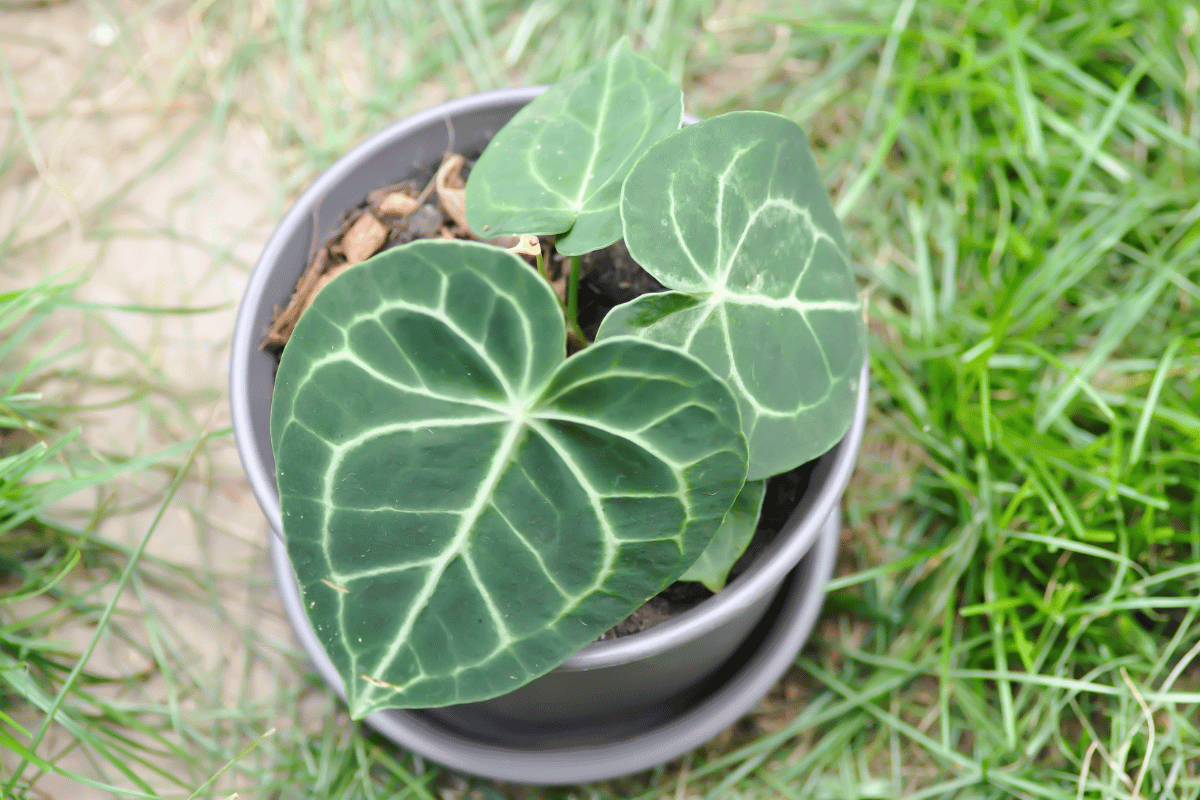
Anthurium clarinervium: similar to crystallinum but with smaller, darker leaves. Popular with collectors
Anthurium 'White Champion' and Anthurium 'Pink Champion': modern hybrids with white or pink spathes that hold their colour well
Where to put your anthurium
Anthuriums want bright but indirect light. Direct midday sun, especially in summer, scorches the leaves, leaving brown patches. In deep shade, they survive but don't flower.
A spot near an east or west-facing window, with a sheer curtain to filter the strongest light, is usually ideal. You can also place the plant a meter or two back from a south-facing window. In a dark room or during winter, a full-spectrum LED grow light can fill in the gap.
It's a good idea to turn the pot every week or so. The plant grows towards the light, and rotating it keeps the shape balanced.
Temperature
Anthuriums are strictly tropical and want steady, warm temperatures year-round.
- Ideal range: 18-27°C all year
- Won't survive below 10°C and starts suffering below 15°C
- Doesn't cope with temperatures above 32°C unless humidity is high
- Sensitive to sudden changes. Keep the plant well away from radiators, air conditioning vents, and cold draughts from doors or windows
If your home drops below 15°C at night in winter, move the anthurium to a warmer room or position it away from cold spots.
Humidity
This is one of the most critical points for anthuriums. In the wild, they grow in tropical forests at 50-80% humidity, and they expect something close to that indoors.
In most homes, particularly in winter with central heating, humidity often falls to 30-40% or even lower. At those levels, the leaves develop brown edges, buds fail to open, and overall flowering suffers.
There are several easy ways to raise humidity around the plant. One of the simplest is a pebble tray with water beneath the pot, with the pot resting on the pebbles rather than sitting in the water. Grouping several plants creates a small humid microclimate that benefits all of them. In very dry rooms, a small humidifier makes a real difference. Misting the leaves first thing in the morning is another useful habit, as long as you avoid the spathes themselves because water marks them. A bright bathroom is also an excellent spot for an anthurium, since the humidity there is naturally higher.
Potting mix
In the wild, anthurium is epiphytic, meaning it grows on the trunks and branches of trees rather than in soil. Its roots are used to a loose, airy material. Ordinary potting soil is too dense and holds far too much water, so it doesn't work for anthuriums.
The RHS recommends a mix of 2 parts peat-free ericaceous compost, 1 part perlite, and 1 part orchid bark. If you'd rather not mix your own, you can buy a ready-made aroid mix designed for anthuriums, monsteras, and philodendrons. Aim for a pH of around 6.0 to 6.5.
Watering
Anthuriums want their potting mix kept lightly and consistently moist, but never waterlogged. It's a fine balance.
The general rule is to water when the top 2-3 cm of the mix feels dry. At home, that usually works out to every 5-7 days in spring and summer, and every 10-14 days in winter.
When you water, water thoroughly until you see water draining from the bottom of the pot, then empty the saucer. Water shouldn't sit pooled under the pot.
In many areas, tap water is hard, and over time, the minerals build up in the potting mix and burn the leaf edges. If you can, use rainwater, distilled water, or filtered water. Otherwise, let tap water sit in an open container for 24 hours so the chlorine can evaporate. Cold water can shock the roots, so use water at room temperature.
Feeding
Anthuriums have moderate feeding needs. A liquid fertilizer for flowering plants at half strength, every two weeks during spring and summer, works well. In winter, cut back to once a month or stop entirely.
To encourage flowering, choose a fertilizer with higher phosphorus and potassium relative to nitrogen. Too much nitrogen pushes leaf growth at the expense of flowers.
Don't overfeed. Excess nitrogen and accumulated salts build up in the potting mix, burn the leaf edges, and stress the roots. Once a year, flush the pot with plenty of water to wash out built-up salts.
Repotting
Anthuriums need repotting every 2-3 years, in spring, into a pot only 2-3 cm wider than the current one. A pot that's too large holds too much moisture around the roots and increases the risk of rot.
There's a common myth that anthuriums flower better when "tight" in their pot. That's not actually true. Once the roots completely fill the pot and start tangling, the plant struggles to absorb water and nutrients, and flowering drops off.
When you repot, use fresh aroid mix and trim away any dry or rotten roots. Healthy anthurium roots are thick, firm, and silvery-white with green tips. Brown, soft, or brittle roots indicate rot.
Pruning
Anthuriums don't need regular pruning. However, you should remove the following regularly.
- Faded or yellowing spathes, cutting the stem as close to the base of the plant as possible with clean, sharp scissors
- Old yellowing leaves, in the same way
- Any dry or damaged leaf sections
This keeps the plant looking tidy and lets it channel energy into new growth.
Propagation
For home gardeners, the easiest method by far is division.
Division
- The next time you repot a mature plant, look for natural "clumps" with their own roots and leaves
- Gently tease the roots apart with your fingers
- Separate into two or more sections, each with its own roots and at least 2-3 leaves
- Plant each section in its own pot with fresh aroid mix
- Water sparingly and keep humidity high until each piece settles in
Stem cuttings
In older plants, aerial roots often develop along the stem. When that happens, you can cut a piece of stem with aerial roots and at least one leaf, and plant it in an aroid mix. Rooting usually takes a few weeks.
Why your anthurium isn't flowering
One of the most common complaints. If your plant produces healthy leaves but no spathes (or only small, pale, or green ones), check the following in order.
Not enough light: The most common cause is by a wide margin. In shady spots, anthuriums survive but don't flower. Move the plant to a brighter position with bright indirect light, or supplement with a grow light.
Wrong fertilizer: Too much nitrogen produces leaves but no flowers. Switch to a fertilizer higher in phosphorus and potassium.
Low humidity: Below 50% humidity, flower production drops off significantly.
Wrong temperature: Cold nights below 15°C or hot days above 32°C interrupt spathe development.
Recent move or repotting: If you've just brought the plant home or repotted it, give it 1-3 months to settle before expecting flowers.
Natural flowering cycle: A healthy anthurium produces spathes in cycles of about three months with gaps in between. It doesn't flower constantly.
Why your anthurium leaves are turning yellow
The second most common issue, with several possible causes. Look at the pattern of yellowing to work out which one applies.
Old leaves at the base are yellowing and falling. Normal aging, no action needed.
Many leaves are yellowing at once and going soft. Almost always overwatering and root rot. Stop watering, check the roots. If they're soft and brown, cut away the rotten parts and repot in a fresh mix.
New leaves are pale yellow. Usually, there is too little light or a general nutrient shortage. Move to a brighter spot and feed.
Yellow leaves with brown edges or spots. Salt build-up from hard water or overfeeding. Flush the potting mix and switch to filtered or rainwater.
Yellow patches in a V-shape starting from the leaf edge. Possible bacterial disease (see below).
The whole plant is pale and growing slowly. Probably too much light bleaching the foliage, combined with temperature stress.
Pests and diseases
Anthuriums are fairly resilient but can pick up the usual houseplant pests.
Whitefly: Tiny white moth-like insects that fly up when you touch the plant. Spray with insecticidal soap.
Mealybugs: White cottony patches at leaf joints and on stems. For light infestations, dab them with a cotton swab dipped in rubbing alcohol. For heavier ones, spray with insecticidal soap.
Scale insects: Small brown or whitish bumps along leaves and stems. Spray with horticultural oil.
Aphids: Small green insects on new growth. Rinse off with water, then follow up with insecticide soap.
Spider mites: Show up in dry air. You'll see fine yellow stippling on the leaves and tiny webs on the undersides. Raise the humidity and spray with water.
Thrips: Tiny sucking insects that cause deformities and brown patches on the spathes. Remove affected parts.
Bacterial blight (Xanthomonas): The most serious anthurium disease, documented by UF/IFAS Extension. It appears as water-soaked yellow patches along the leaf edges that develop into characteristic V-shaped dead lesions. It's very hard to control once established. Isolate the affected plant and remove damaged leaves. In serious cases the plant should be destroyed before it spreads to other aroids.
Root rot: Caused by overwatering and poor drainage. It's the most common serious problem in the home. Once established, it's hard to reverse, so prevention with a proper aroid mix and careful watering is everything.
Are anthuriums toxic or poisonous?
Yes. All parts of the anthurium plant are toxic to humans and pets if eaten, due to calcium oxalate crystals (a feature shared with the rest of the Araceae family). According to the ASPCA, ingestion by dogs or cats can cause oral irritation, drooling, difficulty swallowing and vomiting.
In humans, chewing the leaves can cause intense burning and swelling of the mouth. The plant's sap can also irritate sensitive skin. Wear gloves when pruning or repotting, and keep the plant away from young children and pets.
Frequently asked questions
How long does an anthurium flower last? A healthy spathe typically lasts 4-6 weeks before it starts to fade and turn green. After that it yellows and dries up. The plant produces new spathes in successive cycles of about three months when conditions are right.
Why has my anthurium spathe turned green? Often it's just natural ageing. As spathes get older they gradually lose colour and revert to green before drying out. But if every new spathe comes out green from the start, the growing conditions usually aren't quite right (typically wrong light, temperature or fertiliser).
Should I mist the leaves? Misting the leaves first thing in the morning helps with humidity and clears dust, but try not to mist directly onto the spathes because they spot easily. A humidifier or pebble tray is usually a better long-term solution.
Can I put my anthurium outside in summer? In a sheltered shady or partly shaded spot on warm summer days, yes. Bring it back indoors as soon as night temperatures drop below 15°C, and keep it well out of direct sun.
How do I clean the leaves? Wipe them gently with a soft, damp cloth from time to time. This removes dust and helps the plant breathe. Avoid commercial leaf shine sprays, which can clog the leaf pores.
Can I grow an anthurium from seed? In theory yes, but it's very difficult for home growers. Anthurium seeds need to be fresh and germinate at a steady 24-27°C, and reaching a mature plant from seed takes 4-5 years. Division is far more practical.
Important notes
Every plant and every home is unique. Conditions vary significantly depending on your region, exposure, water quality and the overall health of the plant, so the guidance above is general and a starting point rather than a strict rule.
If you suspect a serious nutrient deficiency or disease that doesn't respond to basic remedies, consider talking to a horticulturist or local garden centre for accurate diagnosis. For persistent problems, a simple soil or water test can identify the actual issue and save you time and money on trial and error.
Use plant protection products with care. Try non-chemical methods first wherever possible (cultural practices, insecticidal soap, horticultural oil). When chemical intervention is needed, use only products approved for indoor and ornamental use, follow the dosage on the label exactly, and keep treated plants away from children and pets.
References
- Royal Horticultural Society. How to grow anthuriums.
- Royal Horticultural Society. Anthuriums plant guide.
- Royal Horticultural Society. Anthurium andraeanum plant details.
- University of Florida IFAS Extension. Cultural Guidelines for Commercial Production of Interiorscape Anthurium (ENH956/EP159).
- University of Florida IFAS Extension. Anthurium Diseases: Identification and Control in Commercial Greenhouse Operations (PP292).
- Missouri Botanical Garden. Anthurium andraeanum plant finder.
- ASPCA Animal Poison Control. Toxic and Non-Toxic Plants: Flamingo Flower.