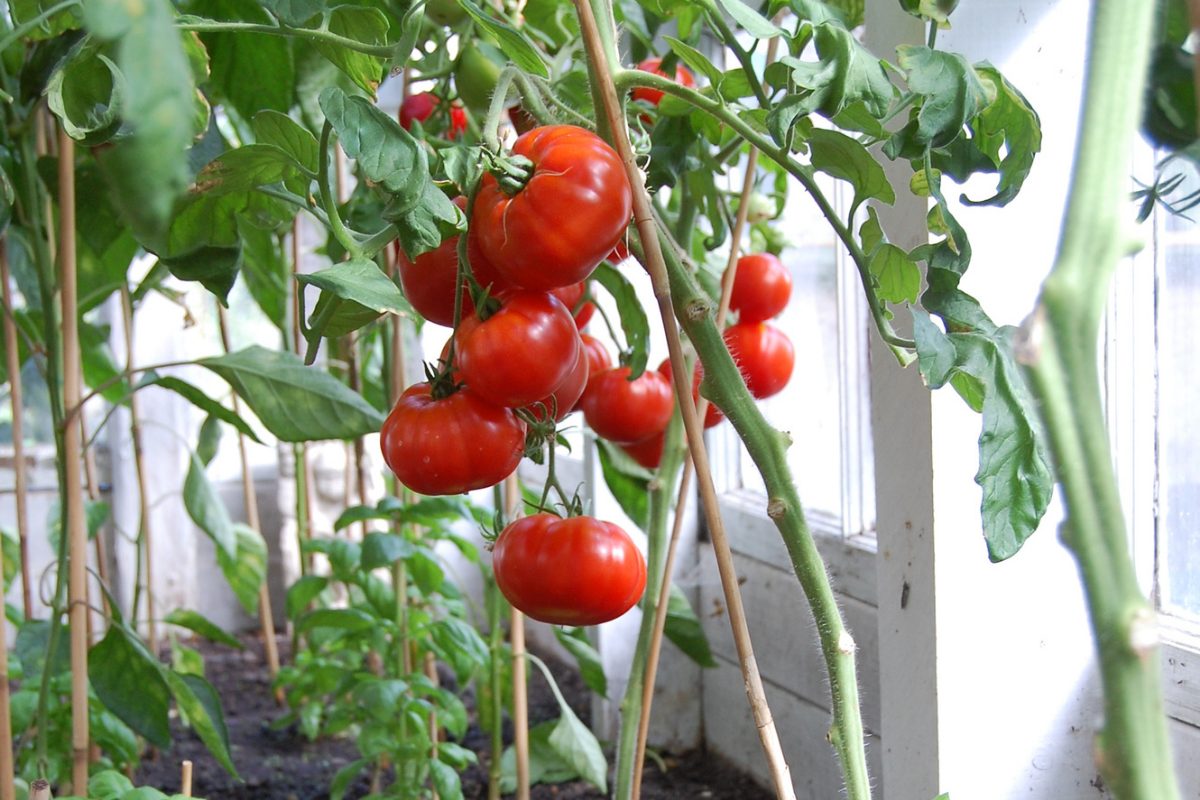
Your tomato crop is stretching, the heads reaching up and the internodes lengthening. Is the plant running vegetatively?
The honest answer is that you cannot know yet, and that answer is the whole point of this article. Stretching on its own looks like a vegetative warning. But a head that stretches and stays thick does not necessarily indicate a weak, vegetative plant. It can be a sign of a strong, balanced one. A head that stretches and goes thin is the real warning sign.
Notice what settled it. Not the length, but the length together with the thickness, in other words compactness. The plant is always telling you what it needs. The difficulty is that it never speaks in single numbers.
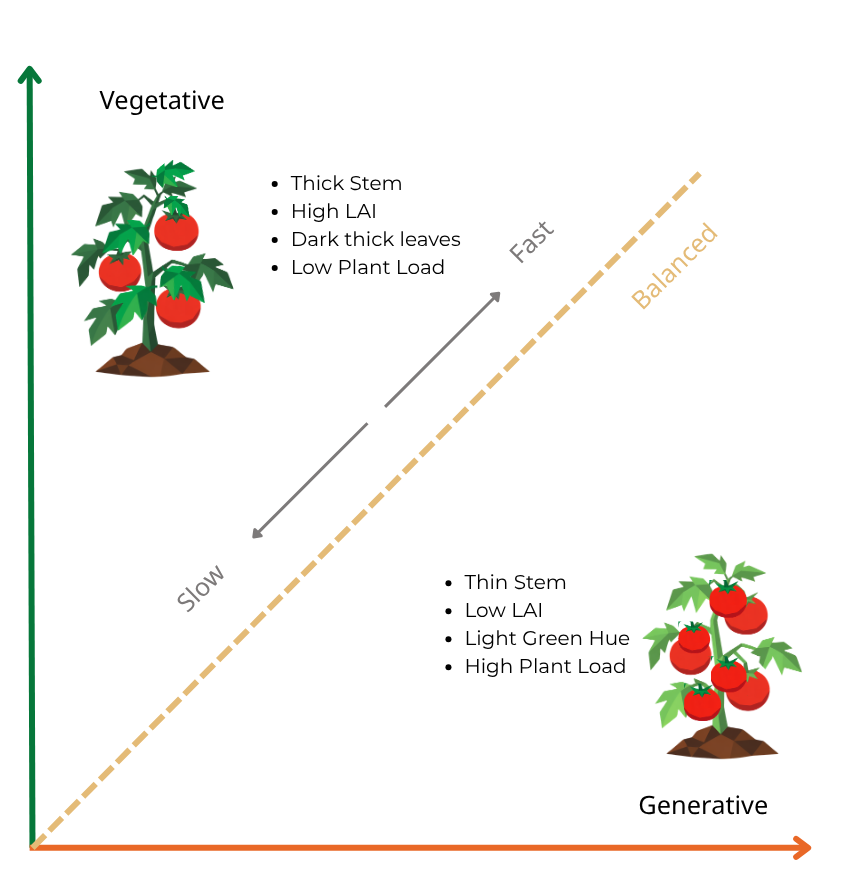
Vegetative and generative crop balance, with the characteristics associated with each direction. LAI is leaf area index, the ratio of leaf surface to ground area.
The plant is always talking.
A vegetative plant is investing in itself, building leaves and stems and growing structure. A generative plant is investing in the next generation, flowering, setting fruit, and filling it with assimilates. Neither is good or bad in itself. The right balance depends on the season, your strategy, the market, and the stage of the crop.
A tomato crop shows you where it sits through what it does: thick or thin heads, short or long internodes, large or small leaves, fast or slow flowering. These are the plant's signals.
They are also a record of the past. What you measure today was shaped by the conditions the plant actually experienced, which are not necessarily the ones your climate computer recorded, and different parts of the plant record different periods. The head is the fast record, since its thickness, internodes and newest leaves were formed over the last days to weeks and carry what the crop has experienced recently. Fruit and plant load are the slow record, because a fruit ripening now was set weeks ago and has been filling under everything that happened since.
Why one signal misleads
Take a harder case, flowering speed. Suppose flowering speed and plant load are both in line with cultivar expectations, but the week has been dark. Less light means fewer assimilates, so the assimilate balance has shifted even though neither measurement has changed.
The question is whether your cultivation strategy should change with it. Can the crop sustain what it has taken on, or should you prune further and let fewer fruit develop? That depends on the growth stage, where you want the crop to be in six weeks, and the plant's vigour. Vigour here is not how fast the crop is growing, but how much strength and reserve it has to draw on when conditions turn against it.
Vigour itself is never one number. It is read from several measurements, and mostly as relationships or ratios rather than raw values:
- Compactness of the head
- Canopy investment and leaf shape
- Flowering speed against leaf appearance
- Plant load and fruit weight
One ratio still is not enough. Combine several, because each reveals a different kind of imbalance. A compactness ratio can reveal a plant losing structural strength, while a response-against-light ratio can catch a crop that is not converting the light it receives as expected. Read together, they reduce the noise and uncertainty that any single signal carries on its own.
Trends beat snapshots
Even a good ratio, read once, is a single dot. The plant's real state is the direction it is moving. So the sharper question is not what this week's value is, but whether this week is where the last few weeks suggested it would be.
Track a ratio across recent weeks, notice the line it has been tracing, then see whether the newest point lands above or below it. The difference matters more than it sounds. A crop whose compactness dipped for one week and then recovered was responding to that week's weather. A crop whose compactness has drifted thinner for three weeks is on a trajectory that may well continue into the next.
A crop accelerating, week after week, is heading towards exhaustion. One decelerating into ever-thicker, slower growth is drifting toward an over-vegetative, stalled state.
What to measure, and how
You need clear, consistent measurements covering structure, development pace, and load. Together, these capture most of what the plant has to tell you. How you take them matters as much as which ones you choose.
Fix the position, not just the plant: measure the stem at a consistent distance below the growing tip, and always the same leaf position counted from the top. Change the position and you have measured something different.
Fix the moment: the same day of the week, the same time of day, and the same person, if you can. Plants change through the day, and your method should not.
Sample more than one plant: a handful of representative plants, always the same ones, tells you about the crop. A single plant tells you only about that plant.
Record the context in the same breath: the week's light sum, average temperature, and plant load. A measurement without its context will mislead you sooner or later.
Building your own baseline
Measure over a period when the crop is running well, and conditions are reasonably stable. What you record in those weeks becomes your baseline, meaning the range your variety produces in your greenhouse under your management.
Once you have it, track compactness and a response-against-light ratio week by week, and watch the trends they trace rather than the values they take.
Your question changes at that point. Instead of asking whether a reading is within target, you ask two things. Is this where my crop normally sits, and which way is it heading? A generic threshold cannot answer either, because it does not know your variety, your light, or your load. The value is not in the number itself, but in what the crop is telling you over time.