
Ask a grower what climate their crop is growing in and they will usually point at the climate computer. This many degrees, this much humidity, this much light. Those numbers are real, but they describe the greenhouse. They are not quite the climate the plant is actually experiencing.
Every greenhouse runs two climates at once. There is the macroclimate, the overall conditions in the space, which your sensors report and your climate computer steers. And there is the microclimate, the conditions in the thin layer of air right at the leaf and around the canopy, where the plant actually lives. The two can be surprisingly far apart, and confusing one for the other is among the most common reasons a perfect-looking climate setting still produces a struggling crop.
In practice, growers steer the greenhouse rather than the conditions the plant meets. And a greenhouse is far from uniform. The microclimate can vary sharply within a few metres, shaped by the structure's orientation, the layout of screens, paths, and pipes. The macroclimate is really a convenient average that smooths over all of these local parameters, safe to steer by, but not necessarily representative of what any individual plant is experiencing.
Two climates, not one
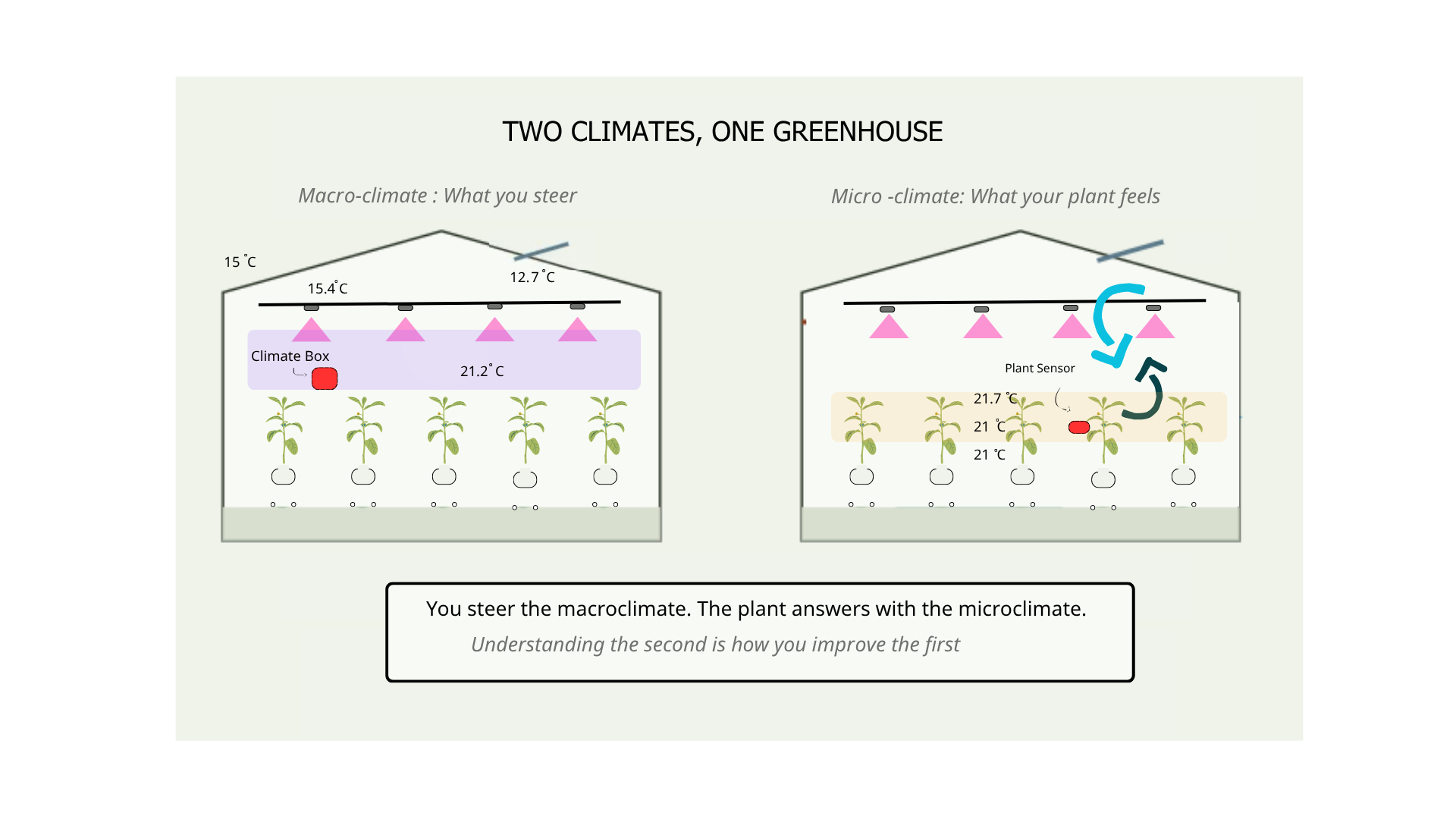
The macroclimate is the greenhouse as a room. It is the average temperature, humidity and light your measurement boxes pick up, usually somewhere above the crop, and it is the set of conditions you monitor and record for climate control.
The microclimate is much more local. At the leaf surface sits a thin, still layer of air, the boundary layer, which can be warmer or cooler, wetter or drier than the greenhouse average. A leaf in full sun can be several degrees warmer than the air around it, while a dense canopy can trap humidity near the lower leaves as the top of the crop sits in drier air. Light is uneven too, with upper leaves flooded while lower leaves sit in shade.
The plant responds to the conditions it actually experiences in its microclimate rather than to your setpoint, which is why two greenhouses with similar computer readings can grow visibly different crops. Reading the plant here means observing conditions at the leaf and learning to relate them to nearby installations. Is that hot, dry patch caused by a screen edge, a heating pipe, or a gap in the airflow? A large part of the skill lies in distinguishing a purely local phenomenon from a genuine, plant-wide trend.
The parameters move together
The second habit to unlearn is thinking about each climate parameter on its own. Light, temperature and humidity are not independent dials. They are links in a single chain, and pulling one moves the others.
Light drives temperature: More incoming radiation adds energy to the greenhouse system and warms surfaces, plants and air. More light means more photosynthesis and warmer greenhouse and leaves. Strictly speaking, a leaf's temperature is set by its whole radiation balance, meaning the shortwave energy it absorbs from sun and artificial lighting plus the longwave radiative heat it exchanges with the surfaces and sky around it.
Temperature sets the air's capacity for moisture: Warmer air can hold more water vapour before it saturates. But dry air does not simply pull water out of the leaf. What drives evaporation is the energy the leaf absorbs, and what regulates it is stomatal conductance.
What the plant feels is the shortfall, not the total: The useful question is not how much moisture sits in the air but how far the air is from saturation, meaning its remaining capacity to absorb water. Greenhouse practice uses two complementary measures for this. Humidity deficit indicates how far the air is from saturation, while absolute humidity describes how much water the air is actually holding. Used together, they capture the greenhouse's humidity balance.
The plant writes its own microclimate
Now the part that climate discussions can easily overlook. The plant is not merely exposed to its microclimate; it actively shapes it through transpiration.
Transpiration is the loss of water from the leaves as vapour, escaping through the stomata and replaced by uptake from the roots. Two things follow. The leaf cools because evaporating water carries heat away, which is the plant's version of sweating. And that vapour goes straight into the air around the canopy, raising the local humidity.
That creates a loop. As the crop transpires, it creates its own microclimate that is more humid. When the moisture is not carried away, the air around the canopy becomes more humid, the vapour-pressure difference between leaf and surrounding air decreases, and transpiration can slow as a result.
In the other direction, when the air is hot and dry, the plant transpires more to cool itself, adding humidity to the surrounding air while risking water stress if uptake cannot keep pace with loss.
This feedback loop is one of the reasons conditions at the leaf diverge from fixed setpoints. It is also why air movement matters so much. Gentle, even vertical air movement refreshes the humid boundary layer at the leaf surface, disperses the moisture the crop releases, and produces a more homogeneous climate. Air movement is not a minor detail. It is what keeps the plant's own transpiration from working against it.
Seeing the gap for yourself
None of this is visible from a single measurement box above the crop. To see the two climates apart you need to measure in more than one place.
A second aspirated box inside the canopy will show how far the leaf-level air has drifted from the greenhouse average.
An infrared leaf-temperature sensor, read against air temperature, tells you directly whether the crop is transpiring freely or struggling.
Those two additions turn the gap between macro and micro from an abstract concept into a measurable number you can act on.
Why this change how you steer
Put the pieces together, and the job looks different. Setpoints are a plan for the room rather than a description of conditions at the leaf, and the crop keeps rewriting those conditions as it transpires. You cannot steer the leaf directly either, because there is no single microclimate to aim at. That is the paradox. The climate you control is not the climate that matters.
The way out is to separate control from interpretation. You steer at the macro level, because that is where heating, screens and vents act. You read at the micro level, because that is where the crop answers. Knowing which zone runs hot or stagnant does not change what you can set, but it changes what you make of what you set, including where to add air movement, how far to trust a given sensor, and when a panel that looks correct is quietly failing part of the house.