Autumn is when the quotes come out. The total light drops week by week; production targets do not; and somewhere on the desk is a proposal for a lighting installation with a payback period attached. The question most growers ask at this point is whether their plants need more light. The better questions are what the light would actually do once it arrived, and why.
Two paces, set by two different things
Development is the pace at which the crop moves forward, setting trusses, filling them, and committing assimilates, the sugars photosynthesis produces, to the next generation. That pace follows the light sum, because the light sum supplies what development spends. A crop with generous income can afford to move forward quickly and fill the flowers it sets.
Growth is the pace at which the plant builds and processes, meaning cell division, elongation, and the enzyme rates that turn assimilates into tissue. That pace follows the average temperature. Warmer plants build faster, and they also spend faster. When light, sum, and average temperature rise and fall in proportion, the plant earns and spends at matching rates and stays in balance.
A useful way to think about the temperature side is in growth units, accumulated degrees over time. A tomato fruit needs roughly a fixed amount of accumulated temperature between setting and harvest. Under warmer conditions, it reaches that total in fewer days, under cooler ones, it takes longer. The same holds for leaf appearance, truss initiation, and the interval between one truss and the next. Temperature does not decide whether these things happen. It decides how long they take.
How light becomes growth, and where it goes
Photosynthesis uses light, carbon dioxide, and water to produce assimilates. The amount produced per day follows the light sum, which is the plant's carbon income.
Before the plant can build new tissue, though, it must first maintain the processes that keep it alive. That is respiration, which runs day and night, breaking down assimilates to provide energy for maintenance. Its rate increases with temperature, so a warmer plant spends more of its assimilates simply maintaining existing processes. What remains after that maintenance cost is the net surplus, and it is the surplus that builds new leaves, stems and fruit. Growth depends on what is left after respiration, not on what photosynthesis produced.
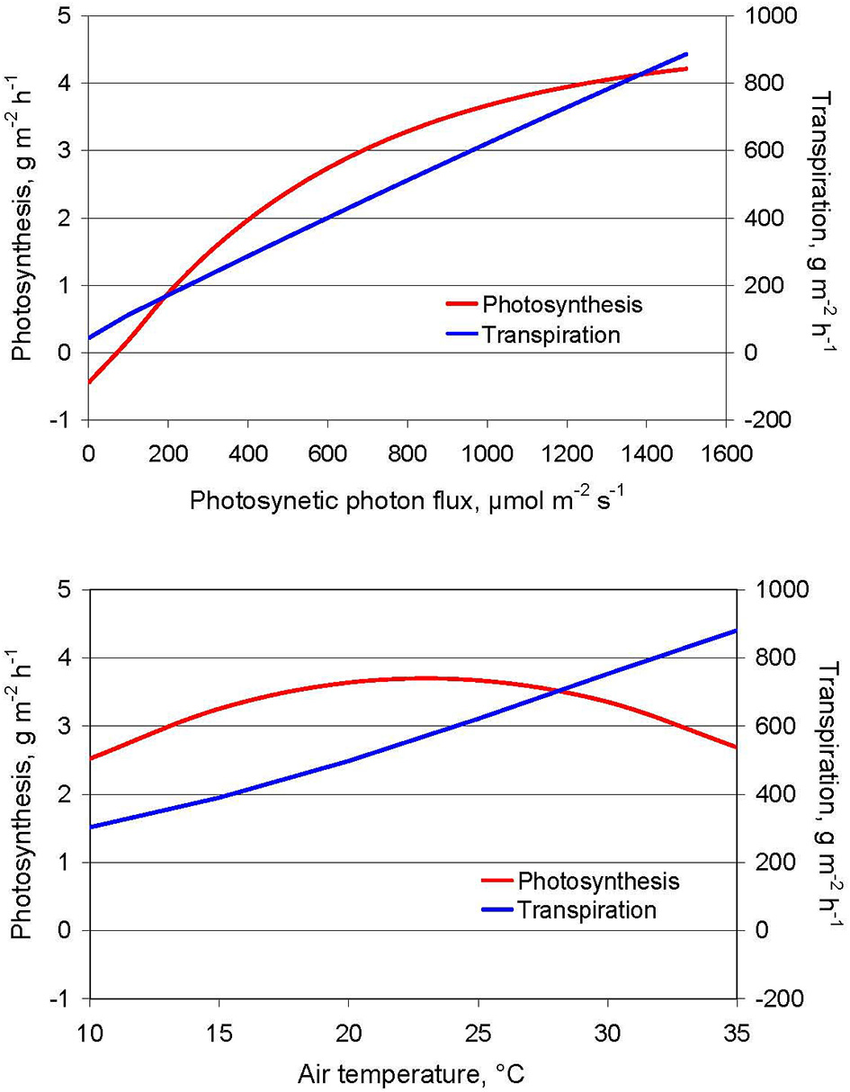
Photosynthesis and transpiration respond differently to light and to temperature. Photosynthesis saturates as light increases and peaks at a moderate temperature before declining, while transpiration continues to rise with both—schematic, shapes after Kläring et al.
Where the surplus goes is decided by demand. The leaves are the supply side. The fruit, growing point, new leaves, and roots are the demand side; each assimilates according to its growth rate, with fruit among the strongest sinks. That puts the crop in one of two states. When supply outruns demand, as in a young crop shortly after transplanting, with leaf area expanding quickly and few fruits set, the surplus has nowhere to go and is stored in stems and leaves as sugar and starch. When demand outruns supply, as in an older, fully loaded crop under falling autumn light, each fruit receives less than it needs, and fruit size declines.
Steering the crop into autumn
The light sum drops fast from late summer onwards. Temperature does not fall at the same rate. September days are still warm, which creates a greenhouse effect where the average temperature is now high relative to the light the crop is receiving.
Growth is therefore outrunning development. The plant keeps building and spending at something close to its summer pace while supply from photosynthesis declines. It stretches, stays vegetative, and cannot properly fill the fruit it sets when the supply is higher. The symptoms appear several weeks later as smaller fruit, slower ripening, thinner heads and a crop that looks tired. This is why many growers top the crop at this point, removing the growing point, after which the plant stops directing assimilates towards future fruit. It concentrates them on finishing what it already carries.
The crop is genuinely tired at this point in the season. It has come through months of high light, high load and hard work, it may be carrying some disease, and its reserves are lower than the summer harvest suggested. That is exactly why reading the crop matters most now. Steering a tired crop into continuously falling light is not a matter of adjusting one setting. It is a matter of asking the crop for what it can still afford rather than what the calendar used to allow.
Two tools matter most here: understanding the balances and reading the crop, and the ratio of temperature to radiation is where they meet. RTR is not a target temperature but a relationship, namely, how much average temperature the crop is running per unit of light it receives that day. Watching that relationship tells you whether the two paces are still moving together, and any decision from here should rest on it.
Once the relationship is understood, the question becomes how to act on it. Setpoints steer the macroclimate, but the macroclimate and the microclimate answer each other, and what the plant experiences may differ from what the climate box shows. The installation chosen decides part of that difference.
- High-pressure sodium: adds radiant heat as well as light, raising crop temperature and supporting transpiration.
- LED: adds light with much less radiant heat, so the crop can run with colder heads, potentially slowing growth at exactly the point when the plant is most vulnerable.
What the light would actually do
So, back to the proposal on the desk. What supplemental light would do is increase available assimilation on days when the sun can no longer. Whether that additional assimilation bears fruit depends on the cropis state. An old, fully fruiting crop under falling light may genuinely be in deficit, and there the light has somewhere to go.
The question was never simply whether the plants need more light. It is what that light would do once it arrived, and the crop, read through its trends rather than its snapshots, is already answering. What kind of light, delivered how, and what it costs to convert are the subjects of the next articles in this series.
Sources
Geelen, P. A. M., Voogt, J. O., and van Weel, P. A. (2018). Plant Empowerment, the Basic Principles. LetsGrow.com.
Kläring, H.-P., Hauschild, C., Heissner, A., and Bar-Yosef, B. (2007). Model-based control of CO₂ concentration in greenhouses at ambient levels increases cucumber yield. Agricultural and Forest Meteorology, 143, 208-216.
Li, T., Heuvelink, E., and Marcelis, L. F. M. (2015). Quantifying the source-sink balance and carbohydrate content in three tomato cultivars. Frontiers in Plant Science, 6, 416.
O'Carrigan, A., Hinde, E., Lu, N., Xu, X.-Q., Duan, H., Huang, G., Mak, M., Bellotti, B., and Chen, Z.-H. (2014). Effects of light irradiance on stomatal regulation and growth of tomato. Environmental and Experimental Botany, 98, 65-73.