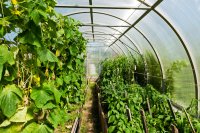
Two nearly identical greenhouses, the same tomato variety, the same crop age, the same climate computer. Then a sudden cold snap arrives in early autumn, grey skies and temperatures dropping hard overnight, a week before the calendar suggests it should.
In the first greenhouse, the grower follows the usual seasonal programme. Screens go a little tighter, heating comes down to the usual autumn setting, and the light strategy stays on last week's schedule.
In the second, the grower looks instead at how the crop's balance has shifted. Less radiation means less assimilation. The drop in temperature slows the pace of growth and affects the roots because cold roots struggle to take up water quickly enough. The plant responds by partially closing its stomata to protect itself, further throttling its own photosynthesis. This grower does not panic, but recognises that this week will shape next week's crop, and adjusts the cultivation and climate strategy accordingly.
The difference between the two is a matter of what each grower thought had gone out of balance. It was not the temperature of the room. It was the plant's own energy balance, income set against demand. That is the idea at the centre of plant empowerment.
This approach has a specific origin. It was developed in Dutch horticulture by Peter Geelen, Jan Voogt, and Peter van Weel, who set it out in their 2018 book Plant Empowerment, the basic principles and who were also the originators of Het Nieuwe Telen, the cultivation method known in English as Next Generation Growing. It is also referred to as Growing by Plant Empowerment, or GPE.
Beyond green fingers and fixed blueprints
Traditional horticulture leans on two things. One is intuition, the green fingers a good grower develops over the years. The other is the fixed blueprint, a set of climate settings that worked well once and gets repeated season after season.
Growing under glass has always been a balancing act between cost and crop performance, and it does not let up. A grower juggles climate, water, nutrients, and disease pressure simultaneously, while pushing for higher yield and better quality on a tight budget with scarce labour. When money is short, the instinct is to run the climate strategy conservatively, with less heating, less lighting, and tighter screens, adjusted by the season rather than by what the crop is actually doing. Most of the time, that instinct holds up.
The problem is the days when it does not. A cold snap that lands harder than expected, or a run of dark days nobody planned for, are exactly the conditions in which a fixed routine turns a small saving into a real loss of yield or quality. The tighter the margins, the less room there is to guess. What a grower needs to know is which process is out of balance on this particular day, which means reading the plant rather than the protocol.
A plant follows physical rules
The foundation of the approach is that a plant is two things at once: a living physiological organism and a physical object subject to physical law. Two laws do most of the work.
- Conservation of energy: Energy is never lost, only transferred or transformed.
- Conservation of mass: Matter likewise has to go somewhere and is never created or destroyed.
These sound abstract, but the consequence is practical. Everything happening to a crop can be tracked as flows of energy and matter that have to add up. Heat arriving at a leaf has to leave again, or the leaf warms up. Water leaving the plant has to be replaced, or the plant runs a deficit. Sugars produced during the day must be spent or they accumulate. Seen this way, growing becomes a question of keeping a set of balances in check rather than a matter of judgment alone.
The six balances
Plant empowerment identifies six balances worth monitoring. Three belong to the plant, and three to the greenhouse around it.
The three plant balances
Energy balance. All the energy that reaches a leaf has to remain in balance. These include the sunlight and grow-light it absorbs, the invisible heat it exchanges with surrounding surfaces, the heat carried away as air moves across it, and the cooling effect of transpiration, which is the plant's version of sweating. When these flows no longer balance, leaf temperature simply rises or falls until a new balance is reached.
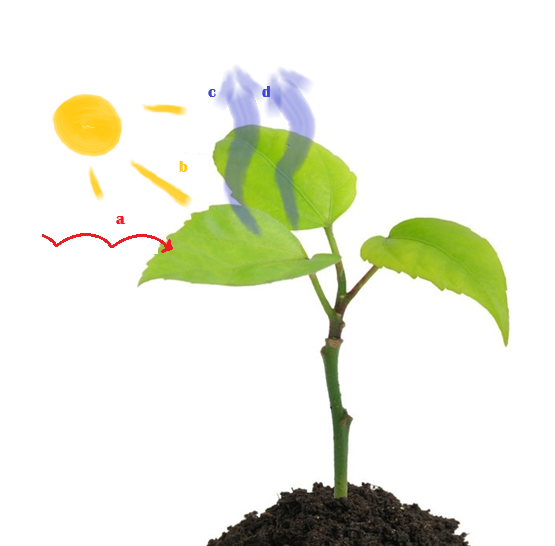
The leaf energy balance. a, convection energy towards the plant. b, solar radiation. c, evaporation as a result of radiation energy. d, evaporation caused by convective energy.
Water balance: Water lost through transpiration must be replaced by water taken up by the roots. This balance is more fragile than it appears, since even a brief period of water stress can hold back photosynthesis for hours after the plant looks to have recovered.
Assimilate balance: Photosynthesis produces sugars during the day, which are the plant's income. Those sugars are then spent on growth and on staying alive through respiration. Light largely determines how much sugar the plant produces, while temperature influences how quickly it spends it. Keeping earnings and spending aligned is what keeps a crop both productive and sustainable throughout the season.
The three greenhouse balances
Energy balance: What heats the greenhouse, meaning sun and heating pipes, set against what cools it, meaning ventilation and heat lost through the cover.
Moisture balance: Removing excess humidity, through ventilation or condensation, so the climate stays outside the range in which fungal diseases thrive.
CO₂ balance: Keeping enough carbon dioxide available for the crop to make full use of the light it receives, rather than wasting bright hours on a shortage the grower never sees.
The value of the framework is that these balances are connected. Push one and the others move, which is precisely why a single fixed setting cannot stay correct for long.
Focus on the balance
Return to the two greenhouses. The grower who kept the crop on track through the cold snap was not following a better blueprint and was not simply watching the plant more closely in a general way. They were watching something specific: whether what the crop was taking in still matched what it was spending.
That is where plant empowerment starts, and it starts small. Mastering all six balances at once can wait. The habit of building first is simpler. For whichever balance is under strain, ask what is coming in against what is going out, then measure it rather than guess.
Sources
Geelen, P. A. M., Voogt, J. O., and van Weel, P. A. (2018). Plant Empowerment, the basic principles.
Geelen, P. A. M., Voogt, J. O., and van Weel, P. A. (2023). Plant Empowerment, digital cultivation.
Plant Empowerment Academy, on the origins of the method and its relationship to Het Nieuwe Telen.