Introduction: The Welfare Challenge in Sheep Transport
Sheep transport is an integral part of livestock production but poses significant welfare challenges due to multiple stressors, including handling, confinement, thermal extremes, and prolonged deprivation of feed and water. These stressors can lead to physiological and behavioral disruptions, increasing mortality rates and reducing meat quality. The welfare implications of transport have been widely studied, yet gaps remain in understanding fatigue, breed-specific responses, and optimal transport conditions (Colitti et al., 2024).
Research indicates that sheep subjected to long-distance transport exhibit elevated cortisol levels, muscle damage, and dehydration (Silva et al., 2023). However, findings vary depending on factors such as space allowance, transport duration, and environmental conditions. While some studies suggest that sheep can adapt to short-term transport stress, prolonged journeys exacerbate welfare risks (EFSA Panel on Animal Health and Welfare, 2022). Additionally, thermal stress is a major concern, particularly for unshorn sheep, which struggle to regulate body temperature in hot conditions (Beatty et al., 2006). This article reviews key stressors affecting sheep during transport, their physiological and behavioral impacts, and evidence-based strategies to improve welfare.
Key Stressors in Sheep Transport
1. Space Allowance and Stocking Density
Space allowance is a critical determinant of sheep welfare during transport. Silva et al. (2023) found that lambs transported with 0.28 m² per animal exhibited lower cortisol and creatine kinase (CK) levels post-transport compared to those confined to 0.18 m². This aligns with Cockram et al. (2004), who reported that insufficient space restricts lying behavior, increasing stress and injury risks. However, the space allowances commonly used in Europe do not always significantly affect dehydration, suggesting that driving style and road conditions also play a role.
2. Thermal Stress and Ventilation
Sheep are highly susceptible to heat stress, particularly when unshorn (Figure 1). Beatty et al. (2006) demonstrated that shorn sheep maintain body temperature more effectively than unshorn sheep, which rely on increased respiration for cooling. Poor ventilation in multi-deck trailers exacerbates heat stress, with Fisher et al. (2009) reporting higher thermal stress in densely stocked vehicles.
3. Feed and Water Deprivation
Prolonged fasting during transport leads to metabolic changes, including increased plasma free fatty acids and β-hydroxybutyrate (Knowles et al., 2014). Cockram et al. (1996) observed that sheep prioritize eating over resting after long journeys, indicating significant hunger. Water deprivation for more than 48 hours causes dehydration, evidenced by elevated plasma osmolality.
4. Handling and Loading Practices
Rough handling increases cortisol levels more than gentle loading techniques (Yardimci et al., 2013). Steep ramp angles prolong loading times, further elevating stress (Cockram & Mitchell, 1999). Training handlers in low-stress animal movement can mitigate these effects (Grandin, 2021).
Impacts of Transport Stress on Sheep Welfare and Productivity
1. Physiological Stress Responses
Transport stress triggers elevated cortisol, CK, and lactate levels, indicating physical strain and muscle damage (Knowles et al., 1999). Young lambs are particularly vulnerable due to underdeveloped stress responses (Knowles et al., 2014).
2. Meat Quality Deterioration
Stress-induced glycogen depletion leads to higher meat pH and reduced tenderness (Kadim et al., 2009). Silva et al. (2023) found that lambs transported with adequate space had lower shear force values, indicating better meat quality.
3. Increased Mortality and Injury Risks
High stocking densities and prolonged transport increase bruising and mortality (Gallo et al., 2018).
Recommendations for Improving Sheep Welfare
- Optimize Space Allowance: Provide at least 0.28 m² per lamb to reduce stress and injuries (Silva et al., 2023).
- Enhance Ventilation: Use mechanical ventilation in multi-deck trailers to prevent heat stress (Zhang et al., 2020).
- Limit Transport Duration: Keep journeys under 24 hours for cattle and 9 hours for sheep (EFSA Panel on Animal Health and Welfare, 2022).
- Improve Handling Practices: Train handlers in low-stress techniques and use ramps with ≤30° angles.
- Provide Mid-Journey Breaks – Allow rest stops with water access to prevent dehydration (Cockram et al., 1996).
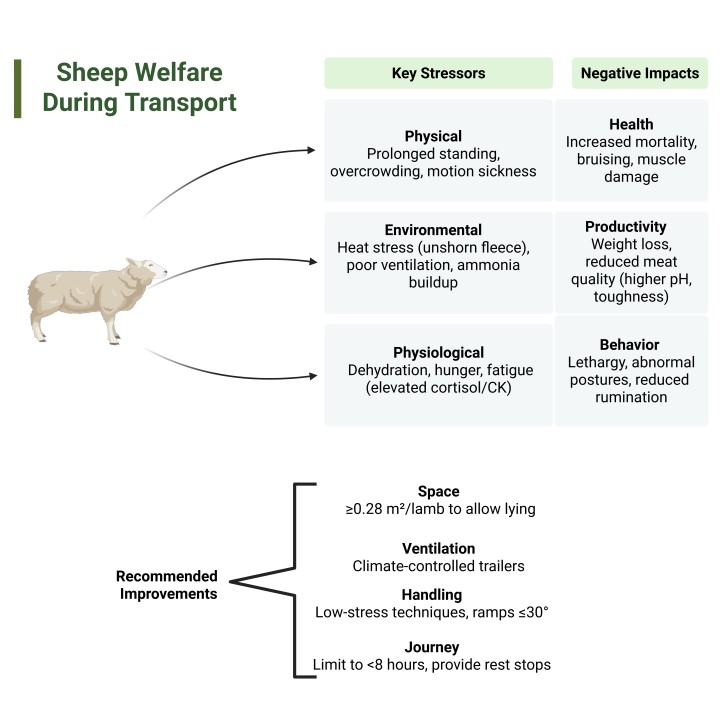
Figure 1. Sheep welfare during transport: stress factors, impacts, and mitigation strategies
Conclusion
Sheep welfare during transport can be significantly improved by optimizing space, reducing journey durations, and implementing better handling practices. Future research should explore breed-specific adaptations and automated welfare monitoring systems to refine transport regulations further.
References
- Beatty, D. T., Barnes, A., Fleming, P. A., Taylor, E., & Maloney, S. K. (2008). The effect of fleece on core and rumen temperature in sheep. Journal of Thermal Biology, 33(8), 437-443.
- Cockram, M. S., Kent, J. E., Goddard, P. J., Waran, N. K., McGilp, I. M., Jackson, R. E., ... & Prytherch, S. (1996). Effect of space allowance during transport on the behavioural and physiological responses of lambs during and after transport. Animal Science, 62(3), 461-477.
- Cockram, M. S., & Mitchell, M. A. (1999). Role of research in the formulation of ‘rules’ to protect the welfare of farm animals during road transportation. BSAP Occasional Publication, 23, 43-64.
- Cockram, M. S., Baxter, E. M., Smith, L. A., Bell, S., Howard, C. M., Prescott, R. J., & Mitchell, M. A. (2004). Effect of driver behaviour, driving events and road type on the stability and resting behaviour of sheep in transit. Animal Science, 79(1), 165-176.
- Colitti, K., Mitchell, M., & Langford, F. (2024). Sheep fatigue during transport: Lost in translation? Animal Welfare, 33, e13.
- EFSA Panel on Animal Health and Welfare. (2022). Welfare of cattle during transport. EFSA Journal, 20(9), e07442.
- Fisher, A. D., Colditz, I. G., Lee, C., & Ferguson, D. M. (2009). The influence of land transport on animal welfare in extensive farming systems. Journal of Veterinary Behavior, 4(4), 157-162.
- Gallo, C., Tarumán, J., & Larrondo, C. (2018). Main Factors Affecting Animal Welfare and Meat Quality in Lambs for Slaughter in Chile. Animals, 8(10), 165.
- Grandin, T. (2021). How to improve livestock handling and reduce stress. Improving animal welfare: A practical approach, 84-112.
- Kadim, I. T., et al. (2009). Effects of transportation during the hot season and low voltage electrical stimulation on histochemical and meat quality characteristics of sheep longissimus muscle. Livestock Science, 126(1–3), 154–161.
- Knowles, T. G., Warriss, P. D., & Vogel, K. (2014). Stress physiology of animals during transport. In Livestock handling and transport (pp. 399-420). Wallingford UK: CABI.
- Knowles, T. G., Warriss, P. D., Brown, S. N., & Edwards, J. E. (1999). Effects on cattle of transport by road for up to 31 hours. Veterinary Record, *145*(20), 575-582.
- Silva, F. V. e., et al. (2023). Effect of space allowance during transport of Dorper x Santa Inês lambs on biochemical stress parameters and meat quality. Small Ruminant Research, 219, 106910.
- Yardimci, M., Sahin, E. H., Cetingul, I. S., Bayram, I., Aslan, R., & Sengor, E. (2013). Stress responses to comparative handling procedures in sheep. Animal, 7(1), 143-150.
- Zhang, M., Dunshea, F. R., Warner, R. D., DiGiacomo, K., Osei-Amponsah, R., & Chauhan, S. S. (2020). Impacts of heat stress on meat quality and strategies for amelioration: a review. International journal of biometeorology, 64, 1613-1628.