


Understanding post-harvest losses in global farming
Did you know that a significant portion of farmers’ harvests never makes it to consumers’ tables? Post-harvest losses (PHL) occur along the value chain, from harvest and handling to storage, transport, processing, and retail, and can be categorised into two distinct types: quantitative and qualitative, as shown in Figure 1.
Quantitative loss refers to the actual decrease in the total volume or weight of food, usually expressed as a percentage of the overall yield. This type of loss is the most direct and often occurs due to physical factors, such as spoilage, spillage, damage from pests, or waste during handling, storage, and transportation. For instance, this could involve losing a basket of oranges due to mechanical damage during transportation, or apples decaying in storage due to unfavourable environmental conditions (Aulakh et al., 2013).
Qualitative loss occurs when the natural quality of fruits declines, affecting their appearance, colour, texture, and even nutritional value. This can make them less appealing in the market. Several factors can contribute to this, including pest infestations, bacterial growth, or physical damage. It is essential to address these issues to keep our fruits looking and tasting their best. Examples include colour changes, such as black spots appearing on bananas or uneven ripening of mangoes; vitamin C breakdown in citrus fruits during prolonged storage; and fermented flavours in overripe pineapples or mangoes (Kitinoja & Kader, 2015).
Learn more about minimizing post-harvest losses for specific crops and best practices for post-harvest safety.
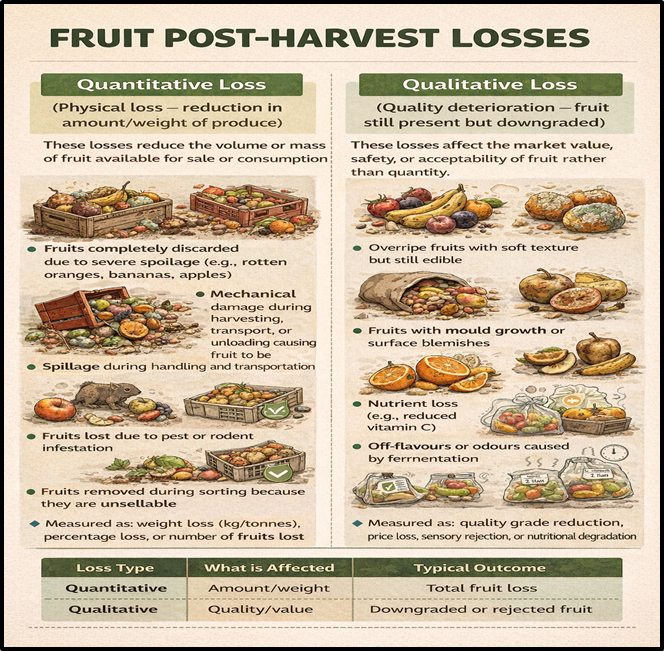
Figure 1: Difference between quantitative and qualitative post-harvest losses
The economic impact of post-harvest losses
The financial consequences of PHL are enormous and often underestimated. Global estimates suggest that losses in fruits and vegetables alone surpass $310 billion annually. The FAO (2019) further highlights that approximately 13.2% of food is lost between harvest and retail, with another 19% wasted during retail, food service, and at home worldwide.
For smallholder farmers, who form the backbone of global food production, the impact is devastating. These farmers often lose 15–25% of their yearly income due to post-harvest losses alone. The consequences extend far beyond individual farmer incomes:
- Food security threats: PHL significantly reduces global food availability at a time when the world population is growing
- Rural poverty: Financial setbacks accelerate migration from agriculture to urban centers
- Environmental degradation: Wasted food means wasted water, energy, and farming inputs
- Climate impact: Decomposition of lost food in landfills produces greenhouse gas emissions that contribute to climate change
These interconnected challenges underscore the urgent need for effective post-harvest management strategies in the fruit supply chain—with one of the most promising approaches being product diversification.
What fruit product diversification really means
Transforming surplus and off-grade fruit into value-added products
Product diversification is a vital strategy for reducing waste and enhancing market value in the food sector. It involves converting fresh crops, particularly surplus, off-grade, or highly perishable fruits, into value-added products that extend shelf life and consumer appeal.
In the fruit industry, primary processing techniques such as cleaning, sorting, cutting, drying, packaging, freezing, and preserving create convenient products for everyday use.
Advanced methods, including fermentation, juicing, pureeing, and fortification, enable the development of innovative items such as jams, juices, smoothies, dried fruit snacks, and functional foods. These practices not only minimise waste but also ensure year-round availability of different fruits. (Singh et al., 2024).
How diversification transforms farmer income
Farmers have a fantastic opportunity to transform their fruit crops into a wide range of value-added products, which can significantly enhance their earnings. Research shows that processing fresh fruits into these products can potentially raise sales by three to five times more than selling them as raw produce.
Consider this compelling example. Making wine from grapes can yield up to six times the profit compared to just selling fresh grapes. This is great news because wine is a longer-lasting product that's easier to store and ship, and there's always a strong demand for it in local markets! international markets. While fresh grapes spoil quickly and have limited selling time, wine can be sold throughout the year at a higher price (Garg et al., 2023). The development of value-added products thus facilitates the introduction of novel fruit varieties with improved nutritional profiles and refined sensory attributes (Figure 2).
Discover how to add value to agricultural products and strengthen your market position.

Figure 2: Diversified products from different fruit parts
Utilizing every part of the fruit as a circular economy approach
All fruit parts contain vitamins, antioxidants, minerals, and phytochemicals that provide health benefits, including antioxidant activity and fibre enrichment. Valorising these components supports sustainability by reducing waste and conserving resources.
The whole fruits are rich in vitamins, minerals, and bioactive compounds that contribute to health benefits. They are commonly processed into jams, jellies, preserves, candies, and bakery products, offering extended shelf life and improved marketability.
Fruit peels, often discarded as waste, are abundant in antioxidants, vitamins, and minerals. They can be transformed into marmalade, candied peels, chips, and juice powders, reducing waste and enhancing resource efficiency (Sodhi et al., 2022).
Juice extracted from fruits serves as a base for ready-to-drink beverages, syrups, and concentrates.
Pulp and seeds are used in the manufacture of jams, jellies, candies, functional ingredients, and cosmetic products. Seeds can also be processed into oils or flours, adding functional properties to food products.
How to extract value from food industry by-products and transform waste into innovation.
Benefits of fruit product diversification
Figure 3 highlights the various benefits of fruit product diversification.
- Post-Harvest and Environmental Benefits: Product diversification aids the reduction of fruit post-harvest losses, utilises surplus and imperfect fruits that would primarily be deposited in landfills, supports waste valorisation, and promotes the circular economy system.
- Shelf-Life extension and Availability: The differentiation of fruit products through the application of various processing techniques, such as drying, fermentation, freezing, and canning, helps to extend the shelf life of fruit crops and improve year-round availability.
- Economic and Livelihood Benefits: Fruit value addition increases the income of all stakeholders in the fruit value chain, especially farmers and processors. It also creates new markets and value-added products that would not be ordinarily available from fresh produce. Furthermore, it generates employment opportunities along the value chain.
- Nutrition and Food Security: Fruit product diversification improves access to fruit-based products in multiple forms, for example, mango could be processed into juice, dried mango, concentrates, powder, and jam. This enhances dietary diversity, enables nutrient retention, and offers the possibility of fortification with products.
- System Resilience and Innovation: Diversification reduces dependence on fresh fruit markets, thus building resilience to price volatility and climate shocks. Additionally, it promotes product and process innovation, providing organisations with greater competitive advantages.
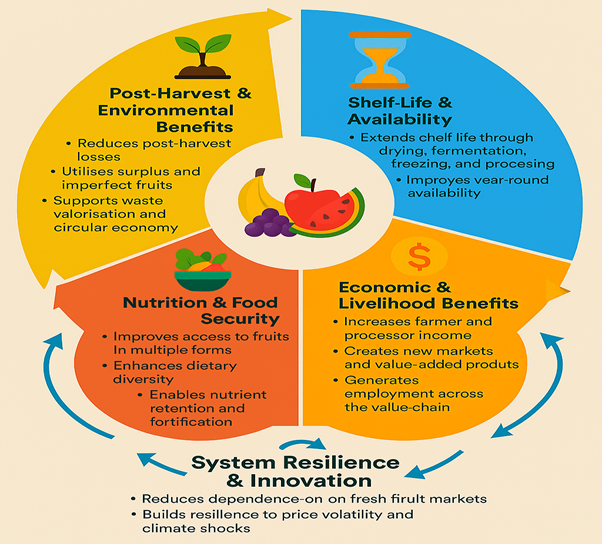
Figure 3: The benefits of Fruit Product Diversification
The real cost of staying dependent on fresh markets
For farmers: Price volatility, waste, and income instability
Price volatility is severe: Fresh fruit prices can fluctuate by over 70% due to seasonality and oversupply. This unpredictability makes farm planning, debt management, and family budgeting nearly impossible. (Yeasin et al., 2023)
Cosmetic standards create losses: Strict appearance requirements mean that fruits with minor blemishes or size differences are rejected outright, resulting in losses exceeding 35% of production. These cosmetically imperfect fruits are nutritionally identical but economically worthless in fresh markets.
Environmental waste multiplies: Rejected produce represents wasted water, fertilizer, energy, and labor—all expended with zero return. This environmental cost is invisible but real, contributing to agricultural unsustainability.
Income unpredictability: Without diversification, farmers face feast-or-famine income cycles that perpetuate poverty and prevent agricultural investment.
For consumers: Limited availability, higher costs, and food insecurity
Consumers experience the consequences of non-diversification through seasonal scarcity and elevated prices. Seasonal gluts cause price crashes that benefit no one (markets become flooded, prices collapse, farmers suffer losses), while off-season shortages create scarcity premiums. Limited product formats reduce dietary diversity, and strict cosmetic standards inflate supply chain costs that retailers pass directly to shoppers. (Porter et al., 2018).
Environmental and climate implications
Wasted fruit contributes significantly to climate change. When discarded fruit decomposes in landfills, it produces methane—a greenhouse gas approximately 28 times more potent than CO₂ over a 100-year period. This environmental burden poses long-term threats to food security and ecological stability.
Explore strategies to reduce these costs: How pre-cooling improves post-harvest management and profitability and post-harvest storage solutions that reduce food loss.
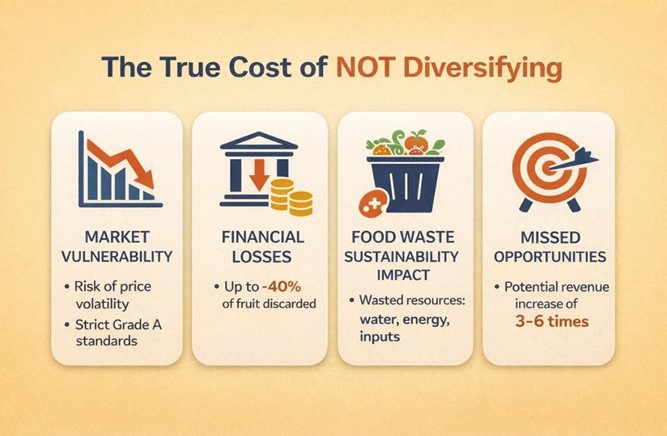
Figure 4: The Cost of not diversifying
A practical 7-step path to reduce losses and diversify
Step 1: Identify fruits with high loss risk
It’s a good idea to keep an eye on fruits that spoil quickly, or that tend to have price drops during their peak season. While these can lead to some losses, they also offer fantastic chances to make improvements. By enhancing how you handle or process these fruits, you can reduce losses and increase your profits.
Step 2: Understand the type of loss
Before deciding on a product, determine whether your losses are primarily physical (such as spoilage and waste) or based on quality (such as appearance, texture, or flavour). This knowledge will help you determine whether to process fruits immediately, explore alternative markets, or create products where appearance is less important.
Step 3: Start with simple market-ready products
You don’t need to dive into complicated or costly processing right away. Begin by creating low-risk, affordable products that are in high demand locally and align with your skill set. Items such as dried fruits, juices, purees, jams, and syrups are often easy to produce with basic tools, which helps extend shelf life and improve market appeal.
Step 4: Use existing resources and skills
Successful diversification relies on maximizing what you already have. Utilise your available labour, local expertise, water, energy, and basic processing equipment. Cooperatives can really benefit by sharing resources, equipment, and tasks among members to lower costs and risks. Don’t forget to identify any training needs early on to ensure the consistent quality of your products.
Step 5: Put food safety and quality first
Keeping food safe is crucial for gaining consumer trust and accessing better markets. Even small-scale operations can make a significant difference by practising good hygiene, such as using clean water, maintaining a tidy processing area, handling products properly, and using suitable packaging. Focusing on quality and consistency can help your products stand out and reduce spoilage.
Step 6: Test the market before scaling
Before making a big investment, try out your products in small batches to gather feedback on taste, packaging, pricing, and shelf life. Local markets and community outlets are great places to start testing your products. This approach helps minimise risk and ensures your offerings meet customer preferences.
Step 7: Track costs and grow gradually
Diversifying your products is a learning journey. Keep track of production costs, sales, and losses to better understand your profitability and identify areas for improvement. As your experience grows and demand becomes clearer, you can expand gradually by increasing production volume, enhancing packaging, or introducing new products—all without putting too much strain on your resources.
By following these steps, you can effectively reduce fruit loss and successfully diversify your farming endeavours!
Building a resilient fruit value chain
Product diversification is an innovative solution that addresses multiple critical challenges simultaneously: it reduces waste and environmental impact, ensures year-round access to nutritious products, offers consumers affordable and longer-lasting options, and dramatically enhances farmer profitability and food security.
The path forward is clear: begin where you are, with the resources you have, creating products your local market wants. Test, learn, optimize, and gradually expand. The hidden opportunity in fruit diversification is no longer secret; it's waiting for farmers ready to transform waste into wealth and surplus into security.
References
Aulakh, J., Regmi, A., Fulton, J. R. & Alexander, C. E. (2013). Estimating post-harvest food losses: Developing a consistent global estimation framework.
Cardoso, I. (2025). Post-Harvest Losses and Their Management in Horticultural Crops: Strategies for Sustainable Food Security.
Food and Agriculture Organization of the United Nations. (2019). The state of food and agriculture 2019: Moving forward on food loss and waste reduction. FAO. FAO. The State of Food and Agriculture 2019
Garg, S., Jha, G., Kim, S. H., Miller, Z., & Kuo, W. Y. (2023). The need and development for a value-added toolkit—A case study with Montana speciality fruit growers. Frontiers in Sustainable Food Systems, 7, 1084750.
Kitinoja, L. & Kader, A. A. (2015). Measuring postharvest losses of fresh fruits and vegetables in developing countries. PEF white paper, 15, 26.
Ogedengbe, T. C., Malomo, O. J. and Akanji, N. E. (2022). Post-harvest losses and reduction techniques in crop production: a review.
Porter, S. D., Reay, D. S., Bomberg, E., & Higgins, P. (2018). Avoidable food losses and associated production-phase greenhouse gas emissions arising from the application of cosmetic standards to fresh fruit and vegetables in Europe and the UK. Journal of Cleaner Production, 201, 869–878.
Singh, S., Salaria, M., Talekar, N. & Suresh, A. (2024). A review on value-added goodies from different major and minor fruits from the perspective of India. Journal of Applied & Natural Science, 16(2).
Sodhi, A. S., Sharma, N., Bhatia, S., Verma, A., Soni, S., & Batra, N. (2022). Insights on sustainable approaches for production and applications of value-added products. Chemosphere, 286, 131623.
Yeasin, M., Sharma, P., Paul, R. K., Meena, D. C., & Anwer, M. E. (2023). Understanding price volatility and seasonality in agricultural commodities in India. Indian Agricultural Statistics Research Journal.