

After the two earlier attacks on the Crimean bridge, in October 2022 and July 2023, the price of milling wheat in the EU rose by 1.4% and 1.9% in the first week, a little more than in the same weeks of other years, but after the 2022 attack the rise did not last, according to a Wikifarmer analysis of the weekly prices that member states report to the European Commission. This week the bridge, which links Crimea to Russia across the Kerch Strait, was hit again, as an arch and a section of the road deck fell into the sea after Ukrainian attacks on the nights of 16 and 17 November 2026, according to the Ukrainian news outlet RBC-Ukraine, which writes that the collapse blocks shipping in the strait.
In October 2022 the price rose 1.4% in the first week and was 4.2% lower by the eighth
The attack of 8 October 2022 came on a Saturday. From the week of the attack to the following week the median price across the 42 price series with enough history rose by 1.4% in one week, while in the same weeks of 2016 to 2025, excluding 2022 and 2023, the usual rise was 0.7%, according to the weekly cereal prices of the European Commission. Each series is the price of one market at one marketing stage in one member state, and in the eight weeks before the attack the median price had stayed almost flat, with a change of less than 1%.
Over four weeks the rise was 1.7% against a usual 3.3%, and in only 14 of the 37 series did the price beat its usual change. Eight weeks after the attack the price was below the attack week in 41 of the 44 series, with a median fall of 4.2%, while in the same weeks of other years the price usually rose by 4.5%, so in all 44 series the price did worse than usual.
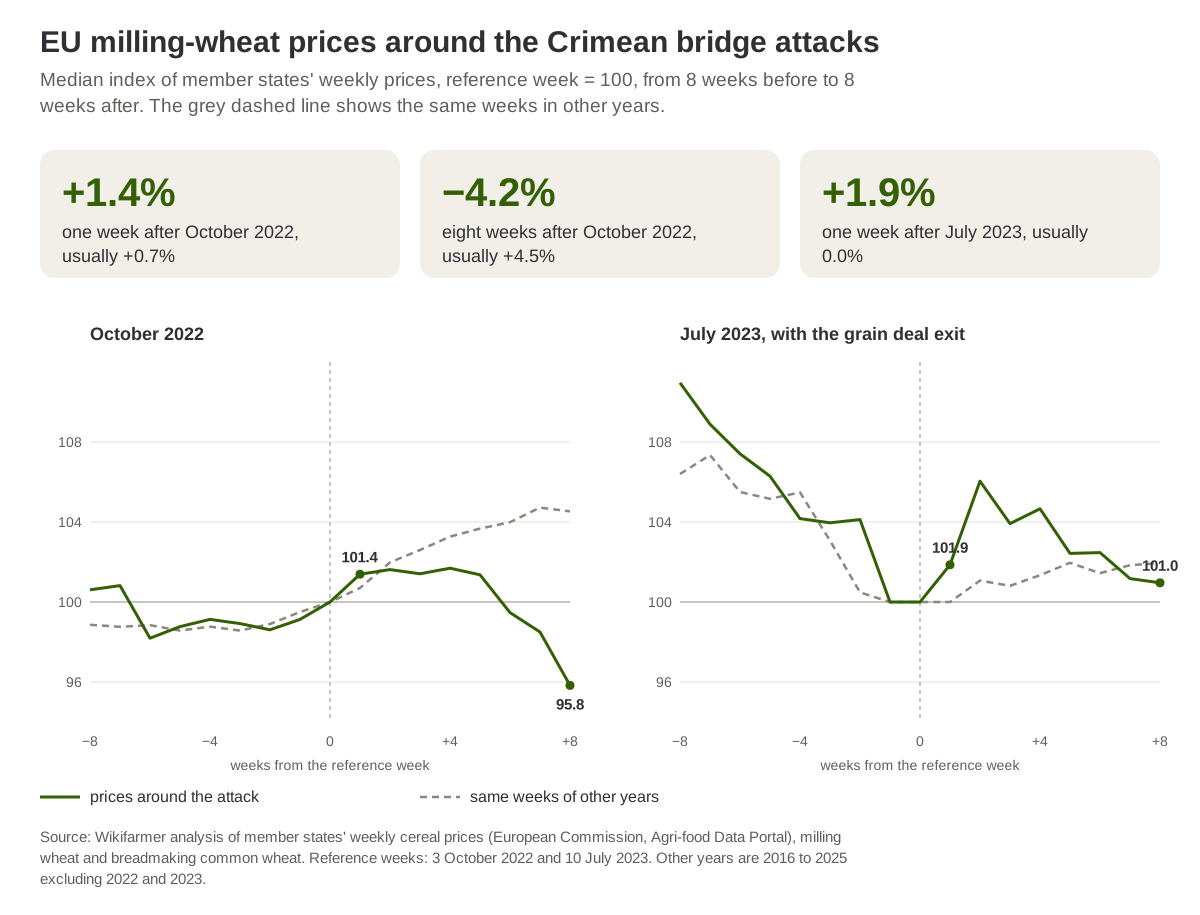
Source: Wikifarmer analysis of member states' weekly cereal prices (European Commission, Agri-food Data Portal). Reference week = 100. The dashed line shows the same weeks of 2016 to 2025, excluding 2022 and 2023.
In July 2023 the rise coincided with Russia leaving the grain deal
The attack of 17 July 2023 came on the same day Russia announced it was leaving the deal for grain exports from Ukraine's Black Sea ports, so price movements in the following weeks cannot be put down to the bridge alone. In the first week the median price rose 1.9%, while in the same weeks of other years it usually stayed flat (0.0%), and over four weeks the rise reached 4.7% against a usual 1.3%.
Eight weeks later the median price was 1.0% above the week before the attack, against a usual 2.0%, with about half of the 42 series above their usual change. In the eight weeks before the attack the price had fallen 9.6%, with falls in 41 of the 43 series, at a time when the price usually also eased in the same weeks of other years.
Two attacks are too few for a general conclusion
Two cases, one of which coincides with Russia leaving the grain deal, are not enough to show what usually happens after such an attack. Both times the price rose a little in the first week, while after the 2022 attack the rise was gone within eight weeks, at a time when the price usually rose in the same weeks of other years. The series cover eight member states and the EU average, and the 2026 market differs from those of the two earlier episodes, as Russian wheat exports are heading for their lowest level in five years.
EU prices for the weeks after the new attack have not been published yet
The European Commission weekly prices used by Wikifarmer run to the week of 19 October 2026, so the movement of EU prices after the bridge collapse will show in the next updates. Before the new attack, in October, EU milling wheat prices were above a year earlier in all 25 markets with complete data. The figures concern wheat growers and flour millers in the EU, but they describe two past episodes and are not a forecast of prices in the coming weeks.
The analysis compares each price series with its own history
The analysis is Wikifarmer's, based on the weekly cereal prices that member states report to the European Commission (Agri-food Data Portal), for milling wheat and breadmaking common wheat in the EU and nine member states, with data from November 2015. Each series is the price of one market at one marketing stage in one member state. The reference week is the week starting 3 October 2022, the week of the attack on Saturday 8 October, and the week starting 10 July 2023, the last before the attack on Monday 17 July. The change is measured from the reference week to one, four and eight weeks later, only where there is a price in both weeks, and compared with the change in the same series over the same weeks of 2016 to 2025, excluding 2022 and 2023, with at least six years to compare. For that reason the number of series differs from one interval to the next. Medians were calculated over all series in each interval, and the data used run to the week of 19 October 2026. The analysis does not attribute the price movements to the attacks. All price figures were recomputed independently from the original file. The data describe what prices did and are not a forecast.
Sources
- European Commission. (2026). Agri-food Data Portal, cereal prices (API guide). Member states' weekly cereal prices, downloaded 2 November 2026.
- RBC-Ukraine. (2026, 17 November). Crimean Bridge hit hard: How Ukraine's strikes disrupted Russian logistics and blocked Sea of Azov access.