


The arrival of Venerable Mihindu Thero (son of Emperor Asoka of ancient Dambadiva) with Theravada Buddhism marked a turning point in the history of Sri Lankan civilization. This transformation was further deepened by the eighteen art forms and cultural practices introduced by Sanghamiththa Theri, the sister of Venerable Mihindu and a highly respected ordained Buddhist nun. She also brought with her the Sri Maha Bodhi sapling, a sacred tree associated with the life of the Buddha and worshipped by Buddhists across the world to this day. From the very beginning, the introduction of Buddhism to Sri Lanka was closely connected to nature and natural rhythms.
The concept of nature farming in Sri Lankan agriculture finds its roots in Buddhism, which is embedded in the lifestyles of Sri Lankan farmers. In the North, Central, and Southern provinces, where farming remains the major livelihood, Buddhism is practiced more as a philosophy of life than merely a religion. When we examine the core values highlighted in Buddhist teachings, it becomes clear that Buddhism is a way of life—one that encourages peace, balance, and coexistence with nature.
Village farming: a religious foundation and united effort
A core concept on which the whole traditional village farming in Sri Lanka was based is‘’ Gamay-Pansalay-weway-dagebay’’ (Gama-village, Pansala-buddhist temple, wewa-tank, dageba- pagoda). In this concept, Gama symbolizes the village community as a whole, which is working on their farmlands and is considered their main and sole means of survival, while the Buddhist temple and dagoba are connected with the spiritual upbringing of the villagers. Wewa, or the village tank, is the means of collecting and conserving water for the growth season when monsoon rains are not to be expected. These four stations were considered as one system that operates in synchrony and depends on each other to bring out the final outcome of prosperity and peace to the village and, through that, to the whole country.
Community-based water and labor sharing
Wel widane, a village official who is well respected by the farmers and appointed by the majority preference of the villagers, is responsible for the timely and fair distribution of the gathered water in the tank to the paddy fields in water-scarce periods and whenever there was a dispute on the water irrigation water distribution, Loku hamuduruwo or the chief incumbent monk of the Buddhist temple was consulted and he was trusted with the most peaceful and just counsel. Farming was regarded as a harmonious way of living rather than a competition between fellow farmers. Aththam's (reciprocal labor) system ensured the participation of sufficient manpower in key agronomic practices such as transplanting and harvesting, demanding each and every farmer to be present whenever each other’s major agriculture operations were due.
Shifting cultivation, on nature’s terms
Chena/Hena, or shifting cultivation, which Sri Lankan farmers have practiced since the dawn of civilization on the island, is based on the fundamentals of cohabiting with and conserving nature. Simply, Chena cultivation is the farming method of clearing a forest area, cultivating it for three or four growing seasons, and moving into a new forest area, abandoning the harvested chena, which allows forest regeneration. Although this appears to be a practice that disrupts forest growth, when the major activities are studied along with their key principles, the influence of Buddhism in chena cultivation is visible.
The influence of Buddhism in chena cultivation starts with the selection and clearing of the forest area (slash and burn) in the designated area for chena cultivation. Village elders are responsible for determining a suitable land area for chena cultivation based on ecologically sound criteria such as the slope of the land to avoid soil erosion after rain and the type of vegetation to have an idea of the soil fertility.
Right before the forest burns, farmers make a loud noise by chanting, possibly using drums and such instruments. This is addressed towards the deities of the forest, as well as the animals of the jungle area being cleared. The farmer repeatedly asks for their forgiveness for the slashing and burning of the forest. However, this chanting sounds like a message that will draw out small animals living in the forest area, such as rabbits, serpents, mongooses, and rats, thus saving their lives from the fire that is soon to burn the forest area.
Loving-kindness, the core value of farming
There is no record of Chena farmers setting traps for or hunting wild animals to protect the growing crop. Instead, the debris preserved at the burnt chena (logs and large plant roots) is used to build up a fence ‘’Dandu weta’’ around the chena to keep the animals away. Although the farmlands possibly attracted animals such as deer, wild boar, peacock, and rabbit, farmers were reluctant to use them as an opportunity to hunt them down. This loving-kindness and compassion are the impacts of Buddhism, which is conveyed to the village farmers through the temple.
There is one famous Sri Lankan folk song associated with rice cultivation, which emphasizes that ‘’ there is no sense in securing food by acquiring sins of killing.’’. This is further proven by allocating a certain plot of the grown crop for the birds "Kurulu paluwa" without harvesting it while the rest of the mature crop is harvested and gathered. Traditional farmers believed that farming is a way of living that should integrate nature since it is nature that provides them with a good harvest at the end of every growing season.
Lessons for sustainable farming
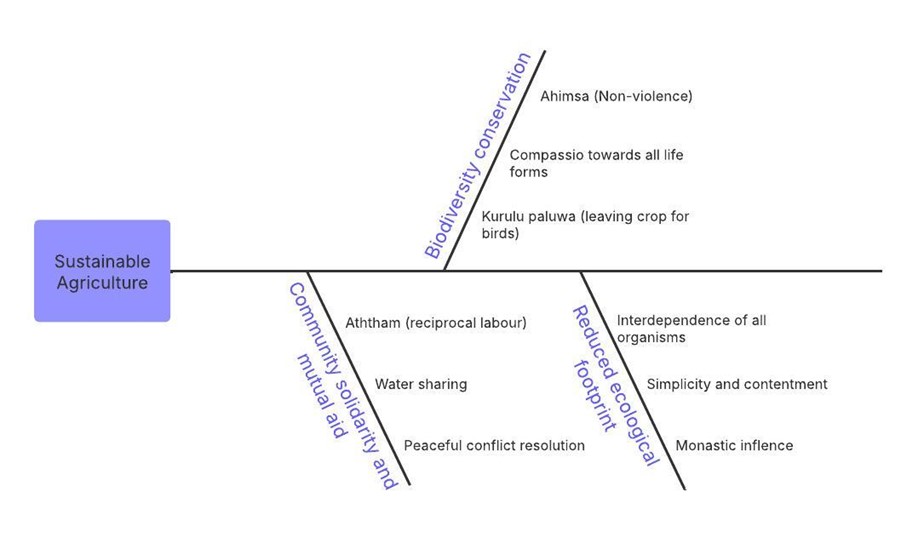
Figure: Buddhist nature farming principles for sustainable farming
When studying the traditional Sri Lankan farming system, it is clear that there are a number of significant aspects that can be integrated into the present intensive agriculture system. The low-input farming system in the past ensured a pesticide—and herbicide-free meal while safeguarding the lives of nature's creatures and considering them in high regard.
References
Bandara, J. S. (2007). Nature farming: Integration of traditional knowledge systems with modern farming in rice.
FAO. (2017). Agroecology knowledge hub: Sri Lanka country case study. Food and Agriculture Organization of the United Nations. Available at:Agroecology Knowledge Hub database entry — FAO
Goonatilake, S. (2008). A 2,500-year history of sustainable agriculture in Sri Lanka. In Uphoff, N. (Ed.), Agroecological innovations: Increasing food production with participatory development (pp. 131–138). Earthscan Publications. Available at: Books — IDRC
Obeyesekere, R. (2006). Buddhism, ecology, and agriculture in Sri Lanka. In Kearns, L. and Keller, C. (Eds.), EcoSpirit: Religions and philosophies for the Earth (pp. 295–308). Fordham University Press. Available at: EcoSpirit — Fordham University Press
Further reading
Wheat-Pea Intercropping: A Sustainable Approach to Resource Efficiency and Crop Productivity
Soil Health and Soil Biota: Building Resilient Ecosystems for Sustainable Agriculture
Building Resilient and Sustainable Agrifood Systems for the Future
Sustainable Agriculture and Food Systems: Ensuring Food Security and Environmental Protection
Regenerative Agriculture in Africa: Restoring Land and Securing Livelihoods
Regenerative Farming in India: A Smallholder Success Story
Improved water management practices empower women in the drylands of India
Farmer Producer Organizations: A Way to Increase Smallholder Farmers’ Income