Regenerative Agriculture Practice – A Need of the Hour
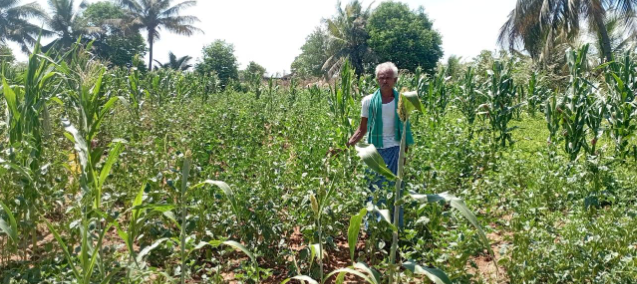
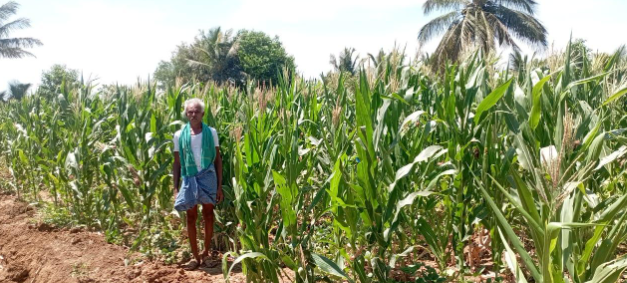
"I am confident of achieving more yield at a lower cost in the coming kharif season for my maize crop," says Puttappa Karadi, a farmer from Aladakatti village in Ranebennur Taluk, Haveri District, Karnataka. His optimism stems from a hands-on experiment with regenerative agriculture during the last rabi season, which delivered encouraging results. With limited land and increasing costs, Puttappa represents a growing number of Indian farmers turning towards low-input, sustainable solutions to secure their livelihoods.
Regenerative agriculture is not new to India. Many of its techniques are rooted in traditional farming practices that emphasize soil health, biodiversity, and natural inputs. However, these methods have gained scientific validation and policy-level support in recent years, making them more structured and replicable. Puttappa's experience offers insights into how such practices can be applied practically on a small landholding while achieving economic and environmental benefits.
Practices Adopted by Puttappa Karadi
Puttappa applied various regenerative practices in his one-acre land during the rabi season. These techniques improved crop health and reduced his reliance on expensive external inputs like chemical fertilizers and pesticides. Each of the practices he adopted is explained below:
Bund Plantation
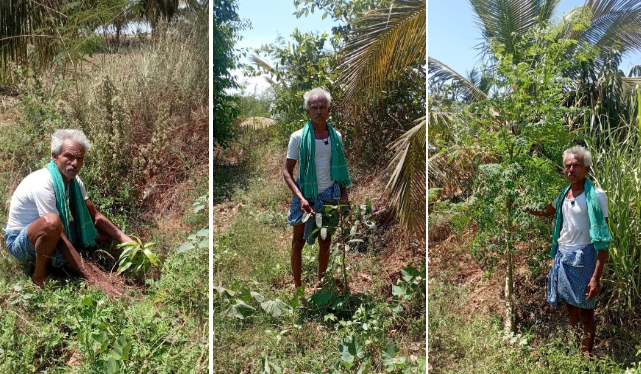
Puttappa planted Guava, Drumstick, and Mango trees along the borders of his field. This method, referred to as "bund plantation," is a traditional agroforestry technique that provides multiple ecosystem services. Trees planted on bunds help prevent soil erosion, improve moisture retention, and act as windbreaks. In addition, they increase biodiversity on the farm and offer future income through fruit or timber sales. India’s National Agroforestry Policy encourages such bund-based plantations to increase tree cover and farmer incomes without compromising food production.
Integrated Nutrient Management (INM) – Jeevamruth
To enrich the soil naturally, Puttappa prepared and applied Jeevamruth, a fermented microbial solution made from fresh cow dung, cow urine, jaggery, pulse flour, and a handful of native soil. This concoction introduces beneficial microbes into the soil, enhancing nutrient cycling and promoting plant growth. Widely promoted under the Zero Budget Natural Farming (ZBNF) model in Karnataka and Andhra Pradesh, Jeevamruth helps farmers maintain soil fertility without synthetic fertilizers. Scientific studies (e.g., from UAS Dharwad) have shown that it improves microbial biomass and nutrient availability in the rhizosphere.
Seed Treatment – Beejamruth
Before sowing, Puttappa treated his seeds with Beejamruth, a traditional bio-coating solution containing cow dung, cow urine, water, lime, and soil. This mixture disinfects seeds, protects against seed-borne diseases, and enhances germination rates. According to research from ICAR and other Indian agri-universities, seed treatments like Beejamruth help reduce early-stage crop mortality and improve plant vigor, especially in rainfed regions.
Intercropping with Cowpea: Natural Nitrogen Fixation
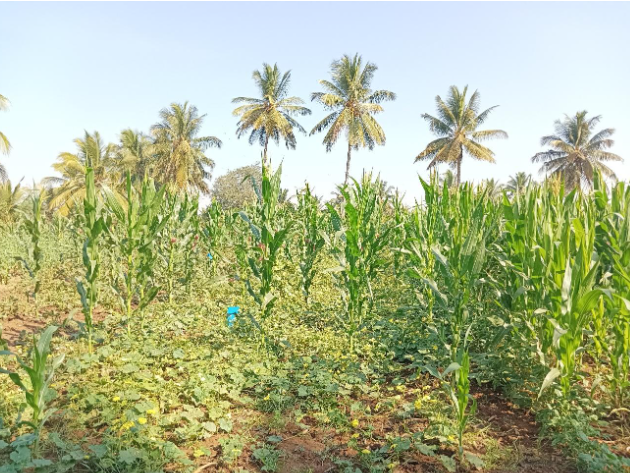
In his maize field, he chose cowpea as an intercrop. Intercropping—growing two or more crops in proximity—is a core regenerative practice that boosts soil fertility, suppresses weeds, and reduces pest pressure. Legumes like cowpea fix atmospheric nitrogen, enhancing nutrient availability for the main crop. FAO and ICRISAT have promoted such intercrop systems for smallholder farmers in semi-arid zones of India for their productivity and resilience benefits.
Mixed Cropping
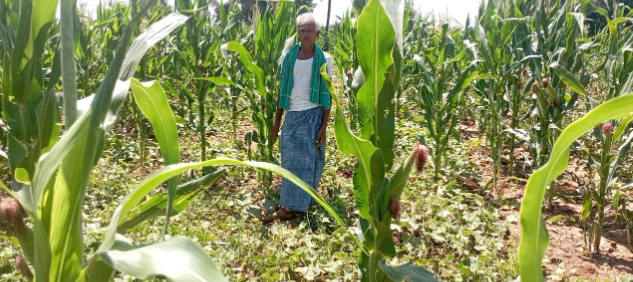
Apart from intercropping, Puttappa adopted a mixed cropping strategy by sowing cluster beans, groundnut, ridge gourd, cucumber, and moth beans along with maize. This practice imitates natural ecosystems, where multiple species coexist and support one another. Mixed cropping diversifies income sources, reduces total crop failure risk, and improves overall land productivity. Research from Indian agricultural universities confirms that mixed cropping is particularly effective in managing pest outbreaks and balancing nutrient demand from the soil.
Sticky Traps: Non-Toxic Pest Control
Puttappa used blue sticky traps for insect pest management, a simple but effective method for controlling sap-sucking and flying pests like whiteflies and thrips. These colored traps attract specific pest species and immobilize them upon contact. Sticky traps are widely promoted in Integrated Pest Management (IPM) programs as a non-toxic, cost-effective way to reduce chemical pesticide use while maintaining pest surveillance.
Bio-Pesticide – Neemastra
To protect his crops naturally, he sprayed Neemastra, a homemade biopesticide derived from neem leaves, cow dung, and cow urine. Neem contains azadirachtin, a natural compound with insecticidal and antifungal properties. Neemastra disrupts the feeding and reproductive cycles of many common crop pests. According to the Indian Council of Agricultural Research (ICAR), neem-based solutions are a safer alternative to synthetic pesticides and have minimal impact on beneficial insects and soil organisms.
Border Crops: Natural Barriers Against Pests
To strengthen his field’s edge ecosystem, Puttappa planted Sorghum (Jowar) and Maize along the borders. Border cropping acts as a first line of defense by absorbing pest attacks before they reach the main crop. Certain crops also attract beneficial insects, reduce wind speed, and support moisture conservation. ICAR and organic farming institutes recommend border crops as part of integrated pest and disease management strategies in dryland and rainfed systems.
Broader Relevance: Regenerative Agriculture in India and Beyond
Puttappa's experience is part of a larger shift in farming methods across India, especially in states like Karnataka, Andhra Pradesh, and Maharashtra. As climate risks and input costs rise, regenerative agriculture offers a path forward for smallholder farmers to build more resilient, profitable, and eco-friendly farms.
Globally, regenerative agriculture is gaining attention as a climate-smart solution. It aligns with goals set by the Intergovernmental Panel on Climate Change (IPCC) for improving soil carbon sequestration and reducing greenhouse gas emissions. In India, state-level programs and civil society-led initiatives like Rythu Sadhikara Samstha in Andhra Pradesh and Sahaja Samrudha in Karnataka are helping farmers adopt such practices at scale.
Studies by ICRISAT and FAO have also shown that integrating organic inputs, biodiversity, and agroecological techniques can improve soil structure, enhance yields over time, and reduce environmental degradation. Furthermore, practices like bund plantation and mixed cropping offer co-benefits like nutrition diversification and pollinator habitat conservation.
Conclusion
Puttappa Karadi’s farm is a living example of how traditional wisdom, backed by modern ecological principles, can transform smallholder agriculture. By implementing low-cost, regenerative practices, he has reduced his cultivation expenses and laid the foundation for long-term soil health and food security. His story is a powerful reminder that solutions to today’s agricultural challenges often lie in the synergy between past knowledge and future innovation.