


An initiative under the Srishti Regenerative Agriculture Project
India’s rainfed regions: challenges for smallholder maize farmers
India's agricultural backbone lies in its vast rainfed regions, where nearly 60% of the total cultivated area depends entirely on rainfall. These regions support millions of smallholder farmers but often face chronic issues: low soil fertility, poor organic matter, high input costs, and the unpredictability of monsoons - all of which impact both productivity and farmer income.
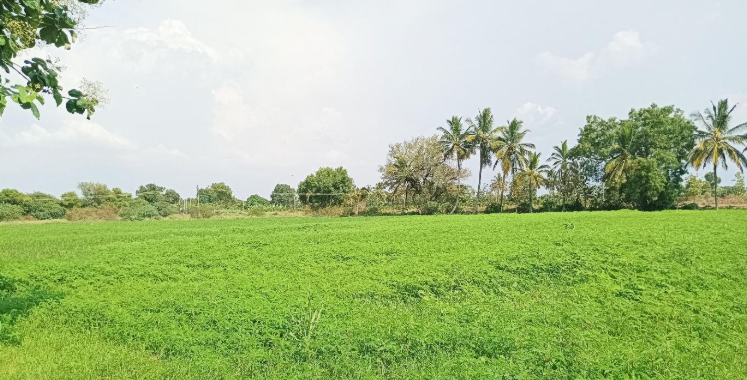
In Karnataka, a southern Indian state with a significant share of rainfed farmland, maize is a key crop in a few districts. Maize here is mostly grown without irrigation, making it vulnerable to erratic rainfall and soil degradation. Despite its importance as a food, fodder, and industrial crop, maize under rainfed systems often underperforms due to declining soil health and growing dependence on synthetic fertilizers.
Recognizing this challenge, we at the Srishti Regenerative Agriculture Project launched a targeted intervention: the introduction of green manure crops, specifically Diancha (Sesbania aculeata) and Sunhemp (Crotalaria juncea), into these maize-based rainfed systems.
Importance of Green Manure Crops in Rainfed Systems
Green manuring is not a new practice in India, but it has largely been restricted to irrigated systems or perennial plantations like arecanut, especially in parts of Karnataka. In contrast, rainfed cereal-based systems like maize rarely see the use of green manure crops despite their immense potential to regenerate soils and reduce input costs.
Why Diancha and Sunhemp work in dryland agriculture
Green manure crops are grown not for harvest, but to be incorporated back into the soil, enriching it with nutrients and organic matter. Diancha and Sunhemp, both leguminous species, grow quickly during the summer fallow period and are plowed into the soil before the monsoon planting of maize.
This approach is especially critical for rainfed areas where access to fertilizers is limited, costly, or environmentally unsustainable. In these conditions, rebuilding soil health naturally becomes essential not only for productivity but also for resilience in the face of climate variability.
The Science Behind the Practice
The benefits of green manuring are well-documented in Indian and global research:
- Nitrogen Fixation: Sunhemp can fix 60–80 kg N/ha (53.5-71.3 lbs/ac), and Diancha up to 100 kg N/ha (89.2 lbs/ac) through their association with nitrogen-fixing Rhizobia bacteria. (Aulakh et al., 1982)
- High Biomass in Short Duration: These crops generate 10–15 tonnes of biomass per hectare within 45–60 days, ideal for incorporation before the onset of monsoon.
- Rapid Decomposition: Soft-stemmed legumes decompose quickly, releasing nutrients at the right time for young maize seedlings. (Sharma & Mittra, 1991)
- Soil Organic Carbon & Microbial Health: Long-term use increases soil carbon levels and enhances microbial activity - critical for sustainable productivity. (Manna et al., 2005)
The Maize-Green Manure Link: A Regenerative Transition
In the Srishti project areas, maize is central to both nutrition and income. Yet farmers face multiple barriers: poor soil fertility, rising costs of fertilizers and FYM (farmyard manure), and frequent dry spells. The green manure strategy addresses these issues holistically:
- It builds soil fertility naturally, reducing dependence on external inputs like DAP and urea.
- It improves moisture retention, a critical trait in drought-prone blocks.
- It reduces the need for FYM, which is often expensive or unavailable.
- It supports better maize establishment and early vigor, crucial for good yields in rainfed farming.
By improving soil health while lowering input costs, green manuring provides both an ecological and economic win for smallholder farmers.
Farmer Involvement and Community Learning
To support adoption, the Srishti team conducted Field Demonstrations & Farmer Meetings across all four blocks, i.e., Jagalur, Ranebennur, Rattihalli, and Athani. Farmers witnessed firsthand the lush growth and dense biomass of Diancha and Sunhemp. They engaged in open discussions about nutrient cycling, soil structure, and how green manuring compares with conventional FYM use.
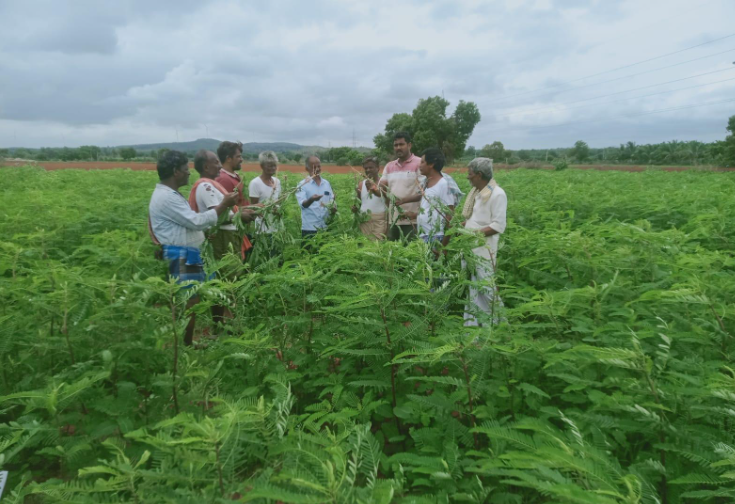
The response was overwhelmingly positive. Many farmers, especially those with limited access to fertilizers, expressed interest in adopting green manure crops in their own fields from the next season onward. This kind of grassroots enthusiasm is essential for scaling regenerative agriculture.
A Scalable, Climate-Resilient Model for Global Rainfed Systems
This initiative represents more than just a local innovation. It is a scalable model for climate-resilient rainfed agriculture that builds on traditional practices but is informed by modern agroecological science. By reintroducing green manure crops in rainfed maize systems, we aim to restore soil ecosystems, stabilize yields, and strengthen farmer livelihoods.
As we continue to monitor changes in soil nutrient levels, maize performance, and cost savings, our long-term goal is to embed green manuring as a mainstream pre-cropping practice in dryland India and to share these learnings with broader rainfed geographies across the Global South.
At the heart of this work lies a simple truth: healthy soils create healthy harvests and healthy harvests sustain healthy communities.
References
- Aulakh, M. S., Rennie, D. A., & Paul, E. A. (1982). Gaseous nitrogen losses from cropped and summer-fallowed soils. Canadian Journal of Soil Science, 62(1), 187-196.
- Sharma, A. R., & Mittra, B. N. (1991). Effect of different rates of application of organic and nitrogen fertilizers in a rice-based cropping system. The Journal of Agricultural Science, 117(3), 313-318.
- Manna, M. C., Swarup, A., Wanjari, R. H., Ravankar, H. N., Mishra, B., Saha, M. N., ... & Sarap, P. A. (2005). Long-term effect of fertilizer and manure application on soil organic carbon storage, soil quality and yield sustainability under sub-humid and semi-arid tropical India. Field crops research, 93(2-3), 264-280.
