

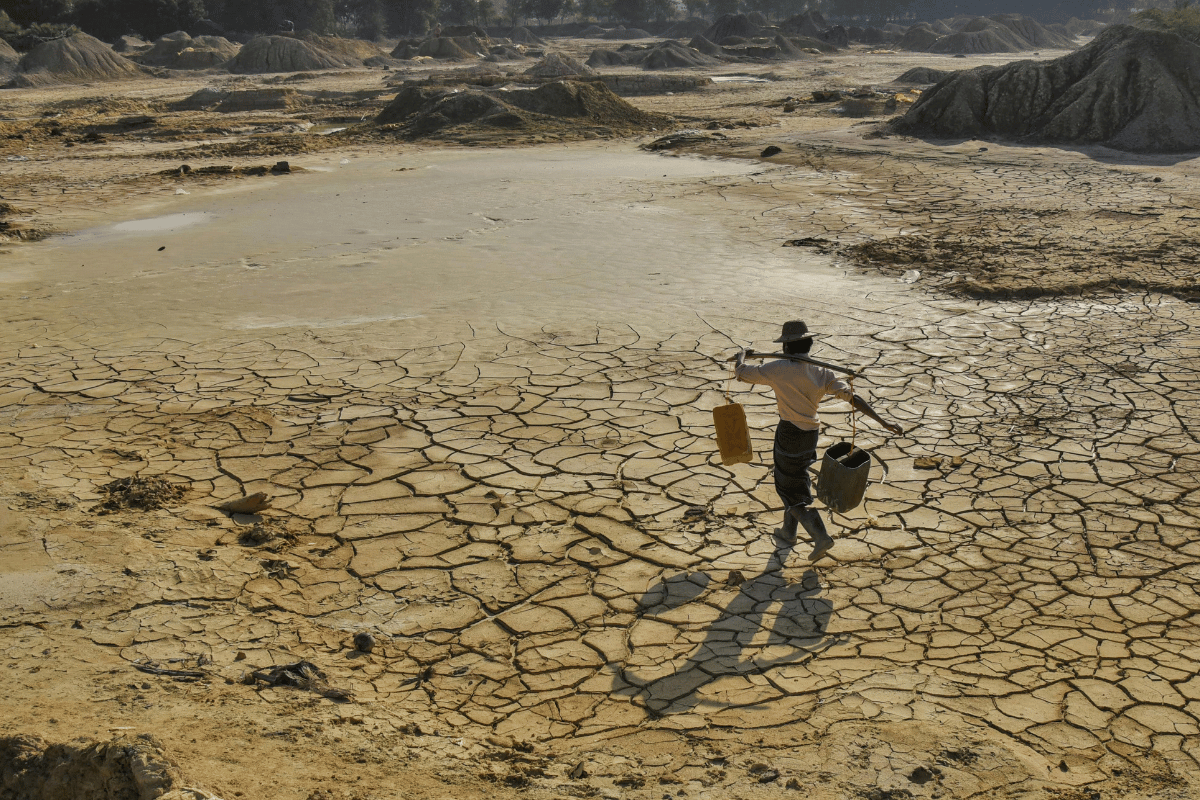
For the first time, Africa is home to the largest number of people facing hunger anywhere in the world. An estimated 309 million Africans were undernourished in 2025 against 292 million in Asia, a crossover that has been building for fifteen years and has now arrived. The figures come from the 2026 edition of The State of Food Security and Nutrition in the World, published jointly by FAO, IFAD, UNICEF, WFP and WHO.
Globally the direction is better. Hunger affected 645 million people, or 7.8% of the world, down from 8.1% in 2024 and 8.6% in 2022, the third consecutive year of improvement. That still leaves more people hungry than in 2019, and about 50 million more than in 2015 when the Sustainable Development Goals were adopted, since population growth has outpaced the fall in the rate.
Key takeaways
- 645 million people faced hunger in 2025, 7.8% of the world population, down from 8.1% in 2024.
- Africa overtook Asia for the first time, with 309 million people against 292 million.
- Africa's share of world hunger rose from 28% in 2010 to 48% in 2025, while Asia's fell from 65% to 45%.
- One in five Africans is hungry, at 20.0%, against 6.0% in Asia and 4.8% in Latin America and the Caribbean.
- Between 510 and 520 million people are projected to face hunger in 2030, and 56% of them will be in Africa.
Hunger has fallen for a third year
The prevalence of undernourishment measures whether people have access to enough dietary energy for a healthy, active life. It fell from 8.6% in 2022 to 8.1% in 2024 and 7.8% in 2025, with the point estimate of 645 million sitting inside a range of 608 to 696 million. Compared with 2024 that is roughly 14 million fewer people, and 43 million fewer than in 2022.
Progress has not returned the world to where it was before the pandemic. The 2025 total remains above 2019, and the comparison with 2015 is the one that matters for the Sustainable Development Goals, where the rate has barely moved from 8.0% to 7.8% while the absolute number climbed by about 50 million.
Africa passed Asia because the two moved in opposite directions
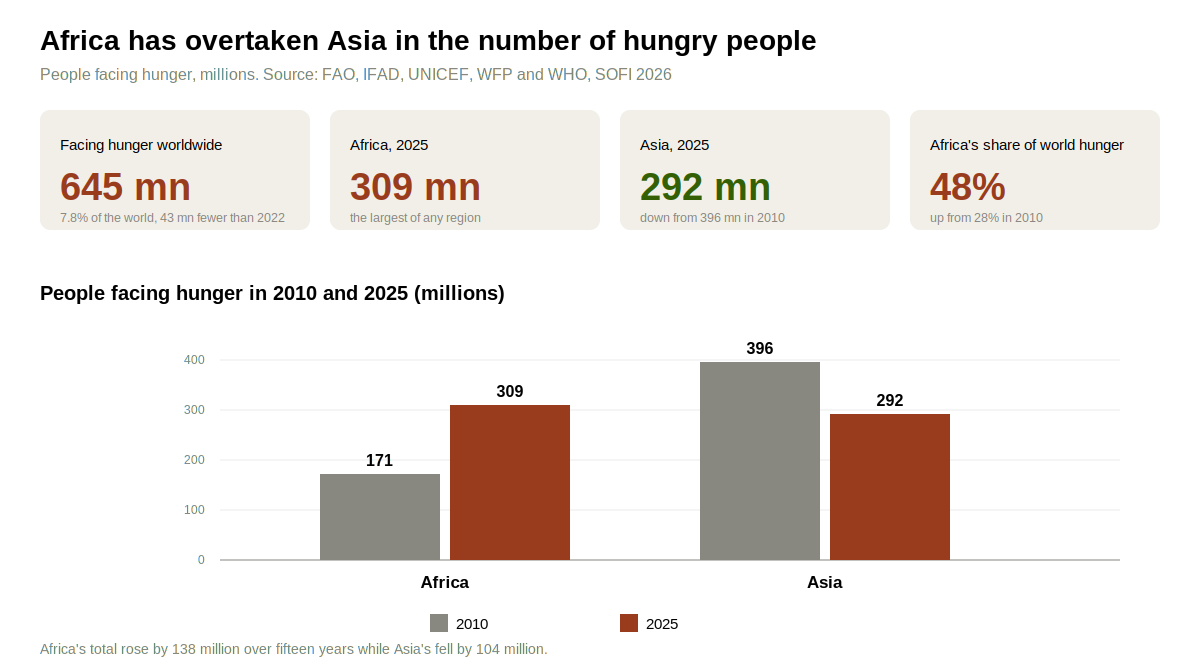
Between 2010 and 2025 the number of hungry people in Africa rose from 171 million to 309 million, while in Asia it fell from 396 million to 292 million. Africa's share of global hunger went from 28% to 48% over that period and Asia's from 65% to 45%, with Latin America and the Caribbean steady at around 5%.
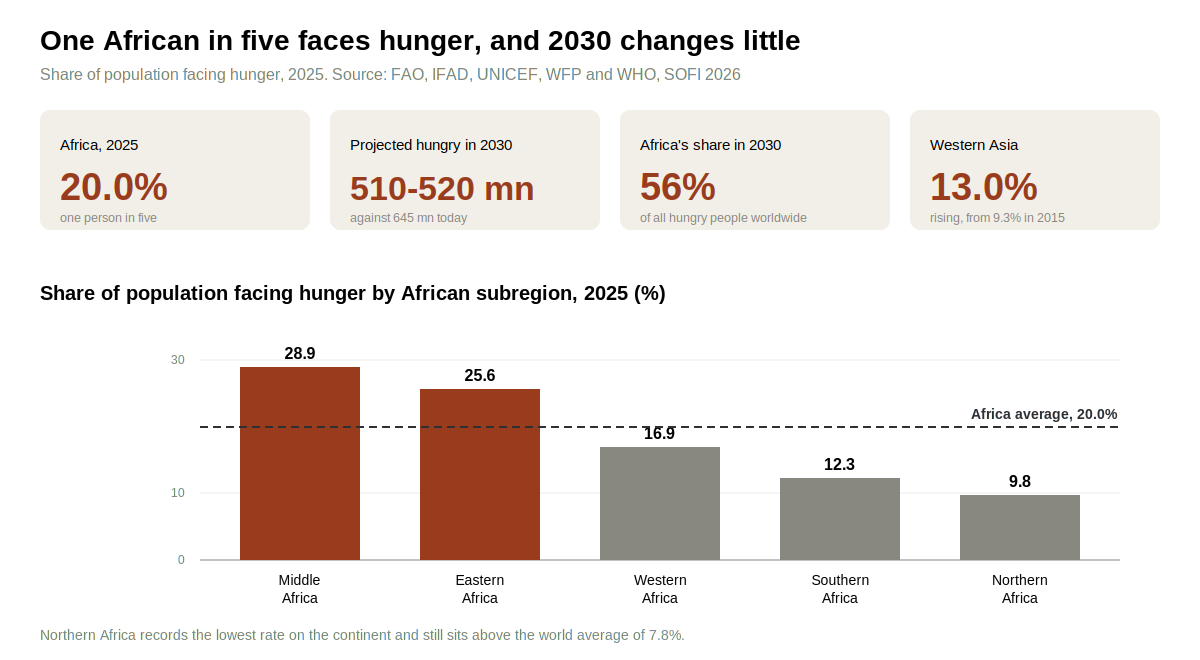
Africa's own rate did improve slightly, from 20.3% in 2024 to 20.0% in 2025, which halts an upward trend that had run since 2017. That improvement failed to translate into fewer people, because population growth absorbed it. One in five people on the continent still lacks enough to eat.
Within Africa the burden is uneven. Middle Africa records the highest prevalence at 28.9%, followed by Eastern Africa at 25.6% and Western Africa at 16.9%, while Southern Africa sits at 12.3% and Northern Africa at 9.8%, the lowest on the continent. Improvements in Eastern, Middle and Western Africa produced the small overall decline, offsetting a marginal worsening in Southern Africa.
Asia produced most of the global improvement
Asia's rate dropped from 7.9% in 2021 to 6.0% in 2025, which translates into more than 80 million fewer people. Southern Asia did most of the work, falling from 13.9% to 9.3% over the same four years, with South-eastern Asia easing from 5.6% to 5.1%. Eastern Asia has stayed below the 2.5% reporting threshold since 2015 and Central Asia has nearly reached it at 2.8%. Measured against 2015, Asia's hunger rate is 25% lower, the strongest regional performance since the Sustainable Development Goals began.
Western Asia is the exception and is moving the wrong way, climbing from 9.3% in 2015 to 13.0% in 2025. Latin America and the Caribbean improved to 4.8%, below pre-pandemic levels, though the Caribbean remains at 16.6% with progress stalled between 2024 and 2025.
Two billion people still cannot eat reliably
A second indicator captures a broader problem. In 2025 an estimated 2.1 billion people, 25.8% of the world, were moderately or severely food insecure, meaning they had been forced to cut the quality or quantity of what they eat. That is 86 million fewer than in 2024 and 135 million fewer than in 2020, and Africa recorded its first improvement on this measure since 2015, falling from 58.5% to 56.6%. Even so, more than half the continent's population remains affected, against 20.3% in Asia, 22.9% in Latin America and the Caribbean and 8.7% in Northern America and Europe.
Severe food insecurity, where people run out of food and go days without eating, affected 778.6 million people, 9.5% of the world and 25 million fewer than in 2024.
Two patterns within those totals deserve attention from anyone working in rural development. Food insecurity remains consistently higher in rural areas than in towns and cities, at 29.7% rural against 25.4% peri-urban and 22.3% urban, and the rural to urban gap widened from 6.7 percentage points in 2022 to 7.4 in 2025. The people who grow food remain more exposed than the people who buy it. Women also remain worse off than men, at 23.6% against 22.7%, although that gap narrowed sharply from 1.7 percentage points in 2024 to under one, driven mostly by Asia. Latin America and the Caribbean now shows the widest gender gap at 3.7 percentage points.
Famine entered the record for the first time
Chronic hunger and acute crisis are measured differently, and the second picture is worse. The 2026 Global Report on Food Crises found that 266 million people, 22.9% of the population analysed across 47 countries and territories, faced high levels of acute food insecurity in 2025. Around 39.1 million were in IPC Phase 4, classified as Emergency, and 1.4 million in Phase 5, Catastrophe.
Famine was confirmed in parts of the Gaza Strip and in the Sudan during 2025, the first such classification since IPC reporting began. The countries with the largest numbers affected were Nigeria, the Democratic Republic of the Congo, the Sudan, Yemen and Afghanistan. The mechanics of how a crisis reaches that point, and why it is almost always foreseeable, are covered in our analysis of what drives a modern famine.
What 2030 looks like from here
Projections now put the number of hungry people in 2030 at between 510 and 520 million, a fall of about 20% from today. Reaching zero is out of the question on current trends, and 56% of those still hungry will be in Africa, close to 17% of the continent's population.
The range reflects the 2026 conflict in the Middle East. Before it began, the projection stood at 503 million. Factoring in the energy and fertiliser price effects observed in the first quarter of 2026 raises that to 511 million, and a scenario in which damage to Gulf infrastructure delays recovery in the energy and fertiliser markets until 2030 pushes it to 522 million. Asia absorbs the largest impact with about 10 million more people hungry by 2030, followed by Africa with 8 million, while Latin America and the Caribbean stand to benefit as a net energy exporter.
Those numbers exclude other disruptions. A shift toward El Niño conditions in 2026 and 2027 is not factored in, nor are the weather extremes that increasingly interrupt harvests, both of which would compound the effects already counted. Ending hunger by 2030 was the commitment, and the arithmetic now points somewhere else, which makes the quality of what people can actually access, and not only the quantity, the measure that matters for food security in the years ahead.
Sources
- FAO, IFAD, UNICEF, WFP and WHO. 2026. The State of Food Security and Nutrition in the World 2026. Rome.
- FAO, WFP and Global Network Against Food Crises. 2026. 2026 Global Report on Food Crises. Rome.