



Urban beekeeping is an increasingly popular practice worldwide, offering cities a practical way to support pollinators, strengthen biodiversity, and reconnect residents with food production. While it is already well established in cities such as New York, London, Toronto, and Sydney, urban beekeeping in Greece is still developing. Athens, in particular, has begun to explore how beehives can coexist with dense urban environments, rooftops, and neighborhoods, creating tangible environmental and social benefits.
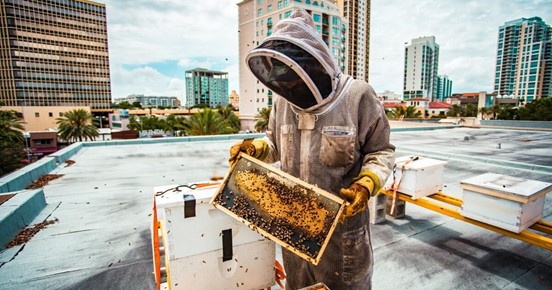
Copyright Diego Grizi - Nectar nest
I had the honor and luck to work with one of the most conscious and ethical initiatives for urban beekeeping in Greece as their Communication Manager. This initiative is Astiki Melissa (which translates in English as Urban Bee). Working with the founders to help them spread the message of sustainable beekeeping opened my eyes and gave me hope that we could potentially transform big city centers into hubs that are more welcoming to nature and life in general.

Copyright AP Photo/Michael Varaklas
What is urban beekeeping
Urban beekeeping refers to the practice of maintaining honey bee colonies within city limits. Hives are typically placed on rooftops, balconies, community gardens, or other safe urban locations.
Unlike rural beekeeping, urban beekeeping relies on diverse urban flora from ornamental plants, trees, balcony gardens, and parks. It involves smaller-scale hive management and places a strong emphasis on coexistence with residents and public awareness.
Contrary to common concerns, numerous studies and real-world applications have shown that bees can thrive in cities, often benefiting from continuous flowering periods and reduced pesticide exposure compared to intensive agricultural areas.
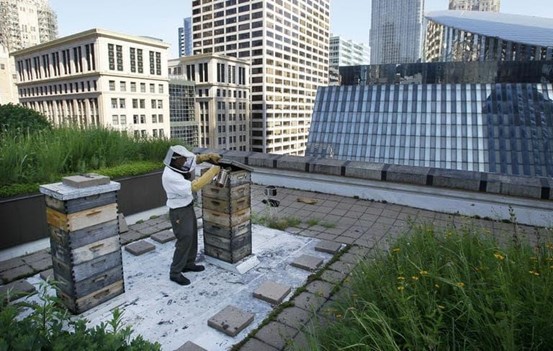
Beekeeper Michael Thompson applies smoke to settle down the more than 1000,000 bees in a hive on top of City Hall in Chicago. (AP)
Is urban honey safe to consume
The most frequent question people ask when they hear about urban beekeeping is whether the honey produced by city bees is safe to consume. While it is natural to expect honey from a polluted environment like a city to be contaminated, urban honey produced in Athens is tested in laboratories and consistently found to be pure, free of harmful pollutants. Similar results have been documented in other cities worldwide.
A study testing honey, pollen, and nectar from hives in central Belgrade found that contaminant levels were generally below regulatory limits, pesticide residues were below detection limits, and PAH (polycyclic aromatic hydrocarbon) levels were low. The conclusion was that urban honey met European safety standards and was safe for consumption despite being in a city environment.
Research analyzing honey from several urban apiaries showed that while some trace metals like zinc, lead, and cadmium were present, only lead occasionally exceeded safety limits, and PAH levels remained very low (below 10 μg/kg). A systematic review of global data on PAHs in honey found that although these compounds do occur in honey, levels were below safety thresholds in most cases. A separate study in Poland measuring 19 elements in honey samples from urban and rural locations showed that while some metals were slightly higher in urban honey, overall quality remained comparable and the risk assessment confirmed urban honey was generally safe.
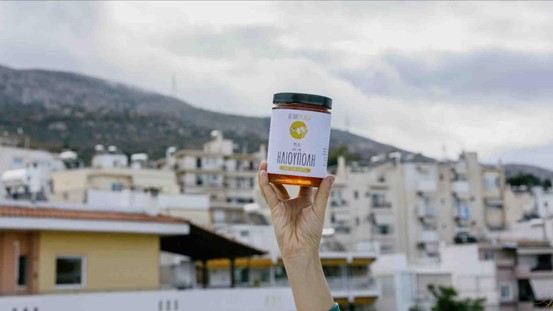
Honey produced in Athens by Astiki Melissa is sold and consumed by many people. Their hives are located on rooftops and in gardens across neighborhoods including Ilioupoli, Zografou, Petralona, Agia Barbara, Kifissia, and Glyfada. The honey is distinctly flavorful, and its taste varies depending on the neighborhood where it is produced, since each area has its own variety of plants.
Why Athens is well-suited for urban beekeeping
Athens presents unique conditions for urban beekeeping. The Mediterranean climate, long flowering seasons, and abundance of citrus trees, herbs, and ornamental plants provide rich forage for bees throughout most of the year.
Copyright Photographer: Angelos Giotopoulos
Organizations such as Astiki Melissa have played a key role in introducing and supporting urban beekeeping in the city. Through educational programs, hive placements, and community engagement, they have demonstrated that beehives can be safely integrated into the urban fabric without disturbing daily life.
Based on hands-on experience in Athens, urban beekeeping here is not simply symbolic. It actively supports pollination in fragmented green spaces, produces high-quality urban honey, and educates residents about biodiversity and food systems. While it is difficult to say whether Athens was the first Greek city to adopt this practice, it is certainly among the pioneers in systematically and visibly implementing it in the city center.
How Athens compares to international examples
Globally, urban beekeeping is far more widespread and better supported by institutions.
New York City legalized beekeeping in 2010 and now supports hundreds of registered hives through organizations like Bees.NYC. The New York Bee Club is a community-focused organization that supports hobbyists and newcomers across all five boroughs through workshops, mentoring, pest- and disease-training, public education events, and local meetups. Bee U NYC, a 501(c)(3) non-profit, uses urban beekeeping as a tool for environmental education, community engagement, and youth workforce development, offering hands-on hive experiences and paid fellowships that connect participants with green job skills.
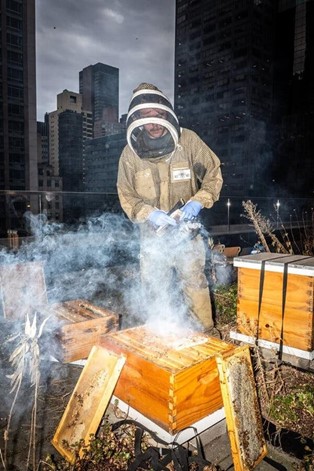
Copyright Graham Dickie The New York Times
London has a long tradition of rooftop hives, including on public buildings and cultural institutions. The London Beekeepers' Association (LBKA) promotes responsible and ethical beekeeping through education, courses, and public outreach. Urban Bees complements these efforts by creating pollinator habitats and running teaching apiaries. The London Beekeeper Ltd provides professional services, managing hives on rooftops and urban sites while producing local honey and offering educational programs for schools and the public.
Toronto actively promotes urban pollinators through beekeeper associations and municipal programs. The Urban Toronto Beekeepers' Association helps hobbyists and newcomers learn hands-on skills through monthly meetings, workshops, and a mentorship program. The Toronto Beekeepers Collective manages hives across the city, including in parks and historic sites, while engaging the public through workshops, honey tastings, and community outreach.
Sydney and Melbourne integrate urban beekeeping into sustainability education and local food initiatives. City Bee, a family-run Australian beekeeping business, offers raw honey, queen bee breeding, beehive hosting, humane swarm collection, and varroa mite treatment, making beekeeping accessible to hobbyists and commercial operators alike.
Copenhagen is home to Bybi, a social enterprise that installs and manages hives on rooftops, gardens, and business properties. They produce and sell local honey, run beekeeping workshops and tours, and involve community members, schools, and partners in learning about bee ecology, while creating jobs and training for marginalized groups.
Compared to these cities, Athens is still at an early stage. However, this also presents an opportunity: urban beekeeping can grow alongside environmental awareness, climate resilience strategies, and community-driven sustainability efforts.
Challenges and responsible practice
The placement of beehives within a city requires careful consideration. It is not safe, responsible, or legal for someone to place a beehive anywhere they wish within an urban area. Proper hive placement to avoid disturbance must be ensured by a professional and experienced beekeeper. This is especially important in apartment buildings where numerous people live and where residents allergic to bee stings may be present. Anyone wishing to place hives on a shared rooftop must contact all building residents, obtain their approval, and check building regulations carefully.
In an urban environment, beehives must also be strategically positioned so that honeybees can access sufficient floral resources to collect nectar and pollen, which they use to produce honey, feed the colony, and build reserves for the colder months. If city residents do not plant flora to support bees, the colonies will struggle to find what they need to survive. This is one of the biggest challenges to address. Even a few plants on each balcony, terrace, or rooftop can help, and municipalities can contribute by planting pollinator-friendly species along streets and in public spaces.
It is equally important for an experienced beekeeper to conduct regular inspections of the hives to detect and manage diseases or parasites such as Varroa mites, Nosema, and foulbrood. These inspections ensure the health of the colony and prevent the spread of pathogens to other hives or wild pollinators. This means routine, scheduled visits, not just occasional check-ins.
In Athens, collaboration between beekeepers, municipalities, and community organizations has proven essential, but it is still in early stages. No clear rules are established yet for fully lawful and sustainable urban beekeeping. Clear communication and transparency can help ensure that urban beekeeping remains a positive presence rather than a source of conflict, and that, in the future, it becomes more established and better protected by government regulation.

Promotional Material for the Documentary: Big Hive – Beekeepers in the City by Fernandez Magenes
The environmental and social impact of urban beekeeping
Urban beekeeping offers environmental benefits that go far beyond honey production. By enhancing pollination of urban vegetation, parks, and private gardens, it supports biodiversity in areas with fragmented green spaces and acts as an indicator of environmental health, since bees are highly sensitive to pollution and habitat quality. Urban bees often forage across surprisingly large distances, linking isolated green patches and strengthening urban ecosystems.
In Athens, strategically placed beehives have sparked curiosity and conversations among residents, helping to reduce fear and misconceptions about bees, raise awareness about pollinators and food systems, and reconnect people with nature in a largely concrete environment. Educational activities around these hives attract schools, volunteers, and local communities, turning urban beekeeping into a practical tool for environmental education rather than a niche agricultural practice.
Looking ahead
As cities face challenges like climate change, biodiversity loss, and disruptions to food systems, urban beekeeping demonstrates how small-scale initiatives can have meaningful impact. For Athens, these practices strengthen local ecosystems, promote environmental responsibility, and show that urban areas can actively contribute to pollinator protection.
Yet companies in Greece have largely yet to integrate beekeeping into their CSR strategies. While some examples and corporate gifts exist, ongoing support is still needed. Volunteers, whether professional or amateur, play a vital role, and government involvement will be necessary to sustain and scale these efforts.
With continued community engagement, education, and responsible management, Athens and Greece more broadly can become a leading example of sustainable urban beekeeping in the Mediterranean region.
References
- Amid Bee Die-Off, Healthy Hives Thrive In Cities. WBUR News.
- How City Beekeeping is Spearheading a Pollinator Renaissance. Nectar Nest.
- The Trouble with Urban Beekeeping. Rewilding Magazine.
- Urban Honey: The Aspects of Its Safety. Archives of Industrial Hygiene and Toxicology.
- Content of Selected Harmful Metals (Zn, Pb, Cd) and Polycyclic Aromatic Hydrocarbons (PAHs) in Honeys from Apiaries Located in Urbanized Areas. Foods.
- City Explores Beekeeping Regulations. C&G News.
- Polycyclic Aromatic Hydrocarbons in Honey: A Systematic Review of Occurrence, Concentrations, and Health Risk Assessment. PubMed.
- Micro and Macroelements in Honey and Atmospheric Pollution (NW and Central Poland). Resources.
- Big Hive: Beekeepers In The City. Documentary by Fernandez Magenes.
- From Rooftops to Honey Jars, Athens is Abuzz with Urban Beekeeping. AP News.