


The global food system faces a growing threat. Leading climate models project significant declines in the yields of staple crops for every degree of warming, forcing agriculture to contend with increasingly severe droughts, heatwaves, and erratic weather. The challenge extends beyond quantity into quality: the phenomenon of "CO₂ fertilization" can produce bigger plants that are paradoxically less nutritious, a form of "hidden hunger" where staple foods contain less protein, zinc, and iron. As the limits of conventional breeding and chemical inputs become apparent, securing future food supply requires looking beneath the surface to the very foundation of plant resilience.
How climate change disrupts the microbial world
Plant-associated microbiomes residing in the soil serve as the first line of defense against pathogens. These diverse microbial communities establish intricate relationships with plants, providing protection against diseases, enhancing nutrient uptake, and promoting overall plant health. Climate change brings significant challenges to these beneficial associations, compromising the resilience and adaptability of crops.
The projected effects of climate change on soil microbiomes and crop health include (FIG. 1):
Alteration of microbial reservoirs
Climate change can lead to changes in the structure and composition of microbial communities in the bulk soil. Such alterations may disrupt the delicate balance of beneficial microorganisms, potentially reducing their abundance and diversity.
Impaired plant physiology and immune response
Climate change can influence plant physiology and the production of root exudates, volatile organic compounds (VOCs), and phytohormones. These alterations can hinder the ability of plants to recruit and assemble beneficial microbiomes, limiting their defense mechanisms against pathogens.
Disrupted plant-microbiome interactions
The migration of plants to new locations, driven by changing climatic conditions, can disrupt the established relationships between plants and their native microbiomes. This disruption may leave plants vulnerable to new pathogens and weaken their defense systems.
Impact on plant "cry for help" responses
Plants employ a strategy of recruiting beneficial microorganisms when under attack by pathogens. Climate change can reduce the efficacy of this "cry for help" response, potentially compromising the plant's ability to activate its immune system and recruit beneficial microbes for protection.
Strategies for preserving microbiome diversity
To ensure crop resilience and adaptation to climate change, it is crucial to prioritize the preservation and enhancement of microbiome diversity. Researchers and agriculturalists are exploring several approaches.
Implementing sustainable agricultural practices that promote soil health, such as reduced tillage, cover cropping, and organic amendments, can foster diverse and resilient microbial communities. Microbial-based solutions, including biostimulants and inoculants, offer another path to enhance plant resilience and combat emerging pathogens. Precision agriculture techniques that use advanced technologies such as DNA sequencing and metagenomics are helping scientists better understand and manage plant-microbiome interactions. Conserving and utilizing crop wild relatives, which possess diverse microbiomes adapted to various climatic conditions, provides a way to introduce genetic diversity and associated beneficial microorganisms into cultivated crops.
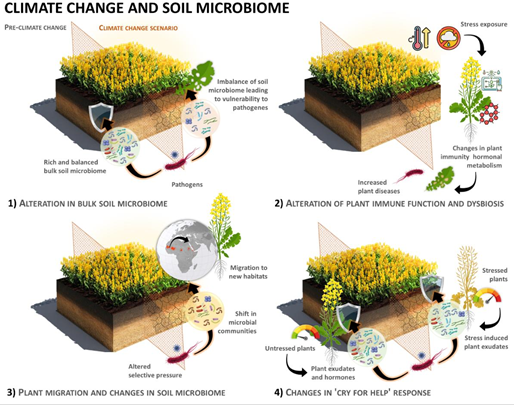
Figure 1: Responses of plant microbiomes to climate change and the consequences on pathogen susceptibility
The microbial toolkit for a resilient future
Within this microbial world lies a powerful toolkit for adaptation. By understanding these mechanisms, we can move from being passive observers to active managers of the rhizosphere. Beneficial microbes enhance crop resilience through a variety of scientifically validated mechanisms.
Drought and heat tolerance
Specific bacteria (Bacillus, Pseudomonas) produce a slimy biofilm of exopolysaccharides (EPS) around roots, which acts like a sponge, retaining moisture and preventing desiccation. Others produce the enzyme ACC deaminase, which lowers the plant's production of the stress hormone ethylene, essentially telling the plant to "stay calm" and continue growing during a heatwave. Arbuscular mycorrhizal fungi (AMF) act as a literal extension of the root system, creating a vast hyphal network that can explore a much larger soil volume to mine for water and nutrients, far beyond the reach of the roots alone.
Boosting nutrient density
To combat the CO₂ dilution effect, microbes are essential. Nitrogen-fixing bacteria can supply the extra nitrogen needed for protein synthesis, while phosphate-solubilizing microbes produce enzymes that unlock phosphorus bound to soil particles. By enhancing nutrient availability, these microbes help ensure that faster-growing crops are also nutritionally complete.
Activating natural immunity
The presence of beneficial microbes primes the plant's immunity through a process called Induced Systemic Resistance (ISR). When challenged by a pathogen, this pre-conditioned state allows for the rapid mobilization of a more robust defense response, increasing the plant's capacity to resist disease.
Looking ahead
Microbiome diversity plays a central role in crop adaptation to climate change. With shifting microbial landscapes and the emergence of new pathogens, preserving and working with diverse plant-associated microbiomes is critical for safeguarding global food security and maintaining the stability of natural ecosystems. Adopting practices like regenerative agriculture, integrating microbial tools into crop management, and investing in rhizosphere research are concrete steps that farmers, agronomists, and policymakers can take to build more resilient cropping systems. The microbial world beneath our feet may well determine whether agriculture can keep pace with the climate challenges ahead.