Metagenome and soil microbial studies show that soil microbes are the true workers, building fertility and resilience and protecting crops. Regenerative practices such as cover crops, compost, and reduced disturbance help these microbes thrive, keeping soils rich in carbon and water. Together, science and farming make soil a living partner that delivers stronger harvests and a healthier future for farming families.
Healthy soils are the backbone of food security and sustainable farming. They produce crops, and they also clean water and air, provide shelter for countless organisms, recycle nutrients, reduce pests and diseases, store carbon, and increase yields. This ability to perform many roles at once is known as soil multifunctionality. Yet soils today are under serious pressure from human activity and global change, which makes it vital to develop strong, reliable indicators that act as early warning signs of degradation. Most soil health checks still emphasise physical and chemical traits such as pH, nutrient levels, or texture. What is often missing is the biological dimension, the living organisms that make soil dynamic, resilient, and truly alive.
Soil life includes both invertebrates, such as earthworms, nematodes, and mites, and microorganisms, such as bacteria, fungi, and protists. These creatures work together to form a living soil network that keeps nutrients moving and plants healthy. One key measure is soil microbial biomass, the pool of fungi and bacteria that break down organic matter and release nutrients for crops. Biological indicators give a fuller picture of soil health because they capture the living side of the soil and its ongoing processes.
In regenerative farming, practices such as composting, crop rotation, and reduced tillage aim to strengthen this living foundation. Genomic tools now allow us to look deeper into soil life, decoding the DNA of microbial communities and revealing how they contribute to fertility, carbon storage, and plant health. By combining metagenomics with other multi-omics approaches, scientists can identify biomarkers of soil health, track microbial functions, and design management strategies that align with natural processes. Treating soil as a dynamic, living system rather than inert matter gives farmers and policymakers new ways to build productivity while restoring ecological balance. Genomics for living soils is about more than science. It is about giving farmers evidence-based tools to regenerate their land and secure sustainable food futures.
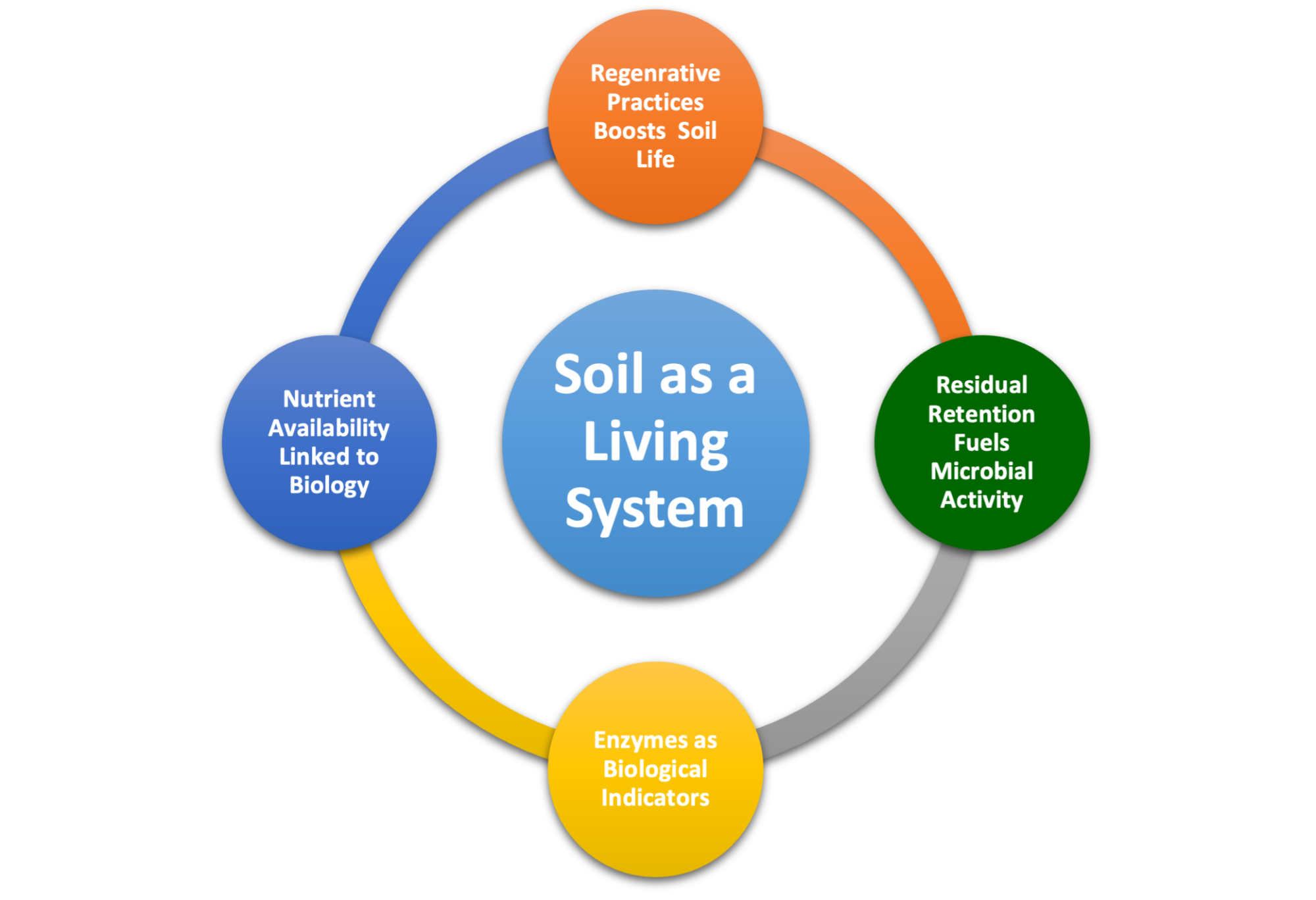
Figure 1: Soil life cycle
Soil as a living system
Soil is more than a place to hold nutrients. It is a living community. Beneath the ground, microbes, fungi, and tiny creatures work together to keep soil fertile and strong. When farmers see soil as a living system, they move beyond test numbers and start caring for the natural processes that build resilience and productivity. Everyday practices such as adding compost, rotating crops, or reducing tillage directly support the living forces that keep soil healthy.
Soil biology is increasingly recognised as the foundation of soil health, with research showing that microbes, enzymes, and biodiversity drive nutrient cycling, carbon storage, and resilience. Conservation agriculture practices, such as residue retention, crop diversification, and reduced tillage, have been shown to boost microbial activity, enzyme function, and nutrient availability compared with conventional systems. This aligns with broader reviews that stress the need to integrate chemical, physical, and biological indicators for a meaningful assessment of soil quality. Together, these studies confirm that acting on a soil analysis takes more than adjusting fertiliser inputs. It means nurturing the living processes that sustain productivity and long-term soil health.
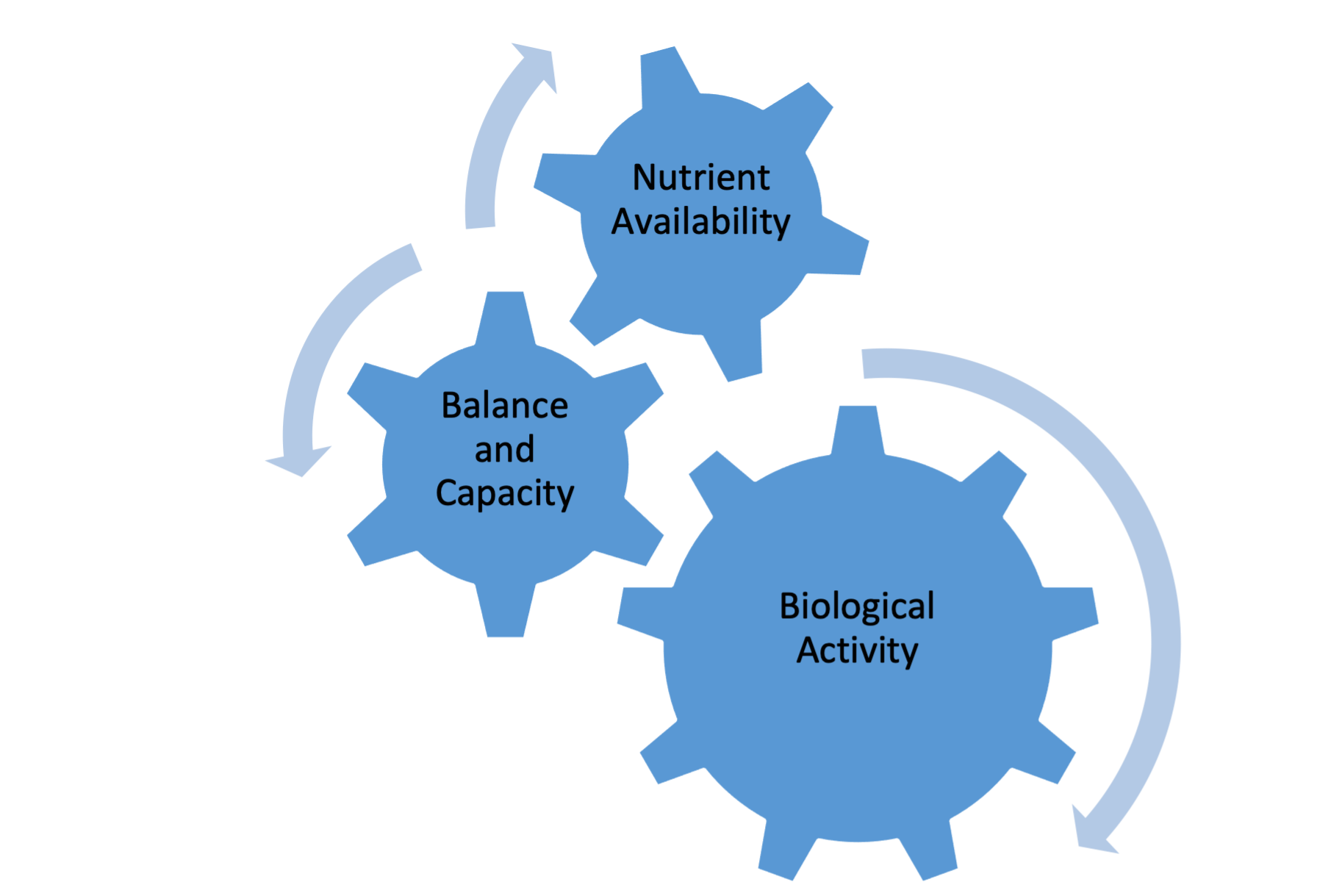
Figure 2: Drivers of soil function
Biological activity in soil
Soil biology is one of the most telling indicators of how healthy a soil really is. The richness and diversity of bacteria and other microorganisms determine whether farming systems stay productive, balanced, and resilient. Most of this activity takes place in the topsoil, from a few millimetres to about 30 cm deep. Living organisms make up less than 1% of soil volume and under 10% of its organic matter, yet their influence is enormous. Microbes recycle nutrients, support plant growth, and reduce dependence on chemical fertilisers, which makes agriculture more sustainable.
The challenge is keeping soils naturally strong against stresses such as drought, pests, and human pressure. Regenerative farming practices such as reduced tillage, crop diversity, cover crops, and compost protect this living system, and the biological activity driven by microbes recycles nutrients naturally and keeps the soil resilient. Together these factors reveal soil as a living system, where chemistry, physics, and biology interact to sustain fertility and productivity.
Bridging soil metagenomics with regenerative agriculture
Genomic tools are opening a new window into soil life, showing how microbes recycle nutrients, store carbon, and protect plants. Next-generation sequencing (NGS) and multi-omics technologies uncover the hidden diversity and functions of these organisms, turning soil from a black box into a living system we can manage wisely.
Soil metagenome studies reveal not only which microbes are present but also what they can do. This connects microbial functions such as nutrient cycling, carbon storage, and stress tolerance to their genetic context. It also reveals functional redundancy, where different microbes perform the same role and make soils more resilient, and taxonomic diversity, the variety of species that keep soils balanced. In simple terms, genomics shows that microbes are active players shaping soil health rather than hidden passengers.
Regenerative farming builds on this knowledge by restoring soils through cover crops, minimal disturbance, compost, biodiversity, and crop rotations. Genomics and regenerative practices form a powerful bridge, where science uncovers the drivers of soil health and farming practices strengthen them. Microbes emerge as active builders of fertility, resilience, and ecosystem services. Linking microbial traits with soil quality shows farmers that soil is a living partner that sustains ecological, economic, and social benefits over time.
What this means for farmers
Soil is a living system whose vitality depends on microbial diversity and activity. Farmers can look beyond chemical tests, since genomic tools such as next-generation sequencing and other tests focused on soil biology now connect microbial functions directly to soil health outcomes. Evidence from metagenome studies supports the shift from chemical-intensive farming to regenerative practices that restore soil integrity and produce nutrient-rich, clean food.
Biofertilisers and microbial consortia enrich soil biology, improve nitrogen efficiency, and reduce greenhouse gas emissions, while soils rich in organic carbon hold water better and improve infiltration and drought resilience. Combined with genomic insight, these practices reveal microbes as active builders of fertility, resilience, and ecosystem services, and they offer a clear, science-based pathway to healthier soils, sustainable harvests, and food systems that nourish both people and the planet.
Sources
Bhaduri, D., Sihi, D., Bhowmik, A., Verma, B. C., Munda, S., and Dari, B. (2022). A review on effective soil health bio-indicators for ecosystem restoration and sustainability. Frontiers in Microbiology, 13, 938481.
Bünemann, E. K., Bongiorno, G., Bai, Z., Creamer, R. E., De Deyn, G., de Goede, R., et al. (2018). Soil quality, a critical review. Soil Biology and Biochemistry, 120, 105–125.
Creamer, R. E., Barel, J. M., Bongiorno, G., and Zwetsloot, M. J. (2022). The life of soils, integrating the who and how of multifunctionality. Soil Biology and Biochemistry, 166, 108561.
Kopittke, P. M., Menzies, N. W., Wang, P., McKenna, B. A., and Lombi, E. (2019). Soil and the intensification of agriculture for global food security. Environment International, 132, 105078.
Kumar, A., Saini, K. S., Sharma, S., Yadav, M., Singh, G., Devi, K., and Kumawat, K. C. (2025). Evaluating soil physico-chemical properties and nutrient availability through intensified conservation agriculture-based cropping systems. Frontiers in Agronomy, 7, 1612792.
Laishram, J., Saxena, K. G., Maikhuri, R. K., and Rao, K. S. (2012). Soil quality and soil health, a review. International Journal of Ecology and Environmental Sciences, 38(1), 19–37.
Li, C., Yan, K., Tang, L., Jia, Z., and Li, Y. (2014). Change in deep soil microbial communities due to long-term fertilization. Soil Biology and Biochemistry, 75, 264–272.
Naher, U. A., Othman, R., Panhwar, Q. A., Shamshuddin, J., and Mohd Razi, I. (2016). Effect of organic and biofertilizers on soil microbial biomass and activity in a Malaysian paddy field. Communications in Soil Science and Plant Analysis, 47(2), 129–141.
Schloter, M., Nannipieri, P., Sørensen, S. J., and van Elsas, J. D. (2018). Microbial indicators for soil quality. Biology and Fertility of Soils, 54, 1–10.
Sicardi, M., García-Préchac, F., and Frioni, L. (2004). Soil microbial indicators sensitive to land use conversion from pastures to commercial Eucalyptus grandis plantations in Uruguay. Applied Soil Ecology, 27(2), 125–133.