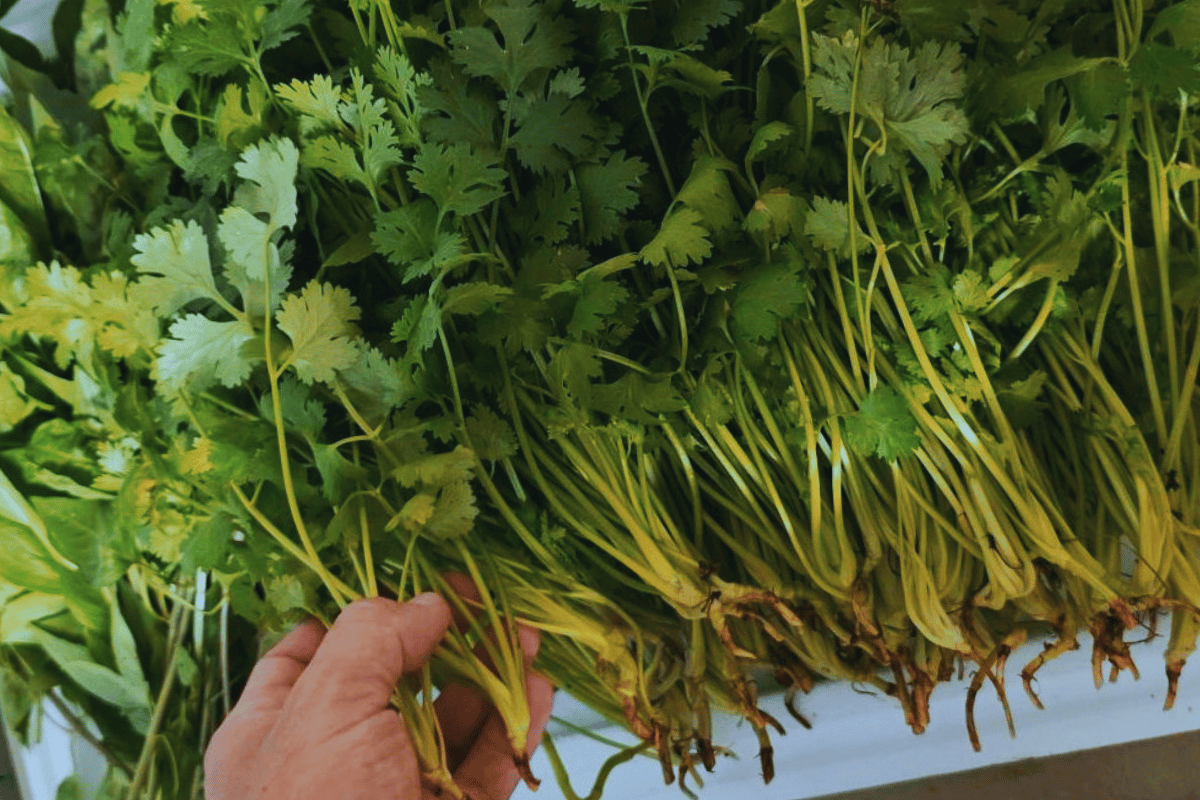
Coming from a decade in ornamental horticulture, I was used to a chemical shed filled with every "fix" imaginable. On Christmas Island, the stakes are different. Our small-scale hydroponic pilot project sits in the middle of a delicate ecosystem and supplies a small, tight-knit community. If there is a place for mindful pest and disease control, this is it.
Through several seasons and a lot of trial and error, we have learned that success in remote hydroponics is less about the strongest insecticide and more about the smartest system.
Why organic
Green Space Tech sits between sensitive colonies of red crabs and Abbott's booby birds, and directly above the reef. We made the choice early on to go fully organic, which meant doing away with a strong lineup of systemic chemicals and instead investing in diligent crop monitoring, smart preventatives, and targeted contact sprays.
The island already has enough challenges acquiring high-quality produce. By committing to organic, we get closer to our goal of providing healthy, reliable, and safe produce to the local community.
Crop monitoring
Getting in amongst the plants is the only way to really understand what is going on in each crop and what pest pressure is out there at any given moment. These are the practices that have made my monitoring time work hardest.
Know what you are looking for and where to look
You do not need to be an entomologist, but spending time to research the common pests for each crop goes a long way. Understand the pest, its life cycle, and the damage it causes. The damage is often the easiest way to find any pest. I follow a quick-glance system and check 1 in 20 to 1 in 200 plants of a crop, depending on the size of the batch.
| Where to look | Pests to look for |
|---|---|
| Stem | Scale, mealybug, aphid |
| Leaf | Caterpillar, leaf miner, snails, hopper |
| Underside | Aphid, whitefly, thrips, mites, mealybug |
Know your crops
Pests are specific, and they like what they like. You will find that you are controlling the same pests on the same crop until the season changes. Sticky traps and indicator plants are good ways of understanding what might be out there at any given time.
Record everything
Paper, spreadsheets, or in our case an in-house app that manages the farm. The key is consistency. Over time you start to notice patterns and can detect outbreaks earlier, which lets you build preventative systems rather than just responding to crises.
Frequency
I am fortunate to do thorough pest and disease checks twice a week and quick scans five times a week. All staff have access to the app and can log new sightings or signs of distress in the crops. If you are time-poor, aim for at least one thorough investigation through the farm per week.
Get microscopic
You cannot see what you cannot see. Certain species of mites, including russet mites and broad mites, are extremely small. You simply will not spot them without a 20–50x microscope.
Understand thresholds
Two aphids in a crop of 500 plants are not a problem. Build an understanding of what an acceptable amount of any given pest looks like for your operation, and act when the population approaches the level where it stops being acceptable.
Understand your insecticides
Understanding your insecticides is a critical step in the treatment of any pest or disease outbreak. I find the easiest way is to build two easy-to-read documents, a Quick Guide and a Pest Matrix.
The Quick Guide captures the critical information for each product, including chemical group, withholding period (the minimum time between spraying and harvesting), active constituent, resistance risks, and any other details that matter for safe handling. I also colour-code for cautions and hazards. The point is to make spray decisions fast and consistent across the whole team. Here is a slimmed version of what our Quick Guide looks like at Green Space Tech.
| Neem Oil | Eco Oil | Insect Killer OCP | Dipel | |
|---|---|---|---|---|
| Active constituent | Azadirachtin | Botanical oils | Potassium salts of fatty acids | Bacillus thuringiensis (Bt) |
| IRAC group | UN | NA | NA | Group 11 |
| Mode of action | Hormone disruptor / suffocant | Suffocant contact | Desiccant contact | Biological, ingested |
| Organic certification | Yes | Yes | Yes | Yes |
| Withholding period | None | None | None | None |
| Risk of resistance | Low | None | None | Moderate |
| Weather caution | Over 32 °C | Over 32 °C | Over 32 °C | None |
| Impact on bees | Low | Low | Low | None |
| Impact on beneficials | Low | Low | Low | None |
| Target pest | Mites, aphids, scale, whitefly, caterpillar | Mites, aphids, scale, whitefly | Soft-bodied insects, thrips, aphid | Caterpillars only |
| Rate | 2–3 mL per litre | 5–10 mL per litre | 10–20 mL per litre | 1–2 g per litre |
| Mix with | Eco Oil | Always | No | No |
The Pest Matrix lists my chemical availability against the pests I come across. This is a quick visual scan to confirm that the chemical I am about to spray actually covers the target pest I am trying to control. Green means full control, yellow means partial control, red means the chemical is ineffective against that pest.
| Pest Matrix | Aphid | White fly | Mealybug | Scale | Thrips | Broad / russet mite | Caterpillars |
|---|---|---|---|---|---|---|---|
| Neem | Yes | Yes | Partial | Yes | Yes | Yes | Partial |
| Eco Oil | Yes | Yes | Partial | Yes | Partial | Yes | — |
| Dipel | — | — | — | — | — | — | Yes |
| Success Ultra | — | — | — | — | Yes | — | Yes |
| Insect Killer OCP | Yes | Yes | Yes | Partial | Partial | Yes | — |
| Eco Fungicide | — | — | — | — | — | — | — |
| Pyrethrins OCP | Yes | Yes | Partial | Partial | Yes | Yes | Yes |
Eco Fungicide stays in the matrix even though it shows red across the row, because the visual confirms at a glance that it is not the spray to reach for when the problem is an insect rather than a fungal pathogen. The matrix prevents the most common spray mistake, picking the wrong product for the target.
Just by consulting these two documents, I can avoid most of the common spray problems, including missing the target pest, building resistance, and phytotoxicity (chemical damage to the plants themselves).
The reality of organic hydroponics
Organic gardening is more labour-intensive. In a traditional setting, a systemic pesticide provides a safety net that lives inside the plant tissue itself. In our organic system, we have traded that safety net for a microscope and a rigorous schedule.
We also face chronic pest pressure from the surrounding jungle, an army of insects evolved to thrive in this humidity. Without synthetic knock-downs, our success depends entirely on contact and suffocation, so our spray coverage has to be 100% accurate. If a contact spray does not touch the pest, the pest survives.
We also manage what I call the "organic paradox". Inputs such as neem oils and potassium soaps can be heavy, and if you over-apply them in the tropical heat they can stress the plant or clog leaf pores. It is a constant calibration between protecting the crop and letting it breathe. The labour is higher, but the reward is a clean system where the biology of the farm works with the island, not against it.
Organic hydroponics is more than a set of rules. It is a shift in mindset from reactive spraying toward proactive integrated pest management.
Key takeaways
Set your IPM goals. Pests are a way of life. A mindful farm does not need to chase a 100% sterile, bug-free environment. The goal is a balance where the crop outpaces the pest.
Know what you are looking for and where to look. Crop monitoring is your best weapon. Understanding what pests eat, where they hide, and how to target them gives you the strongest chance of success.
Coverage is everything. Spraying with poor coverage does more harm than good. It leads to resistance and wastes resources.
Record everything. We record and graph all pest pressure, which means we can see the peaks and troughs of each pest through the seasons, as well as which sprays have worked and which have not. With enough data, you can start to predict what is coming.
Take your time. Consult your documents and get familiar with both your pests and your chemicals. Organic or not, all pesticides can be dangerous to growers and crops alike. Going slow, checking your equipment, and running small-scale trials gives you a lot less to worry about.
About the author
James Scorer is a horticulturalist working with Green Space Tech, a PRL Group-funded hydroponic operation on Christmas Island that supplies leafy greens, Asian vegetables, and herbs to the local community. He came to controlled-environment growing after a decade in ornamental horticulture and now runs the farm's pest and disease program.