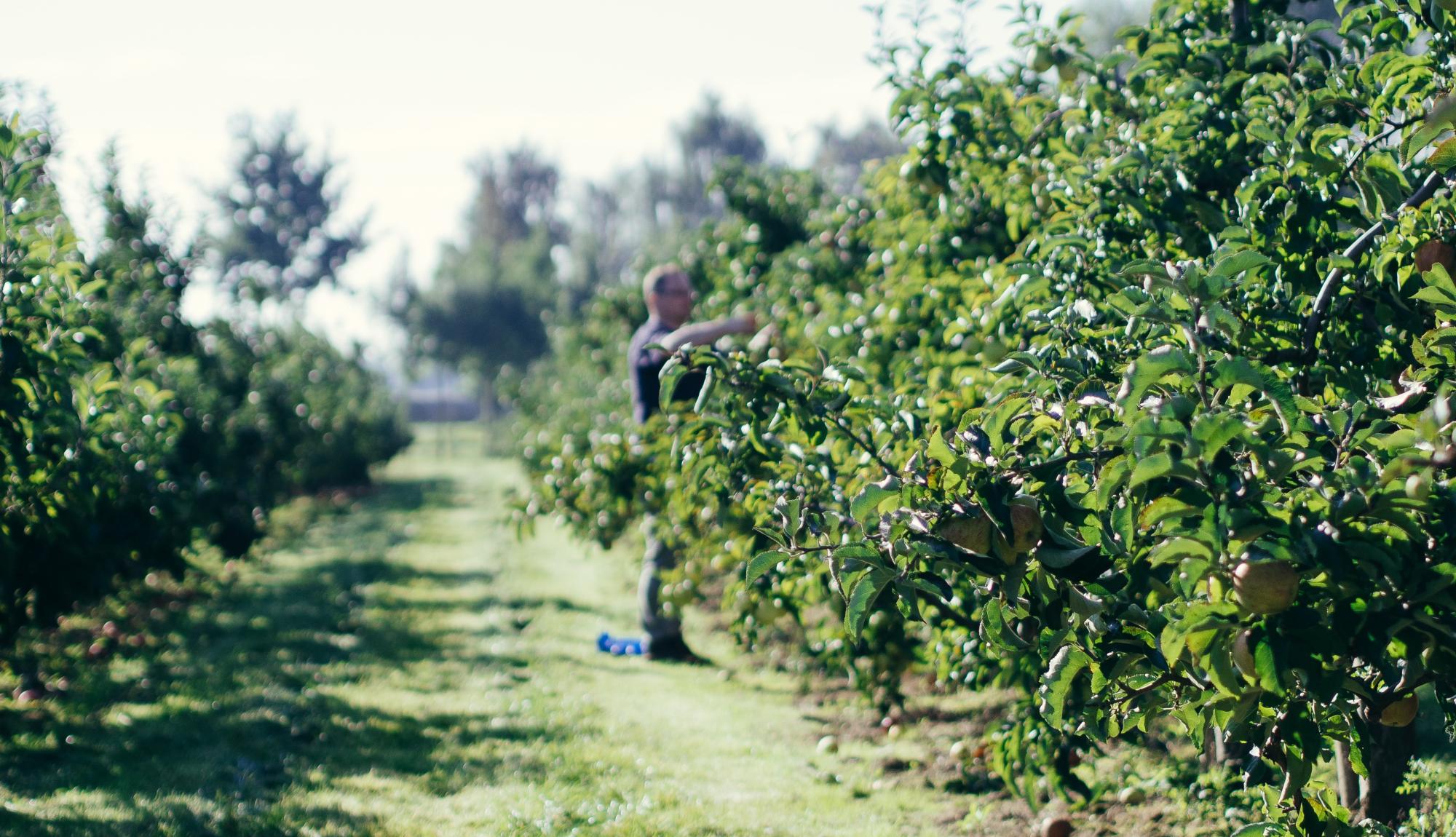
The labor challenge in EU orchards
The agricultural orchard sector in the EU faces severe labor shortages and struggles to attract young practitioners. Most essential operations—pruning, thinning, and harvesting—remain manual and repetitive. Despite decades of research, no high-scale automatic solution exists that can tackle all these operations while remaining accessible and operable for farmers.
This dual challenge of automating complex tasks while ensuring farmer-friendly operation drives the AgRibot orchard robotics initiative.
Robotic harvesting solution (Pilot Case 5)
Technology and capabilities
Pilot Case 5 develops an autonomous orchard robot equipped with a manipulator and soft vacuum gripper for selective fruit harvesting in Belgian orchards. The system combines cutting-edge navigation and manipulation technologies:
Platform architecture:
- Mobile base with LiDAR, 3D cameras, IMUs, and GNSS for autonomous navigation
- 2D gantry providing vertical and lateral movement
- 6-degree-of-freedom industrial arm with semi-spherical reach
- Soft vacuum gripper minimizing fruit damage
- Tool-mounted 3D camera for fruit identification
The robot moves tree-to-tree, computing real-time yield statistics during harvest operations. GNSS and vision-based navigation ensure accurate positioning throughout the orchard.
Validation approach
The iterative pilot evaluates:
- Navigation accuracy between trees
- Fruit detection precision across varying conditions
- Picking efficiency and fruit integrity
- Overall harvest speed and productivity
- Integrated system performance in real orchard conditions
Multi-season data collection trains fruit detection models, with robot components refined between testing rounds based on user feedback.
Robotic pruning and thinning solution (Pilot Case 6)
Precision cutting technology
Pilot Case 6 adapts the same autonomous platform for precision pruning and thinning in orchards across Belgium and Spain. The robot uses identical navigation systems but equips the manipulator with task-specific scissor tools.
Key features:
- Vision-based AI for branch identification
- XR interface supporting operator decision-making
- Tool-mounted 3D camera for precise local alignment
- Controlled execution of pruning and thinning operations
- Safety systems for tree-to-tree operation
Testing and refinement
Seasonal data collection informs model training for pruning decisions. The gripper undergoes multi-season testing across varied tree structures and conditions. Field trials evaluate:
- Navigation reliability
- Target detection accuracy
- Pruning tool efficiency and safety
- Plant health impacts
- Labor reduction compared to manual pruning
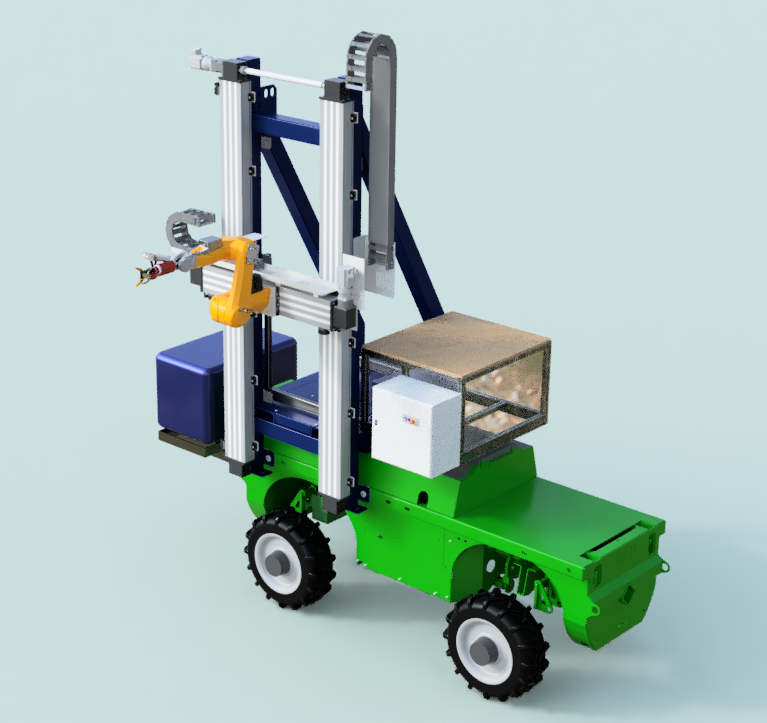
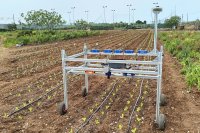
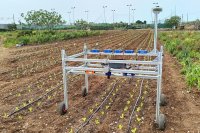
AgRibot robotic platform for Pilot Cases 5 and 6 with autonomous navigation and a 6-DoF arm equipped with a soft vacuum gripper for fruit harvesting (PC5) or a scissor tool for pruning and thinning (PC6)
XR technology: lowering the entry barrier
Both pilots leverage Extended Reality (XR) technologies to make robotic operation accessible to farmers without extensive technical backgrounds. XR provides:
Live operation support:
- Real-time data visualization from robot sensors
- Fruit ripeness and location highlighting
- Supervision capabilities allowing farmers to monitor and adjust robot performance
- Feedback mechanisms for task-specific requirements
Training and knowledge transfer:
- Realistic, egocentric simulations of orchard environments
- Immersive experiences accessible from anywhere
- Demonstration capture of human execution for autonomous operation
- Decision-making model generation from expert knowledge
- Virtual training environments for teaching younger practitioners
The integration of precision agriculture with XR interfaces creates unprecedented accessibility for advanced robotic systems.
Benefits for orchard farmers
Labor management:
- Reduced dependency on seasonal labor
- Support for aging workforce
- Automation of physically demanding tasks
- Increased attractiveness of orchard farming to younger generations
Productivity and quality:
- Higher operational efficiency
- Consistent task execution quality
- Extended working hours (robots can operate in conditions challenging for human workers)
- Real-time yield monitoring and data collection
Economic considerations:
- Initial investment offset by reusable platforms serving multiple tasks
- Reduced long-term labor costs
- User-friendly XR tools lowering training requirements
- Safer working conditions reducing injury-related costs
Sector revitalization:
- Modern technology appeal to young farmers
- Preservation of agronomic know-how through XR knowledge capture
- Enhanced sustainability and precision in orchard management
- Improved competitiveness of EU orchard sector
About AgRibot Pilot Cases 5 & 6
Pilot Case 5 - Harvesting:
- Location: Belgian orchard farmers and cooperatives
- Focus: Autonomous fruit harvesting with soft gripper technology
- Timeline: Multi-season iterative development with field validation
Pilot Case 6 - Pruning & Thinning:
- Location: Belgian and Spanish orchard farmers and cooperatives
- Focus: Precision pruning and thinning with XR-guided operation
- Timeline: Seasonal data collection with multi-season gripper testing
Lead Organizations: EURECAT and KU LEUVEN
Key Innovation: Integration of autonomous farm machinery with XR interfaces for farmer-accessible operation
Learn more:
These practice abstracts were developed as part of the AgRibot project, which has received funding from the European Union.