In my first article, I introduced the six energetic foundations of honeybee health. Honeybees live highly demanding daily lives while relying on limited nutritional resources, which is why energy conservation matters so much to them. They never perform more movements than necessary to accomplish a task. Naturally, the first and most important foundation is nutrition, just as it is for humans.
Fuelling the hive
One of the most fundamental needs of a honeybee colony is proper and sufficient nutrition. Bees require two essential things, adequate food reserves and the energy needed to sustain their demanding daily activities.
Honeybees can use sucrose, maltose, and trehalose, the primary disaccharides found in nectar and honeydew, for energy production. Carbohydrates, mainly obtained from flower nectar, are converted into glucose, from which energy is produced.
I remember one occasion when we had purchased a platform loaded with rice flour feed for our farm animals. The following day, thousands of bees had covered the platform and were carrying the feed back to their hives. For someone who believes that bees collect only flower nectar, it would have been quite a curious sight. The explanation was much simpler. Rice flour is rich in carbohydrates, which bees can process and convert into glucose. Naturally, they did not let such an energy source go to waste.
What bees need beyond carbohydrates
Proteins, obtained mainly from pollen, are essential for the development of muscles, glands, and tissues, as well as for the production of worker and royal jelly and beeswax.
Vitamins are necessary for the synthesis of complex compounds and for regulating important bodily functions. These are derived primarily from the pollen bees collect.
Lipids serve as an energy source, contribute to the formation of fat and glycogen reserves, and also function as structural components of cell membranes. The lipid requirements of bees are mainly covered through pollen consumption.
Water comes either from nectar or is collected directly from external sources. It is necessary for diluting honey, feeding the brood, and supporting many other processes within the hive. For this reason, it is important for colonies to have access to a nearby source of fresh water.
The elements most commonly found in the bee's body are phosphorus and potassium, while calcium, sodium, magnesium, and iron are present in smaller quantities. All of these nutrients are essential throughout every stage of a bee's life cycle.
Why diversity matters
Ideally, colonies should forage in areas with a wide diversity of flowering plants so they remain healthier and more resilient. Colonies that rely heavily on monocultures or live in nutritionally poor environments may develop deficiencies that affect both energy metabolism and immune function. Research has shown that bees feeding on a variety of pollen sources tend to live longer, produce more brood, and are better prepared to cope with diseases.
For beekeepers, moving colonies to areas rich in flowering diversity and avoiding excessive dependence on agricultural monocultures is one of the simplest and most effective ways to support colony health. This practice is known as migratory beekeeping. Large-scale operations, in particular, should regularly relocate their hives.
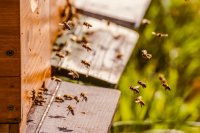
A beginner beekeeper managing fewer than ten hives may limit movements to only the necessary ones, provided there are still adequate honey reserves in each colony. This is the first indication that the environment continues to provide sufficient resources. The second indication is strong flight activity at the hive entrance, with many bees returning while carrying nectar and pollen.
When supplemental feeding is needed
If flight activity becomes sparse and the beekeeper cannot relocate the hives, supplemental feeding should be considered essential. A common syrup mixture consists of water, sugar, and a small amount of lemon juice. The recommended ratio is half water and half sugar. During spring or periods of increased demand, a denser syrup can be used, such as one part water to two parts sugar.
My experience with rice flour sparked my curiosity about what other alternative food sources bees might use. I discovered that sugar syrup is not the only option. Bees are capable of collecting and metabolising aloe vera gel, bananas, and pumpkin.
Experiments have shown that when pumpkin is blended with water into a syrup-like mixture, it becomes easier for bees to collect. There are also examples where beekeepers place whole bananas or aloe leaves cut in half, and bees collect from them normally. Creating a pulp or syrup seems preferable, since bees expend less energy when food is already available in liquid form.
These experiments may not yet provide sufficient evidence for definitive conclusions, but they certainly offer food for thought for anyone interested in exploring beekeeping a little further.
References
Giannoukou, A. (2019). Detection and quantitative determination of pesticides and their metabolites used against the olive fruit fly in bees and bee products using liquid chromatography coupled with tandem mass spectrometry (LC-MS/MS) and gas chromatography tandem mass spectrometry (GC-MS/MS). Larissa.
Neupane, K. R., and Thapa, R. B. (2005). Alternative to off-season sugar supplement feeding of honeybees. Journal of the Institute of Agriculture and Animal Sciences, 26, 77–81.