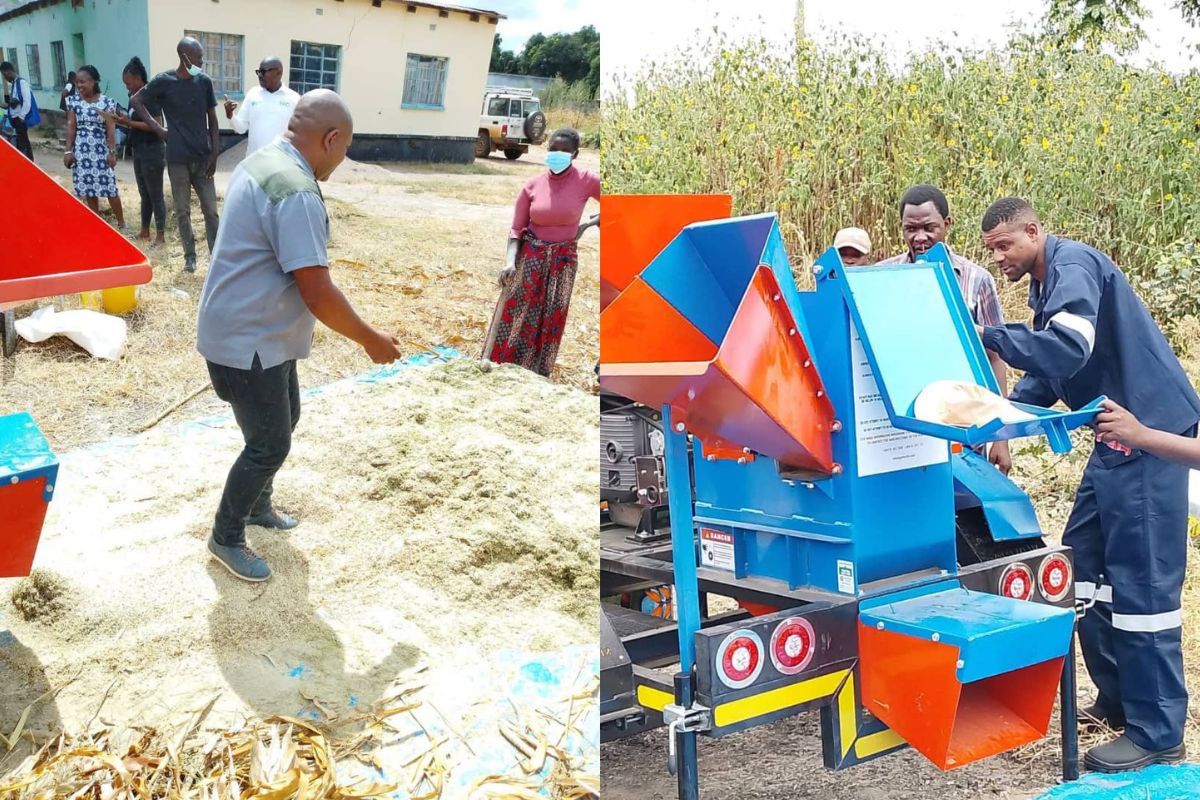
Pellet-making machines are transforming how smallholder and commercial farmers in Zambia and beyond produce animal feed by converting on-farm residues (pasture grasses, maize stalks, and coarse “meal number three”) into dense, nutrient-rich pellets. Under FAO’s drought-response programme, Mungaila and Chitongo cooperatives in Namwala received complete pelleting units (crusher, mixer, and press) supplied by Rudy Agritactic Machines, following Zambia’s declaration of the 2023–24 drought as a National Disaster by President Hakainde Hichilema. These machines, backed by hands-on operator training, allow farmers to harness abundant local biomass, reduce reliance on expensive commercial feed, cut waste and greenhouse gas emissions from residue burning, and build resilience against future dry spells.
What Is Pelletizing and Why It Matters
Pelletizing is the process of compressing or molding powdered or ground materials into uniform cylindrical pellets, improving storage, handling, and digestibility. In animal feed applications, raw inputs (e.g., grass, maize bran, oilseed cakes) are first milled into a fine powder, mixed to achieve a balanced ration, then forced through a die under heat and pressure to form pellets. The generated heat also “cooks” the feed slightly, enhancing nutrient availability and palatability.
Key Advantages of Pelleted Feed
Pelleted feed offers several advantages that are transforming livestock nutrition for farmers. Firstly, the dense nature of pellets significantly reduces feed wastage while boosting weight gain and milk yields, particularly in ruminants. Additionally, pellets have an enhanced shelf life; unlike fresh fodder, they resist spoilage and can be stockpiled for use during dry seasons. Their consistency and flexibility allow farmers to blend various agricultural residues, such as the common grass, maize stalks, and meal number three, to create customized nutrient profiles suited to specific livestock requirements. Most importantly, on-farm production of pelleted feed can cut feed expenses by up to 50%, as reported by farmers in Namwala, making it a cost-effective and sustainable feeding solution. FAO’s Drought Response Boost in Namwala
In response to one of the worst droughts in decades, officially declared a National Disaster on February 29th, 2024, FAO mobilized USD 6.1 million to support 200,000 small-scale Zambian farmers, including cooperatives in Namwala District. As part of this package, Mungaila and Chitongo cooperatives each received a full pelleting unit (crusher, mixer, press) purchased by FAO and delivered through Rudy Agritactic Machines.
Local Training and Adoption of Farmer on the Technology
After delivery, technicians from Rudy Agritactic Machines conducted hands on workshops for cooperative members, covering machine operation, routine maintenance, and feed formulation. These efforts were made possible through the close collaboration and support of the District Livestock Production and Extension Officer (DLPEO), who was key in mobilizing farmer groups, facilitating training logistics, and ensuring that the technology was adopted effectively.
The DLPEO also provided critical technical guidance on selecting suitable feed ingredients and advised farmers on optimal pellet rations based on livestock nutritional needs. Given Namwala’s abundant grass species, from Napier to native rangeland varieties, the units can grind virtually any forage into pellets that livestock can readily consume. Thanks to this strong extension support, farmers report bagging 25 kg of pellets in under 30 minutes and achieving consistent livestock performance even in peak dry months.
Climate and Economic Impacts
By converting crop residues into livestock feed, farmers make use of what would otherwise be waste and help reduce harmful environmental practices such as biomass burning, a major source of CO₂ emissions and particulate pollution. This approach also eases the demand on commercial feed markets. Amid the ongoing drought, cooperative-led pelleting initiatives have made a significant impact: they have halved monthly feed expenditures for participating farmers, ensured a steady supply of fodder which helps prevent distress sales of livestock, and ultimately strengthened community resilience by maintaining animal health throughout the lean seasons.
Looking Ahead: Scaling Resilience
The success in Namwala offers a replicable model: FAO backed, machinery enabled, and cooperatively managed pelleting hubs. With supportive policies and potential financing from government or development partners, more districts could adopt mobile or shared pelleting services, insulating farmers against climate shocks and volatile feed prices.
Reference
- Food and Agriculture Organization of the United Nations (FAO). (2024). Zambia: Emergency Drought Response Plan 2024–2025. FAO Emergency Response Coordination. https://www.fao.org
- Zambia Daily Mail. (2024, March 1). President Declares Drought a National Disaster. https://www.daily-mail.co.zm
- Pelletizing Process in Animal Feed Production. (2022). Feed Strategy Magazine. Retrieved from https://www.feedstrategy.com
- Rudy Agritactic Machines Zambia. (2023). Pellet Feed Machines – User Manual and Product Information. Internal Training Documentation.
- Mekonnen, M. M., & Hoekstra, A. Y. (2010). The Green, Blue, and Grey Water Footprint of Farm Animals and Animal Products. UNESCO-IHE Institute for Water Education.
- Chimonyo, M., & Mapiye, C. (2013). Livestock Feed Resources and Feeding Practices in Southern Africa: Constraints and Opportunities. Journal of Animal Science Advances, 3(5), 246–255.
Further reading
Hydroponic Fodder Production in Namwala District: A Game Changer for Livestock Farmers
Influence of Betaine Supplementation on Heat Stress in Livestock
The Role of Agro-Industrial By-Products for Sustainable Livestock Systems
𝘔𝘦𝘨𝘢𝘴𝘱𝘩𝘢𝘦𝘳𝘢 𝘦𝘭𝘴𝘥𝘦𝘯𝘪𝘪: A Probiotic Solution for Rumen Health and Feed Efficiency
Novel Approaches to Feed Additive Delivery for Enteric Methane Reduction in Cattle
The Role of Fiber in Ruminant Health and Dairy Productivity
Optimizing Nutrition to Prevent Post-Weaning Diarrhoea in Piglets