Every year, millions of tonnes of food are lost or wasted before they can feed anyone. Crops are left behind in the field, fruit is damaged in transport, and food is thrown away in shops and homes. Food can be lost at almost every stage of its journey from farm to fork.
Most attention goes to waste in households, restaurants and supermarkets, but prevention has to start much earlier. Farmers stand at the beginning of the food supply chain, and they can do a great deal to cut losses, particularly at harvest and in post-harvest handling.
Food loss and food waste are not the same
The two terms are often used interchangeably, but they describe different parts of the chain. Food loss is the food that disappears or deteriorates between harvest and retail, during harvesting, handling, storage, transport, processing and wholesale. FAO measures it from the point of harvest up to, but not including, the retail stage.
Food waste happens further along, at retail, in food service and in households. It is food that could have been eaten but is thrown away because it was surplus, past its best, or did not look the way buyers wanted.
Better harvesting, storage and transport reduce losses. Waste calls for different measures, such as better purchasing, food management, redistribution and consumer habits.
How big is the problem?
According to FAO, 13.3% of food was lost globally in 2023 between harvest and retail, up slightly from 13.0% in 2015, when global monitoring began. Sub-Saharan Africa has the highest regional loss rate, at 23.0%.
Fruit and vegetables are the most vulnerable. Their loss rate rose from 23.2% in 2015 to 25.4% in 2023, which FAO attributes to their high perishability and handling requirements.
At the consumer end the figures are just as stark. UNEP estimates that 1.05 billion tonnes of food were wasted in 2022 at the retail, food-service and household levels, almost one-fifth of the food available to consumers. Households account for about 60% of it.
Why it matters
Producing food takes land, water, seed, fertiliser, energy, labour and money, and harvesting, packing, cooling, transporting, processing and selling it takes more. When that food is never eaten, all of those resources have been spent for nothing.
Food loss and waste generate an estimated 8 to 10% of global greenhouse gas emissions, and food decomposing in landfill produces methane, a potent greenhouse gas. UNEP also estimates that food loss and waste take up 28% of the world's agricultural land and a quarter of agriculture's freshwater.
Reducing food loss and waste therefore helps to:
- cut greenhouse gas emissions,
- save water, land, fertiliser and energy,
- improve food availability and food security,
- increase the amount of produce farmers can sell,
- reduce the pressure to expand farming into natural ecosystems.
That is why the Sustainable Development Goals include a specific target, 12.3, to halve per capita food waste at retail and consumer level by 2030 and to reduce food losses along production and supply chains, including post-harvest losses. FAO tracks progress on losses and UNEP on waste.
What farmers can do to reduce food loss
Harvest at the right stage
Harvesting too early or too late affects quality and shelf life. Know the maturity indicators for each crop and the specifications of the market you are selling to.
Handle produce carefully
Bruising, cuts and other physical damage speed up deterioration and give microorganisms a way in. Train workers to handle crops gently, never throw produce into containers, and use harvesting crates suited to the crop.
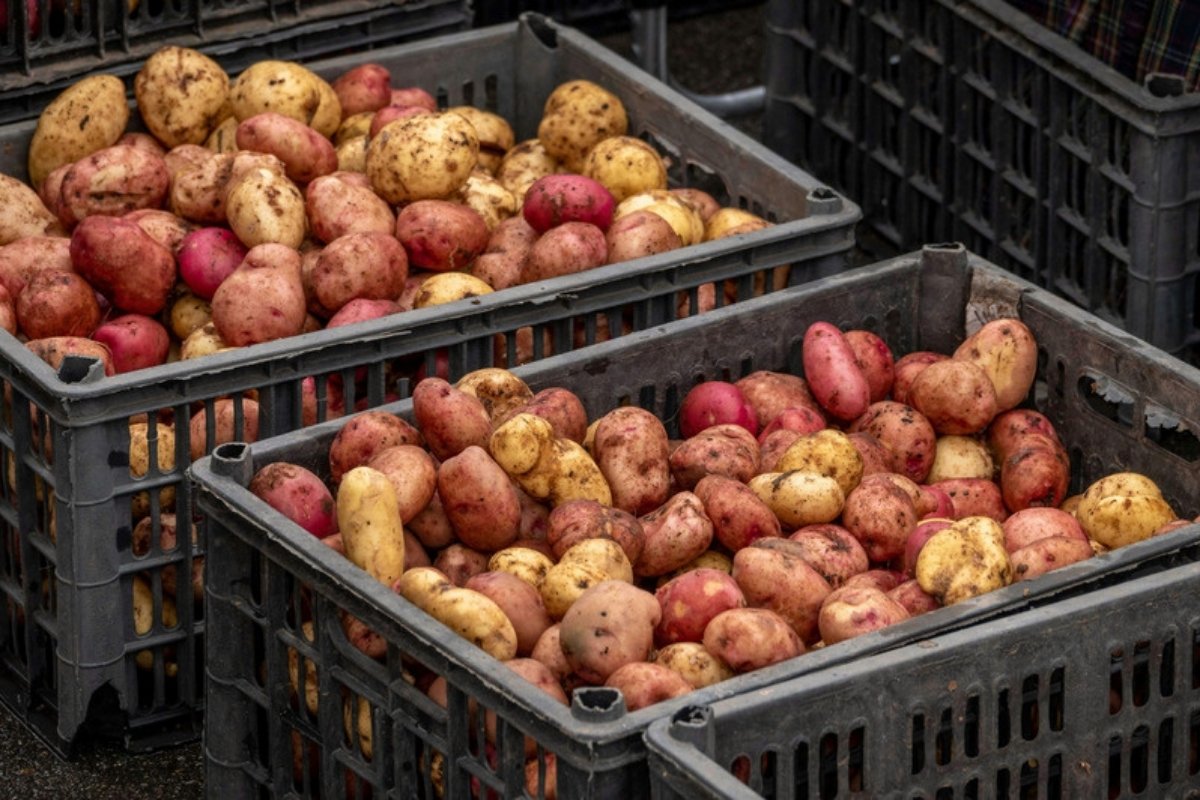
Harvest crates suited to the crop reduce bruising and other physical damage between the field and the market.
Keep harvested produce cool and protected
Many fresh fruits and vegetables deteriorate quickly at high temperatures. Move harvested produce into shade straight away and get it to a suitable cooling or storage facility. For highly perishable crops, pre-cooling and a cold chain can extend shelf life considerably where they are economically feasible.
Improve storage
Storage conditions should match the crop. Grain, for example, has to be dried properly before it is stored. Stores should be clean, well ventilated and protected from pests, moisture and contamination, and fresh produce should be stored so that ethylene from ripening fruit does not speed up deterioration in the crops around it.
Use suitable packaging and containers
The right packaging reduces bruising, contamination, moisture loss and physical damage. What works best depends on the crop, the distance to market and the transport conditions.
Improve transport
Poor roads, unsuitable vehicles, overloading and excessive stacking all cause post-harvest damage. Use suitable containers, avoid overloading, and keep the time between harvest and delivery as short as possible.
Plan production around markets
Growing more than the market can absorb creates surplus. Where possible, talk to buyers before planting, follow market demand, and consider staggered planting and harvesting.
Find other uses for surplus
Produce that does not meet a buyer's preferred size, shape or appearance can still be perfectly good to eat. Alternative markets, processing, drying and preservation, or use as animal feed can keep it from becoming waste. What cannot be eaten or fed can still be composted and returned to the soil, provided it is composted safely.