Most advice on fresh produce export is written around fruits that forgive mistakes. This piece is about one that does not. The fresh fig is among the most rewarding and most demanding fruits in the trade, and following it from the grower's field to the export market shows exactly what fresh export really asks of you. The GI-tagged Purandar fig grown in Maharashtra shows this as clearly as anything, because it rewards good handling and punishes shortcuts.
Why the fig is so demanding
Most fruits give you room to recover from a mistake. An apple travels for weeks and still arrives sellable. The fig asks for more discipline than that at every stage.
A fresh fig has thin, tender skin, and it does not gain sugar after harvest the way a banana or an avocado does. The quality you pick is close to the quality you deliver, minus whatever the journey takes from it. Its useful life is measured in days rather than weeks, and from the moment of harvest, the clock is running: picking, cooling, packing, transit, and shelf each draw down that window.
The numbers make the point better than any description, and for Indian figs, they are tighter than the published figures suggest. In practice, an Indian fresh fig gives around two days of genuine quality after harvest at ambient conditions. Operators handling it well, with disciplined cold-chain management, have pushed that to roughly five or six days. That is a short window, even by the standards of a fruit already known for its short life, and it is the single hardest constraint an Indian fig exporter works against. The cold chain here is not a refinement. It roughly triples the fruit's usable life and determines whether the consignment reaches a distant market in sellable condition at all.
That single fact shapes the entire operation. The craft of exporting figs is the craft of protecting a short, precious life all the way from field to shelf.
What makes the Purandar fig worth the trouble
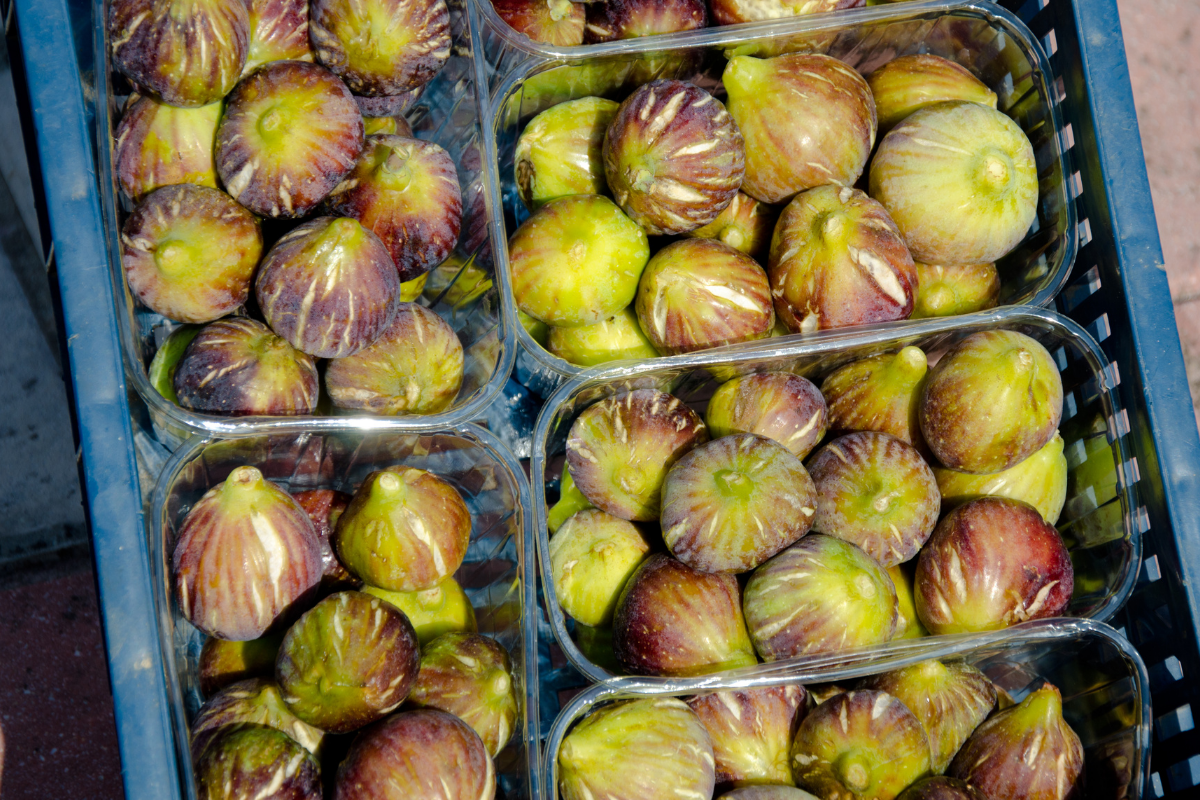
The Purandar fig has a genuine reputation. It carries a GI tag awarded in 2016, the only Indian fig variety to hold one, and it is also known as the Poona fig. It grows in the Purandar taluka of Pune district at roughly 900 to 1,100 metres, where dry weather, hilly slopes and well-drained red and black soils give it its character. The fruit is bell-shaped and larger than most varieties, typically weighing 40 to 60 grams, with greenish-violet skin, reddish-white pulp, more than 80% edible, and a sugar content of 18 to 22 Brix. The main season runs from around October to April.
It is exactly the kind of origin an export market responds to: a specific place, a protected name, and a fruit that tastes of somewhere.
The growing is not the easy part, because nothing about the fig is easy. It demands care in the orchard and more care still the moment it is picked. Getting Purandar fruit to a distant market is a continuous effort to maintain quality against the clock, and it takes real investment in the cold chain, handling, and packing to extend shelf life as far as the fruit will allow.
A shipment that taught the lesson
One early attempt to move Indian figs into the European market taught me more than any success could. I mentioned it briefly when writing about what importers actually check on arrival, and I think it would be worth telling properly here.
The taste was never in question, because the fruit itself was excellent. But by the time the consignment arrived, much of it had continued to soften and had reached full maturity in transit. The uniformity was gone. Some fruit was perfect, some had moved past the point a supermarket would accept, and a supermarket does not buy "mostly good." It buys consistently, or it does not buy.
The lesson was not that the fig is too delicate to export. It was that the fig had to be exported on its own terms, meaning the right ripeness at harvest, an unbroken cold chain, and the right mode of transport. Get those wrong and even superb fruit fails. Get them right, and it travels.
The craft of ripeness
Ripeness is the whole game with figs, and it is a real trade-off with no perfect answer.
Pick too early, and the journey is protected, but the fruit is lost. Because figs barely develop after harvest, an under-ripe fig will never gain the sugar and softness the buyer is paying for. It arrives intact and disappointing.
Pick too late, and you have a magnificent fig that will not hold. At full ripeness, the fruit is soft, sweet and already moving. Put it through cooling and transit, and it arrives overripe.
The export window is therefore narrow. The fruit has to be ripe enough to satisfy the buyer and firm enough to survive the trip. Judging that window is a skill rather than a formula, and it shifts with variety, season, weather and the exact route the fruit will take.
Figs travel by air
This is the single most important operational truth about exporting fresh figs, and there is no way around it. Fresh figs move by air rather than by sea.
For a fruit with a working life of five or six days, even under disciplined refrigeration, ocean freight is not viable. The fruit would never arrive in sellable condition. Air freight is expensive, and that cost sits at the centre of the economics of every fresh fig shipment, but it is the price of entry.
Even by air, with only a couple of days in transit, a fig picked too ripe will still arrive at full maturity. Air freight buys a viable journey. It does not rescue a fruit picked at the wrong moment, and the cold chain and the harvest decision still have to be right.
Within that reality, the levers that matter are speed to cold after harvest, an unbroken chilled chain with no warm gaps, and protective single-layer packaging so that fruit never presses on fruit.
What the market expects
European buyers and supermarkets expect a fresh fig that is uniform in size and colour, visually clean, sweet, and presented in retail-ready packaging. The bar on cosmetic consistency is high because a fig sells partly on how it looks in the punnet. This is the same standard-versus-saleability question that decides whether a buyer reorders, and it applies with particular force to a fruit this fragile.
The domestic Indian market is more forgiving. Figs are sold and consumed closer to where they grow, faster, without the punishment of a long journey or the demand for perfect uniformity. That is why the same fruit can be a star at home and still face a harder test in export markets. The test is not flavour. It is uniformity, and arriving in the condition it left in.
Processing is a strategy, not a fallback
Here is the part that changes the economics of a fig operation, and it deserves to be stated clearly. Processing is not a dumping ground for rejected fruit. It is a deliberate strategy that applies to the whole crop.
A fully ripe fig, the very fruit that is hardest to send fresh, is ideal raw material for a spread, a juice or a dried product. The ripeness that is a liability in a fresh punnet becomes an asset in a processed one, bringing more sugar, more flavour and more depth. The shelf-life problem disappears entirely because a fig spread or a fig juice travels for months at ambient temperature, on ocean freight, into markets a fresh fig could never reach. The Purandar fruit is well-suited to this, with more than 80% pulp and a high sugar content.
Fresh figs capture the premium retail moment wherever the fruit can reach it by air. Processed figs extend the season far beyond harvest, reach markets fresh in ways never possible, and carry the same Purandar provenance and story into a durable product. Two routes from one crop, and together they make the whole operation resilient in a way fresh alone never could be.
This is not a theoretical strategy for Purandar fruit. It has been built. The Purandar Highlands Farmers Producer Company, formed in 2021 by a group of full-time fig farmers, has spent the past decade turning the region's figs into an export story on both routes at once. Fresh Purandar figs reached Europe through Hamburg in 2022, and the first commercial consignment of GI-tagged fruit went to Hong Kong in February 2023. On the processed side, a ready-to-drink fig juice made from the same GI fruit won recognition at SIAL in 2023. It was shown at Macfrut in Italy the following year, which produced the buyer enquiry that led to India's first export of ready-to-drink fig juice, shipped to Poland in August 2024 with APEDA's support. The same fruit now travels under the tāroi brand in both fresh and processed form.
That is the two-route argument working in practice. The fresh fruit takes the premium moment where air freight can deliver it in time, and the juice carries the same provenance into a market, and a season the fresh fig could never have reached. My own company, Scion Agricos, served as the export partner for that juice, so I have watched this particular case up close.
The hardest truth for a fig exporter
If there is one thing to take from this, it is that with figs, the fruit is rarely the problem. The journey is.
Anyone can grow a genuinely world-class fig and still fail at export by treating it like a sturdier fruit. Success comes from respecting what the fig demands, which is precise harvest timing, an unbroken cold chain, air freight as a given rather than a choice, and a deliberate processing route that turns the whole crop into value. It also comes from writing it all down, because a specification that states the tolerances and the arrival condition is what settles a dispute before it starts. Master those, and the fig stops being the most demanding fruit to handle and becomes one of the most rewarding.