Most advice on agricultural export is written from the grower's side of the table. This one is written from the other side. As an importer who receives samples and trial shipments all the time, I want to explain what actually happens when your fruit or vegetables land on an importer's desk, and why so many good products never earn a second order.
The moment a sample arrives
When a trial shipment or a sample reaches us, we do not simply look at it and decide. We run it through a sequence of checks, because our job is to predict how that product will perform in a specific market, well beyond how it looks on the day it arrives.
The first layer is physical: damage, texture, size, variety, and taste. Taste matters, but I treat it carefully, because it is the most subjective attribute, and an importer's palate is not a complete stand-in for the final consumer's.
The second layer is compliance: maximum residue limits (MRLs), pesticide records, and certificates. For a European buyer this layer is not optional. A beautiful fruit that fails on residues is not a product an importer can sell. It is a liability.
The third layer is behaviour over time. If the variety or the product is new to a market, we test how it travels and how it holds. When I brought in one of the first shipments of Brazilian limes to India, a fruit that is completely normal in Europe but new to India, we checked shelf life, whether it kept its colour, and how it behaved in storage. We even gave it deliberate temperature shocks, because the cold chain in India is not continuous the way it is in Europe, and the fruit has to survive the real journey, not the ideal one.
The final layer is the market itself. We send the product to several customers who already work with that category, and to our supermarket buyers, and we move only when the feedback lines up across more than one of them.
The lesson for growers is this. Your buyer is not judging your fruit. They are judging how your fruit will perform after transit, in storage, and in front of their own customer. That is a much harder test than the one you run at your own packhouse.
The same product is not the same product in every market
One of the most expensive mistakes I see is assuming a specification is universal. It is not. The same crop, grown on the same farm, needs to be prepared differently for different destinations.
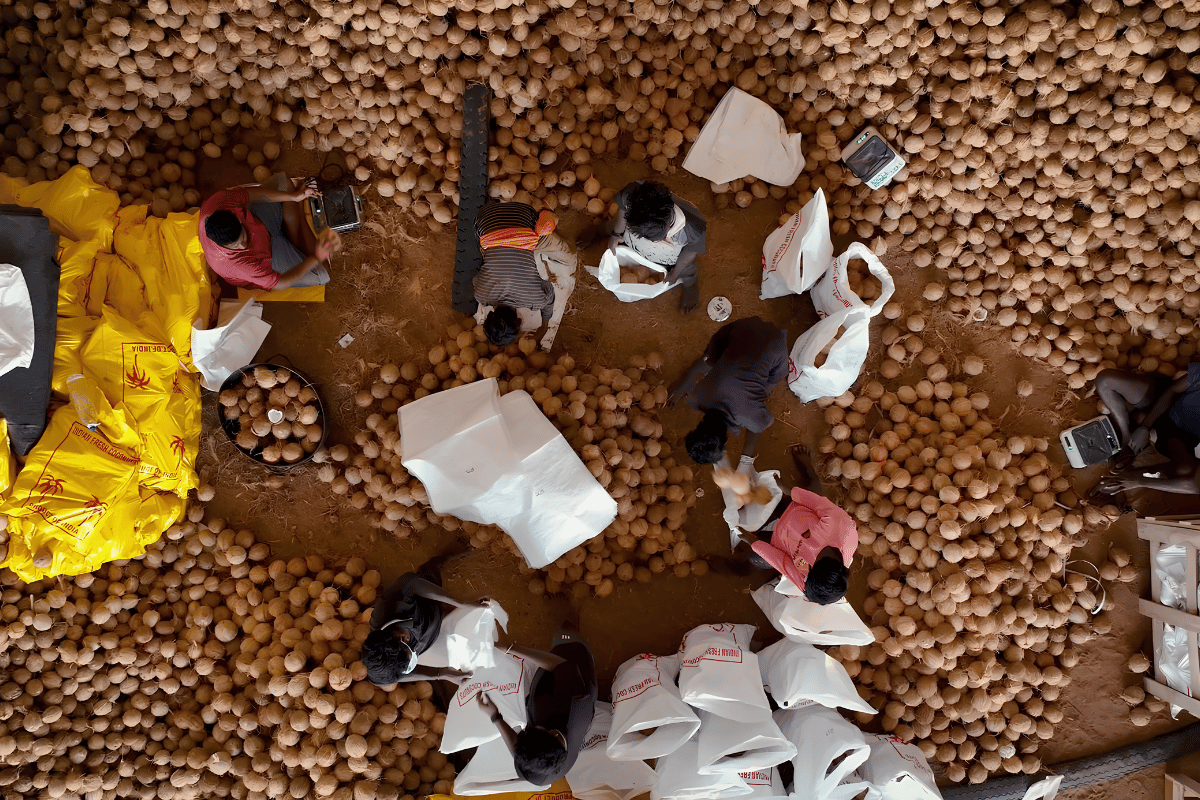
Take coconuts. The same Indian coconut is exported to the Middle East, to several Asian markets, to the UK, and to Europe, and each destination wants something different. Europe and Russia want de-husked coconuts. The Middle East wants them husked. I know of a European company that once imported Indian coconuts from another supplier and received them husked, perfectly good nuts prepared perfectly wrong for that market. The product was fine. The specification was not.
This is the point growers underestimate. A category-two tolerance, a size band, a finish, a wash standard, these are market-specific, not product-specific. Growers from open or lightly regulated markets often have no system to control these variables, and growers who can sell category-two or lower-grade fruit at home assume that grade will travel. In the European Union, it usually will not. Aligning on a written quality standard before anything ships is what prevents this.
Europe and India are almost mirror images
I work across both Europe and India, and they are close to opposites in what the buyer expects. Understanding the difference is worth more than any glossy brochure.
Europe is demanding on the invisible things: residue limits, certification, documentation, cold-chain paperwork, and consistency shipment after shipment. For citrus, up to roughly 10 to 15% of skin marks or blemish can still sit within category one, because Europe accepts that fruit is a natural product. What it will not accept is inconsistency, a failed residue test, unspecified specifications, or paperwork that does not match the pallets.
Two real examples show how easily this goes wrong. We once sent figs from India to the European market. The taste was excellent, but by the time the fruit arrived much of it had reached full maturity in transit, and the uniformity was gone. No supermarket could take it. Separately, we received ginger samples from Indian growers intended for Europe. Our requirement was 200 to 250 g and above; the growers sent pieces as small as 25 g mixed in, unwashed and poorly packed. Good ginger, wrong preparation, wrong result.
India inverts the logic. Yes, we are price-sensitive, but there is something deeper. India imports fruit on the belief that anything imported should be better than what is grown locally: better colour, better shelf life, healthier, a marker of a better lifestyle. Ten years ago avocado was a symbol of wealth here. As origins like Tanzania and Kenya expanded supply and retail prices came down, avocado shifted from a status product toward something eaten more regularly, though still not by everyone. Blueberries and plums, along with a few other fruits, still sit in that premium and aspirational bracket today.
This creates a specific tension. Citrus that is legitimately category one in Europe, with up to 10 to 15% skin or press marks, is often judged as not quite premium in India, because the buyer's whole reason for importing is the expectation of near-perfect visual quality. So there is a constant conversation, and sometimes miscommunication, between grower and importer about what "good" even means.
The myths that quietly cost exporters orders
A few beliefs come up again and again, and each one loses business.
- "My quality is the best." Almost every grower believes this. Belief is not a specification. What matters is whether the fruit meets the destination's written standard, not the grower's confidence.
- "Export testing proves quality." Testing done at origin tells you about the fruit at origin. It does not tell you how the fruit arrives, though with experience your predictions do get better.
- "What we pack is what they receive." This is the most costly assumption of all. A Polish apple shipped to India takes roughly 45 to 50 days to arrive. The question is never what the fruit looks like at packing. It is whether it will still be sellable after 45 days, with enough life left for the buyer to grade, distribute, and put in front of a consumer.
Indian mangoes are the clearest case of these myths combining. The taste is world-class, yet they struggle to reach mainstream supermarkets in the US and Europe beyond the diaspora market, precisely because of inconsistency in sizing, colour, and certification. The fruit is not the problem. The uniformity and the paperwork are.
The specifications buyers actually check
Numbers vary by fruit, but to make this concrete, here is the kind of specification I work with for apples going into India:
- Size: 100 to 165 count works well across most origins into India.
- Sugar (Brix): typically around 13 to 15, depending on the variety.
- Firmness: at least 7 to 7.5 kg/cm² on arrival. For a variety like Gala, firmness matters alongside colour; for a Red Delicious variety, colour can outweigh pressure.
- Shelf life on arrival: three to four weeks of usable life expected.
- Rejection tolerance: usually up to around 5%, though it varies.
These are not universal. Every fruit and every importer has its own numbers. What they show is the level of precision a serious buyer is holding you to. The same discipline underlies published export quality standards for individual crops, which are worth studying for whatever you grow.
What this means if you want to export
If you take one thing from an importer's perspective, take this. Winning a buyer comes down to delivering a consistent, market-correct, transit-proof product, backed by paperwork that matches. The best fruit does not win the order on its own.
Talk to your buyer before you pack. Ask which grade, which size band, which finish, and which certificates that specific market needs. Prepare the fruit for the journey it will actually take, not the one you wish it would take. Sound post-harvest handling through that whole chain is what protects the product between your packhouse and the buyer's shelf. Do that, and you stop being a one-shipment supplier and start being someone we reorder from.