
Water-Efficient Irrigation in Sugarcane Farming Using Pan Evaporation Scheduling
Climate Change Impacts on Asian Agriculture and Food Security
Asia is the most populated region in the world, with 4.5 billion people, or approximately 60% of the global population (Habib-ur-Rahman et al., 2022). Around 70% of the whole population resides in rural communities, 75% of which are poor and most vulnerable to climate change, especially in arid and semi-arid regions. The population will be more than 5.2 billion by 2050, challenging Asia to achieve food demand and attain food security (Rao et al., 2019). In Asia, the income diversification of small and poor farmers and rising urbanization are concerns for agricultural production. Because of the variety of climate-dependent cropping and farming systems, we can anticipate several climate change (CC) impacts negatively affecting the agricultural sector.
Enhanced flood and drought vulnerabilities particularly expose agricultural production to CC, as outlined in the IPCC's Sixth Assessment (Thomas et al., 2020). CC impacts, including increased temperatures, weather-related extremes, and sea-level changes. Global warming already affects the region's agricultural production, economy, and development despite the region's low greenhouse gas (GHG) emissions. Over the past decades, the temperature has increased by 0.6–1.0 °C and precipitation by 18–32%, which may tarnish agricultural productivity in nations like Pakistan (Asif et al., 2013). Most research suggests that things can become even worse in the future, making it a critical problem for Pakistani farming. Climate change-related issues hit industrialized and developing countries alike. However, coping with the fluctuating climatic conditions is a good means to reduce the risky impacts of CC in agriculture in developing nations like Pakistan (Khan et al., 2023).
Water Scarcity Threatens Crop Yields and Food Security in Pakistan
With growing water demands worldwide, water has emerged as a precious commodity in numerous sectors, such as agriculture, irrigation, hydropower, and water supply. Water demands are growing in many regions of the world along with population growth, but freshwater resources are dwindling (Hussain et al., 2023).
Pakistan is grappling with an acute shortage of water caused by wasteful irrigation practices, excessive exploitation of groundwater, low storage capacity, and pollution of surface and groundwater, which contribute jointly to the decline in the quantity and quality of water. Decreased water resources, which would alter crop rotation and modify sowing and harvest trends for an extended period, reduced the nation's major cash crop yields. Principally, the dry weather of the Pakistani southern Punjab renders wheat, cotton, rice, and sugarcane cultivation problematic owing to minimal precipitation levels, limited water supplies, and evapotranspiration levels (Awan et al., 2024).
Why Sugarcane is Vital to Pakistan’s Economy and Agricultural Growth
Sugarcane crops play a crucial part in developing nations' economies. Sugarcane is cultivated mostly in tropical and subtropical areas, producing almost 85% of the sugar used globally. The land under sugarcane has increased tremendously across the globe over the past five years. The production and yield of sugarcane have significantly increased in Pakistan compared to other crops. It is the 2nd most important economically valuable crop next to cotton. Pakistan is one of the major cane-producing nations and stands at 5th in terms of area, 6th in terms of production of cane sugar, and 9th largest sugar producer in the world. It's a high-value cash crop that's important for Pakistan's sugar and allied industries. It provides around 0.6% of the GDP and 2.9% of the agricultural value added. It generates massive revenue for the Government and is utilized as a source of energy/power (Afghan et al., 2023).
The weather in Pakistan favors sugarcane cultivation, particularly in Punjab and Sindh provinces. Various climatic conditions such as sunlight, temperature, germination, tillering, growth, humidity, dew, frost, hailstorms, windstorms, sunburn, and drought significantly influence sugarcane cultivation. The crop needs a significant quantity of water to grow. Hence, it is essential to use innovative, eco-friendly, and water-saving techniques to grow crops. Adopting appropriate measures for enhancing the production and profitability of sugarcane through timely irrigation, low-cost inputs, higher-quality seeds, and preventive measures against post-harvest loss (Raza et al., 2023). In this article, we talk about sustainable irrigation water methods to improve sugarcane cultivation and maintain irrigation water efficiency.
Using Pan Evaporation Technique to Improve Sugarcane Irrigation Efficiency and Yield
What is the pan-evaporation technique? - How can sugarcane yield and quality be enhanced with irrigation?
There are various ways to enhance sugarcane quantity and quality and make irrigation more efficient, such as using organic amendments, mulching in furrows, and alternate irrigation patterns, but the pan evaporation technique is highly appropriate to reschedule irrigation in spring sowing sugarcane crops to cope with climate change and the alarming water scarcity situation in Pakistan.
The purpose of irrigation is to keep the soil moisture levels at optimum value in the zone of plant roots, such that the root will possess a continuous availability of moisture along with proper aeration. The water need of any crop will be a function of crop attributes such as variety, growth stage, duration, plant population, and growing season; soil attributes such as texture, structure, depth, and topography; climatic attributes such as temperature, relative humidity and wind speed and crop management practices such as tillage, fertilization, weeding, etc. Irrigation must be designed to replenish soil water in the root zone to the point where the crop can supply its entire evapotranspiration need (Jadhao et al., 2015).
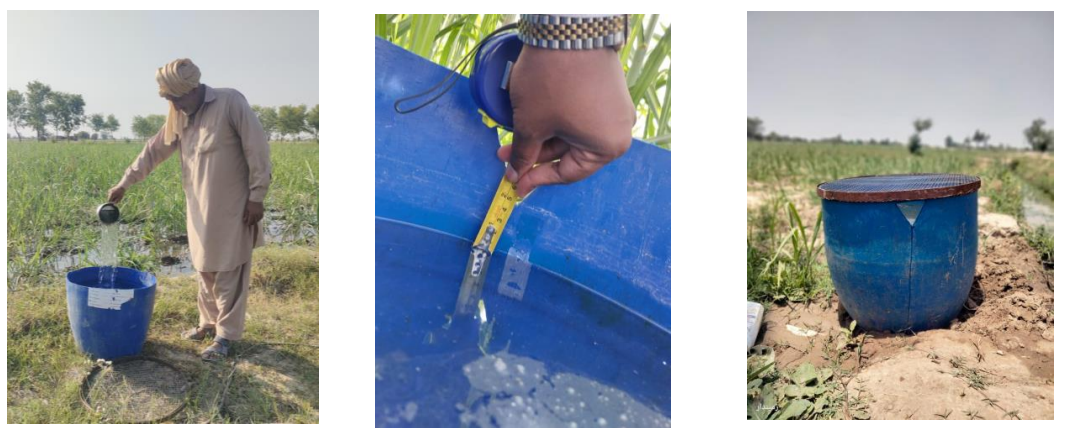
Open pan evaporation technique irrigation scheduling is the organized process through which farmers can determine when to irrigate and how much water to use. The aim of efficient scheduling programs is to provide the plants with adequate water while reducing losses to deep percolation or runoff. Pan- The pan-evaporation technique (Rashad & Omran, 2012) is a low-cost and easy technology that can be more appropriate for farmers. We conducted an adaptive research trial in a farmer's field to understand the working methodology of open pan evaporation.
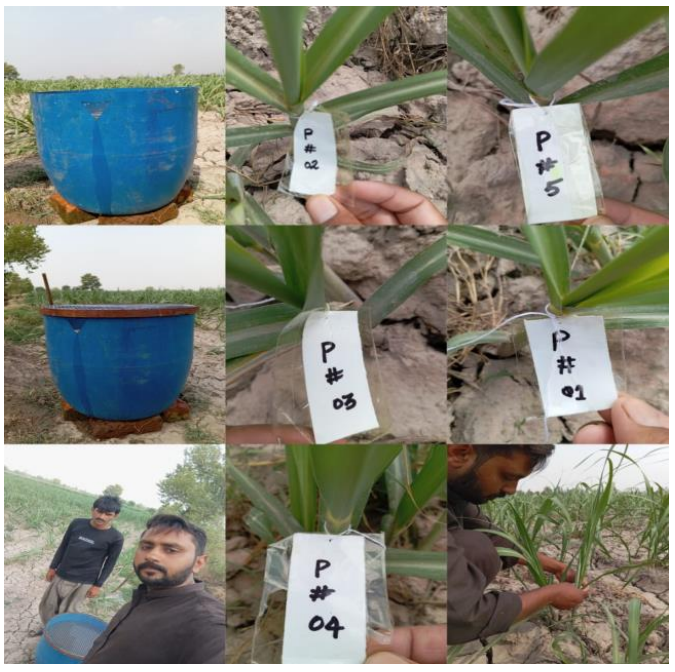
First, place an open evaporation Pan close to the chosen sugarcane acre that has a measuring scale with indicator marks and water at the flooded slot. Second, select 5 plants randomly in the chosen field and mark them with numbers to measure their height at 2 day intervals to ensure adequate and timely irrigation estimation. When chosen crops' growth ceases, and evaporation decreases the water level in the exposed evaporation pan to the marker level, the farmer initiates irrigation with a designated volume of water that refills the soil profile, and the cycle of irrigation is repeated (Vinh et al., 2015).
Conclusion: Climate-Smart Irrigation for Sustainable Sugarcane Production
Implementation of pan evaporation-based irrigation scheduling in sugarcane farming provides a scientifically supported strategy for water saving and yield maximization. Farmers can increase water use efficiency, maintain crop yields, and support environmental sustainability with irrigation aligned to real crop water requirements. The inclusion of contemporary tools such as mobile applications and the awareness of crop water requirements are imperative steps toward sustainable and productive sugarcane cultivation under climatic uncertainties.
References
Afghan, S., Khan, M.E., Verma, K.K. and Nikpay, A., 2023. Economic importance and yield potential of sugarcane in Pakistan. In Sugarcane Cultivation and Management (pp. 263-291). Apple Academic Press.
Asif, M., 2013. Climatic change, irrigation water crisis and food security in Pakistan.
Awan, A.G., Khan, A.R., Shabbir, L.R. and Jalal, A., 2024. ANALYZING THE CAUSES OF WATER SHORTAGE, LOW CROP YIELD, AND FOOD CRISIS IN PAKISTAN: A LONGITUDINAL ANALYSIS (1991-2019). Agricultural Sciences Journal, (1), pp.73-86.
Habib-ur-Rahman, M., Ahmad, A., Raza, A., Hasnain, M.U., Alharby, H.F., Alzahrani, Y.M., Bamagoos, A.A., Hakeem, K.R., Ahmad, S., Nasim, W. and Ali, S., 2022. Impact of climate change on agricultural production; Issues, challenges, and opportunities in Asia. Frontiers in Plant Science, 13, p.925548.
Hussain, S., Mubeen, M., Nasim, W., Fahad, S., Ali, M., Ehsan, M.A. and Raza, A., 2023. Investigation of irrigation water requirement and evapotranspiration for water resource management in Southern Punjab, Pakistan. Sustainability, 15(3), p.1768.
Jadhao, P.V., Chavan, V.K. and Deshmukh, M.M., 2015. Effect of Open Pan Evaporation Based Irrigation Scheduling on Growth and Yield of Wheat. Trends in Biosciences, 8(13), pp.3385-3390
Khan, N., Ma, J., Zhang, H. and Zhang, S., 2023. Climate Change impact on sustainable agricultural growth: insights from rural areas. Atmosphere, 14(8), p.1194.
Rao, N., Lawson, E.T., Raditloaneng, W.N., Solomon, D. and Angula, M.N., 2019. Gendered vulnerabilities to climate change: insights from the semi-arid regions of Africa and Asia. Climate and Development, 11(1), pp.14-26.
Rashad M. and Omran E. 2012. Development of a simple economical evaporation pan. P. 2018 in ‘International Conference of Agricultural Engineering—CIGRAgEng 2012: agriculture and engineering for a healthier life, Valencia, Spain, 8–12 July 2012’. International Commission of Agricultural Biosystems Engineering (CIGR): Kyoto, Japan.
Raza, H.A., Hameed, M.U., Islam, M.S., Lone, N.A., Raza, M.A. and Sabagh, A.E., 2023. Environmental and economic benefits of sustainable sugarcane initiative and production constraints in Pakistan: a review. Global Agricultural Production: Resilience to Climate Change, pp.441-468.
Thomas, A., Baptiste, A., Martyr-Koller, R., Pringle, P. and Rhiney, K., 2020. Climate change and small island developing states. Annual Review of Environment and Resources, 45(1), pp.1-27.
Vinh, H., Keen, B., Tam, H.M. and Slavich, P., 2015. Mini–evaporation pan irrigation scheduling: a tool for improving on-farm water use efficiency for peanut and tree crops in south-central coastal Vietnam. Sustainable and profitable crop and livestock systems in south-central coastal Vietnam, p.108.
Further reading
Soil and Water conservation
Enhancing Sugarcane Procurement & Processing in Pakistan: Strategies for Efficiency & Growth
Information, Uses, Health Benefits, and Nutritional Value of Sugarcane
Maximizing Sugarcane Yields and Sustainability with Intercropping
Price Risk Management in Sugar Cane Industry: Opportunities and Challenges
Regenerative Sugarcane: Sustainable Farming with Organomineral Fertilizers and CBIOs
Digital Soil Mapping: Boosting West Africa’s Agriculture
Optimizing Water Retention in Almond Orchards: Comparing Contour, Keyline, and Conventional Designs
How to Combat Desertification and Drought with Regenerative Agriculture