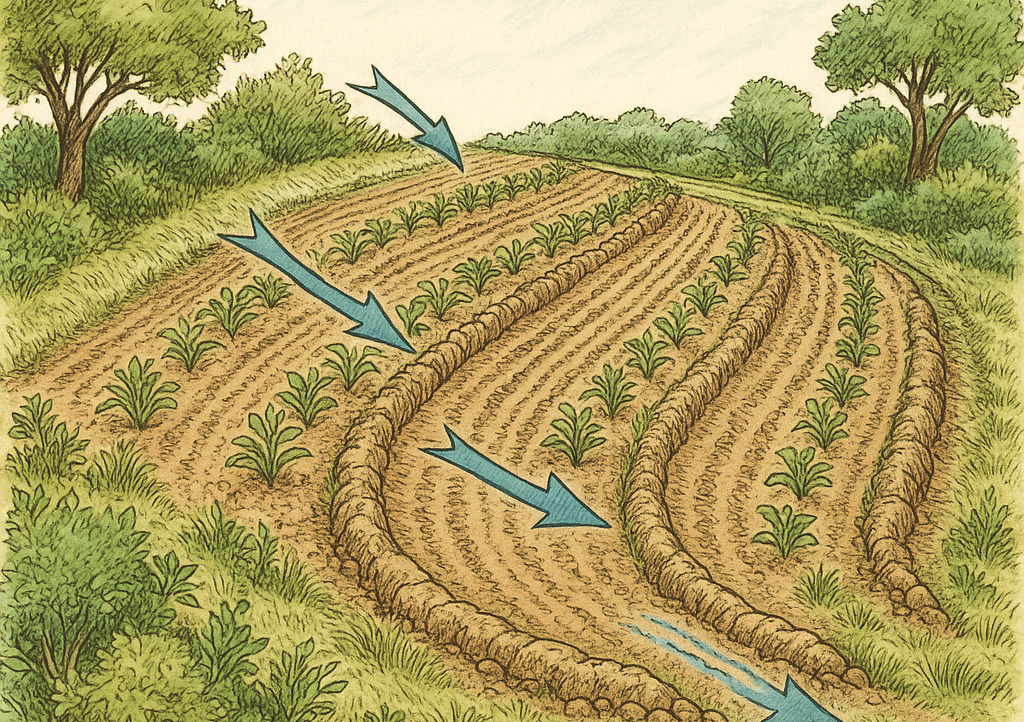
Mitigating Soil Erosion through Curved Slope Edges (CSEs): A Sustainable Approach
Summary
Soil erosion is a major challenge for sustainable agriculture, threatening crop yields and long-term land productivity. Traditional soil conservation methods, such as riparian buffer zones, often fall short-especially in upland or non-riparian areas. This article introduces Curved Slope Edges (CSEs), an innovative and practical soil erosion control technique. CSEs regulate water runoff, prevent sediment loss, and promote nutrient retention, making them a scalable and cost-effective solution for farmers worldwide. By integrating traditional knowledge with modern soil management practices, CSEs support sustainable land use and improved soil health.
Introduction
Soil erosion, the displacement of essential soil minerals and nutrients, poses a significant threat to agricultural productivity and ecological balance (Musa et al., 2024). This natural process, exacerbated by both environmental and human-induced factors, results in the depletion of fertile soil, reducing its ability to support plant growth and sustain optimal crop yields (Lal, 2015). Existing soil erosion control measures, such as Riparian Buffer Zones (RBZs) (Nair et al., 2024), have demonstrated limited effectiveness, particularly in areas far from water bodies where erosion remains unchecked.
A novel strategy, Curved Slope Edges (CSEs), presents a comprehensive solution by integrating traditional wisdom with modern soil conservation techniques. Designed to mitigate erosion across all cultivable lands, CSEs regulate water runoff, retain vital nutrients, and enhance microbial activity to restore soil fertility. This article explores the mechanics of CSEs, their practical implementation, and their impact on long-term agricultural sustainability.
Farmers’ Perspective: Why Soil Erosion Control Matters
For generations, farmers have grappled with the challenges of soil erosion, often viewing it as an unavoidable natural phenomenon (Gomiero, 2016). Many remain skeptical of existing erosion control strategies, citing their inefficiencies and impractical applications. The lack of awareness surrounding RBZs, coupled with poor implementation and inadequate management, has hindered their effectiveness in erosion-prone areas (Boota et al., 2024).
Recognizing these concerns, the concept of CSEs emerged as a practical, farmer-centered intervention aimed at reducing soil loss while maximizing land productivity. By leveraging natural slopes present in farmland and integrating locally available materials, CSEs offer an adaptable, cost-effective solution suited to various landscapes. Farmers can construct CSEs with minimal financial investment while ensuring significant long-term benefits.
How Curved Slope Edges (CSEs) Work
Structure and Implementation
Natural slopes in farmland contribute to soil displacement, particularly in areas with steep inclines (Osman, 2018). Controlling erosion in these zones requires strategic intervention that aligns with the land's gradient and water flow dynamics (Jiang et al., 2019). CSEs achieve this by modifying slope edges in a way that disperses runoff force and preserves fine soil particles.
The construction process of CSEs follows a structured approach:
- Placement: Built at the terminal edges of farmland where slopes are most pronounced.
- Elevation: Rising to a height of 6 inches, gradually tapering down towards the lower slope.
- Material Composition: Made using the same soil present in the farmland to maintain natural compatibility.
- Thickness: Initially 6 inches wide, decreasing to 0 inches at the lowest point, ensuring controlled water flow.
This structural formation regulates surface runoff, reduces erosive force, and traps fine sediment particles at slope endpoints.
Mechanism of Erosion Control and Soil Retention
The efficiency of CSEs lies in their ability to modify water runoff dynamics, reduce soil displacement, and facilitate nutrient retention. As runoff water flows across the farmland, the curved design of CSEs slows its movement, dissipating energy and minimizing erosion. Fine soil particles carried by runoff accumulate at the edge point, preventing their loss.
Once excess water drains away, retained sediments settle and dry at the CSEs boundary, creating nutrient-rich deposits essential for soil fertility. Farmers can then reintegrate these fine particles into the soil, preserving essential minerals required for crop growth (Soares et al., 2019). This cyclical soil restoration process ensures continuous fertility enhancement, reducing the need for external fertilizers while promoting sustainable land management (Mosier et al., 2021).
Advantages and Key Benefits of Curved Slope Edges
- Prevents soil erosion and nutrient loss
- Enhances soil fertility by retaining microbial-rich sediments
- Reduces reliance on external fertilizers
- Improves water retention and moisture balance
- Cost-effective and easy for farmers to implement
- Supports sustainable, long-term land management
The simplicity and effectiveness of CSEs make them a viable solution for farmers seeking cost-efficient, environmentally responsible ways to improve soil quality and agricultural productivity (Hussain et al., 2024).
Conclusion
Curved Slope Edges (CSEs) represent a breakthrough innovation in soil conservation, merging traditional farming techniques with modern strategic planning. By implementing CSEs, farmers can reduce soil erosion, enhance fertility rates, and safeguard long-term agricultural sustainability. This approach offers a scalable, adaptable, and highly efficient solution to one of agriculture’s most pressing challenges, ensuring soil health preservation for future generations.
References
Boota, M. W., Soomro, S. E. H., Xia, H., Qin, Y., Azeem, S. S., Yan, C., Luo, W., Yousaf, A., & Boota, M. A. (2024). Estimation of soil loss and sediment yield by using the modified RUSLE model in the Indus River basin, including the quantification of error and uncertainty in remote-sensing images. Marine and Freshwater Research, 75(17), NULL-NULL. https://doi.org/10.1071/MF24082
Gomiero, T. (2016). Soil Degradation, Land Scarcity, and Food Security: Reviewing a Complex Challenge. Sustainability 2016, Vol. 8, Page 281, 8(3), 281. https://doi.org/10.3390/SU8030281
Hussain, A., Fekry Elkarmout, A., Mansour, Z., Awais, M., Usman, M., Ahmad, H., Faisal, M., Ahmad, T., Khan, A. M., & Pakh-Tunkhwa, K. (2024). An Environment-Friendly Practice, the Climate Smart Agriculture Crop Production and Soil Management Systems: A review. Journal of Sustainable Agricultural and Environmental Sciences, 3(3), 101–124. https://jsaes.journals.ekb.eg/article_362527.html
Jiang, C., Zhang, H., Zhang, Z., & Wang, D. (2019). Model-based assessment soil loss by wind and water erosion in China’s Loess Plateau: Dynamic change, conservation effectiveness, and strategies for sustainable restoration. Global and Planetary Change, 172, 396–413. https://doi.org/10.1016/J.GLOPLACHA.2018.11.002
Lal, R. (2015). Restoring Soil Quality to Mitigate Soil Degradation. Sustainability 2015, Vol. 7, Pages 5875-5895, 7(5), 5875–5895. https://doi.org/10.3390/SU7055875
Mosier, S., Córdova, S. C., & Robertson, G. P. (2021). Restoring Soil Fertility on Degraded Lands to Meet Food, Fuel, and Climate Security Needs via Perennialization. Frontiers in Sustainable Food Systems, 5, 706142. https://doi.org/10.3389/FSUFS.2021.706142/XML/NLM
Musa, I. O., Samuel, J. O., Adams, M., Abdulsalam, M., Nathaniel, V., Maude, A. M., Adedayo, O. A., & Tiamiyu, A. T. (2024). Soil Erosion, Mineral Depletion and Regeneration. In Prospects for Soil Regeneration and Its Impact on Environmental Protection (pp. 159–172). Springer, Cham. https://doi.org/10.1007/978-3-031-53270-2_7
Nair, J. V., Verma, J., & Shinde, V. R. (2024). Enriching and maintaining the riparian buffer zone. Managing Urban Rivers: From Planning to Practice, 161–180. https://doi.org/10.1016/B978-0-323-85703-1.00018-3
Osman, K. T. (2018). Soils on Steep Slopes. Management of Soil Problems, 185–217. https://doi.org/10.1007/978-3-319-75527-4_8
Soares, J. C., Santos, C. S., Carvalho, S. M. P., Pintado, M. M., & Vasconcelos, M. W. (2019). Preserving the nutritional quality of crop plants under a changing climate: importance and strategies. Plant and Soil 2019 443:1, 443(1), 1–26. https://doi.org/10.1007/S11104-019-04229-0
Further reading
Enhancing Grain Production Through Optimized Tillage and Cover Cropping Strategies
Insect Frass: A Sustainable Solution for Soil Health and Fertilization
Land Degradation Neutrality through Carbon Farming Practices
What is Soil Compaction and How to Reverse it?
The Role of Agroforestry Systems in Increasing Water Availability
Soil and Water Conservation Strategies