Current situation
Land is a non-renewable resource, and some detrimental consequences of deteriorating processes on land quality, such as a decrease in effective rooting depth, are irreversible. Land degradation is a significant worldwide problem since more than 70% of the Earth's ice-free land has already been affected by human activity. Desertification occurs in around 33% of the Earth's geographical area and impacts over one billion people, with half residing in Africa (1).
Land degradation negatively impacts soil's ability to support a variety of living organisms, plant growth, and ecosystem well-being. The decrease in land quality due to land degradation influences soil productivity. Soil erosion and desertification have caused a 50% decrease in the production of some farms. However, using extra inputs and adopting superior technologies may readily disguise the impact of land degradation on production.
The annual worldwide cost of land degradation, specifically concerning agriculture, amounts to around US$500 billion (2). In response to alarming ecological and economic situations, the United Nations General Assembly approved the "Sustainable Development Goals" in 2015. These goals include a specific objective to address desertification and rehabilitate damaged land. The objective is to achieve land degradation neutrality by 2030. The framework followed was to minimize > mitigate > counteract the land degradation.
What is land degradation neutrality (LDN)?
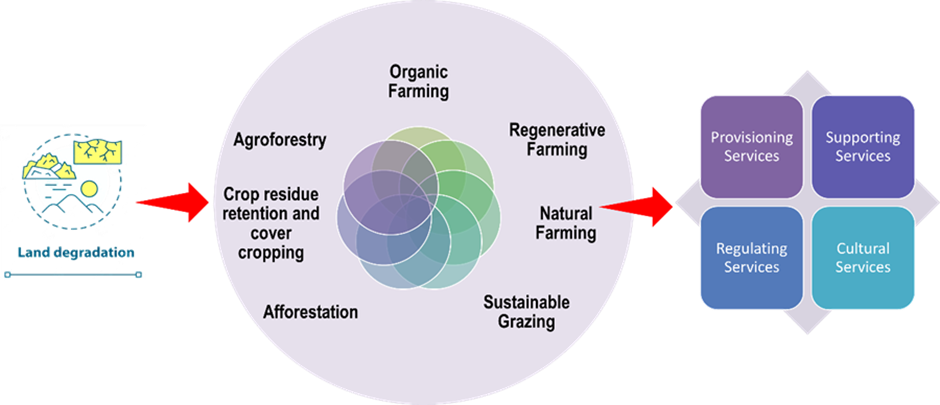
Attaining land degradation neutrality (LDN) refers to maintaining or enhancing the quality of soil and land resources from degradation. It is crucial for achieving food security and climate resilience. Carbon farming is a potentially effective method for achieving the LDN in agroecosystems. Carbon farming offers a comprehensive approach to address land degradation and promote a sustainable, carbon-neutral future. Carbon farming practices use sustainable land management strategies to enhance soil and vegetation carbon sequestration and climate resilience. Some important techniques include:
Agroforestry
Reforestation and afforestation have the potential to significantly improve carbon sequestration in areas that have already been degraded. The majority of commonly used agroforestry (AF) systems are often sustainable or resilient. However, they often encounter issues such as conservation of natural resources, productivity, land degradation, unpredictable climate, desertification and ecological concerns. The use of carbon farming techniques (integrated farming, organic farming, natural farming, permaculture, regenerative farming, precision farming) coupled with agroforestry climate plays a crucial role in enhancing livelihood diversification, improving food security, promoting conservation and effective use of natural resources, delivering a range of ecosystem services, and alleviating pressure on the soil. China and India have fronted international initiatives to enhance sustainable land use, resulting in a 5% expansion in global green space since 2000 (3).
Cover cropping and crop rotation
Methods such as implementing cover cropping and incorporating crop residues into the soil will improve both soil fertility and carbon sequestration. The improvement in organic carbon will minimize the erosion of soil. Legumes (e.g., clover, vetch, peas), grasses (e.g., rye, oats, barley), and brassicas (e.g., radish, mustard) can be used as a cover crop to conserve soil fertility and erosion losses. The crop residues such as corn, wheat straw, soybean, rice straw, and pulses stalks can be used as residues for soil cover to conserve the soil moisture, avoid erosion, and improve the soil organic carbon after a certain period of time.
Organic Farming and Natural Farming
Organic farming and natural farming include simple techniques such as the application of well-decomposed organic manures, throwing of seedballs during monsoons, permanent soil cover with previous crop residues, natural methods of pest and disease control, avoidance of chemicals application, and minimizing the tillage. These techniques will improve the soil's organic carbon and enhance the soil's biodiversity, improving the soil health and fertility to tackle the soil from degradation and desertification.
Regenerative and zero tillage farming
Minimal or no soil disturbance, permanent soil cover, diverse crop rotations, and efficient nutrient management are the core principles in conservation agriculture, which directly enhance the soil's organic carbon and conserve natural resources from depletion. It indirectly helps to improve soil biota, such as earthworms, collembola, and microbial diversity. Minimizing soil disturbance, permanent living root growth, soil cover, integrating livestock, and maximizing crop diversity are the five core principles of regenerative agriculture. This helps achieve land degradation neutrality (LDN) in the following ways: enhancing soil health by improving the soil structure and fertility, reducing soil erosion, promoting biodiversity for ecosystem resilience, reducing chemical inputs by minimizing soil contamination, and encouraging natural pest control.
Sustainable Grazing
Ecological grazing refers to a method of grazing livestock that considers the environmental impact. Implementing sustainable livestock management strategies, such as rotational grazing, can enhance plant cover and promote carbon storage in the soil. The use of trees into grazing and agricultural systems may improve productivity, biodiversity, and carbon sequestration.
References
- Gaur, M. K., & Squires, V. R. (2018). Geographic extent and characteristics of the world’s arid zones and their peoples. Climate variability impacts on land use and livelihoods in drylands, 3-20..
- Eswaran, H., Lal, R., & Reich, P. F. (2019). Land degradation: an overview. Response to land degradation, 20-35.
- Dai, L., Zhao, W., Shao, G., Lewis, B. J., Yu, D., Zhou, L., & Zhou, W. (2013). The progress and challenges in sustainable forestry development in China. International Journal of Sustainable Development & World Ecology, 20(5), 394-403.