Most hydroponic and greenhouse growers do not struggle to grow. They struggle to prove what they have grown.
You can have residue-free basil, cucumbers grown under near-perfect conditions, or strawberries that would win a taste test. When the buyer asks for proof, your word alone is not enough, and that is the moment all that work gets dragged into a price war.
This is the gap blockchain traceability is filling, not as crypto speculation or jargon, but as something closer to a digital passport for your crop.
What it looks like on a farm
Strip out the technical language and it is straightforward. Fertigation logs are stamped and time-coded. Spray records are stored. Harvest batches are tagged with a QR code.
The buyer scans that code and sees the variety and its source, the nutrient cycles and spray records, the harvest date and packhouse details, and the residue checks and certificates. No brochures and no persuading. Just the record.
Who is already doing it?
DailyGurus, Chennai: DailyGurus, trading as Freshleaves Food, was founded in 2019 and runs a platform that connects buyers with produce sourced directly from farmers, using blockchain-based traceability so customers can trace fresh fruit, vegetables, and dairy back to their origins. In practice, that is a QR code on the pack. A shopper scans it to see where the greens were grown and when they were cut, and the company operates on a harvest-to-shelf window measured in hours rather than days. It began with a single line of greens and expanded to around 10 as customers responded to the ability to check the provenance themselves.
Jivabhumi, Karnataka: Jivabhumi Agri Tech built FOODPRINT, a produce aggregation and traceability platform that records information at production, processing and distribution. It began as an internal control system for the company's own procurement, was developed into a working product with a grant from the Government of Karnataka, and has since been used with a farmer-producer organisation in Dharwad district. Produce logged on the system includes paddy, moringa, beetroot, carrots and alfalfa.
TRST01 with PJTSAU, Telangana: The clearest documented case here is Tandur Dal, a GI-tagged red gram variety from the Tandur region. The YALAL Farmers Producers Company, which brings together more than 800 small and marginal farmers, worked with Professor Jayashankar Telangana State Agricultural University to secure the GI tag, and TRST01 supplied blockchain-backed QR traceability, enabling buyers to distinguish genuine Tandur Dal from imitations. The problem being solved there is authenticity, which is the same problem a greenhouse grower faces when a buyer questions a residue claim.
The GrowHub, Singapore: The GrowHub Innovations Company launched a blockchain traceability platform on the Polygon network in 2024, recording each stage of the supply chain from sourcing and production through distribution and retail. A shopper scans the QR code on the packaging and sees the farm of origin, the production method and the transport route. The platform operates across Japan, Australia, Bhutan, Vietnam and Indonesia, and it includes a carbon management tool alongside the traceability record.
Most deployments so far sit in field crops and general food supply chains rather than in protected cultivation. The mechanism transfers directly, because a fertigation log is no harder to record than a harvest date, but a greenhouse grower adopting this today is early rather than late.
The friction, which is worth taking seriously
Blockchain sounds sleek. On the ground, it runs into three problems.
Growers dislike manual data entry, and one missed log breaks the chain. This is the same problem as turning greenhouse data into a daily habit rather than a dashboard nobody opens, and it has the same answer: the recording has to happen without anyone deciding to do it. Small growers cannot justify the cost unless they share it. And buyers only care if they pay a premium for it, so without that incentive, there is no adoption.
How to make it work
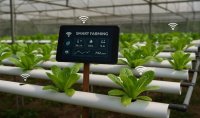
Automate data capture: Connect IoT logs directly rather than expecting staff to enter EC and pH readings by hand.
Pilot with a single buyer: Start with one crop headed for a premium or export market, such as basil, strawberries or cherry tomatoes.
Use QR codes: They are cheap, familiar, and scannable by anyone with a phone.
Go cooperative: Producer organisations and grower groups make the cost bearable. Alone, it is heavy.
Keep it lean: Store the proofs on-chain and keep the large files, meaning lab PDFs and photographs, off-chain.
What it does and does not do
Blockchain will not run your greenhouse or fix your fertigation system. What it does is give your produce something your voice alone cannot: verifiable trust at a distance.
In a market where an assurance no longer sells on its own, a record that a buyer can check for themselves is the difference between bulk rates and buyers competing for your crop.
Sources
Government of Tamil Nadu. Daily Gurus, trust and transformation in agricultural marketing.
Nasscom. Agritech case study series, Jivabhumi.
TRST01 creates value through blockchain traceability, on the Tandur Dal traceability programme with PJTSAU and YALAL Farmers Producers Company.
The GrowHub unveils a blockchain traceability platform in Asia. Quality Assurance and Food Safety, 2024.