Hydroponics Meets AI: Practical Tech That’s Changing the Way We Grow
Let me start with this—most hydroponic farms don't fail because of bad intent. They fail because someone forgot to check the EC on a Sunday afternoon.
You can have the best PVC setup and top-of-the-line nutrients and still mess it all up because the water temperature shot up, and no one noticed. That's the reality of running a soilless system. It demands precision—every hour, every day.
Now, imagine a setup that alerts you when the reservoir runs low. Or one that auto-adjusts your nutrient mix because it "learned" from your last crop cycle that lettuce in October behaves differently from lettuce in January.
That's where AI and IoT walk in—not as buzzwords, but as much-needed tools for real-world growers who are tired of firefighting.
The Hype vs. The Help
Most people writing about AI in agriculture are sitting in air-conditioned offices far from the smell of nutrient solution. For them, it's about "potential." For us, is it about doing this to actually make my life easier?
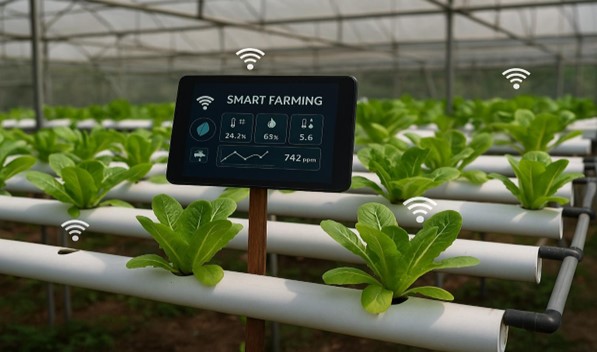
IoT in hydroponics—sensors for pH, EC, temp, humidity, and light—has been around for a while now. But what's changed is cost and convenience. Today, you can get plug-and-play controllers that connect to your phone and give you live stats, even if you're 200 km away.
That's not a luxury. That's basic risk mitigation. AI, though? That's newer. And it's still evolving. We're currently seeing models that use leaf image data to help with predictive irrigation, nutrient calibration, and even disease alerts. It's not magic. It still needs calibration. But it's already way better than guessing.
What's Actually Working on the Ground?
At one of the farms I helped set up last year, we installed a basic IoT rig—nothing fancy: just pH/EC monitoring, temperature logs, and a few relays. The grower was skeptical at first. Now? He gets twitchy if the dashboard doesn't ping for too long. Because it changed how he thinks, he stopped "managing problems" and started optimizing the environment.
Another case: a grower in Ahmedabad who commercially grows basil and kale used an AI-enabled app that suggested nutrient tweaks based on visual data. Did it save him time? Yes. Did it increase yield? Slightly. But the big win? He now trusts the system enough to expand without doubling his workforce.
The Real Roadblocks
Let's not pretend this is frictionless.
- Good internet is still a luxury in many places.
- Language is a problem—most dashboards assume English or Hindi literacy.
- Support is patchy—a failed sensor can halt automation, and local help is rare.
- And the cost is still real—even a basic automation setup can cost ₹30,000–₹50,000 (Euros: €304.50 – €507.50 or US Dollars: $349.20 – $582.00) upfront.
But here's the thing—compare that to the cost of one failed cycle. One bad batch of tomatoes or lettuce. You'll realize you're already paying, just not in cash.
Why It Matters Now
The climate isn't getting any kinder. Inputs are getting pricier. Labor is inconsistent.
If we don't start farming smarter, we'll be stuck firefighting forever.
AI and IoT won't replace growers, but they will amplify the good ones. They'll let a 1-acre (0.4 hectares) hydroponic farmer run it like a 10-acre (4 hectares) setup without losing sleep every night.
And for those just entering this space, this tech might be the difference between a hobby and a business.
Final Thought
Farming isn't about gadgets. It's about control. It is about being able to steer your system, not react to it.
So when your farm starts talking back—through alerts, dashboards, data—listen. That's not tech. That's experience, finally made audible.