
In the lower reaches of the Eastern Himalayas, the Ziro Valley of Arunachal Pradesh is home to one of the world's most sophisticated indigenous farming systems. At around 1,525 metres above sea level, the Apatani people have for centuries turned a climatically challenging high-altitude landscape into a productive, ecologically balanced, and resource-efficient agricultural system without synthetic fertilisers or pesticides. The system, known locally as Aji-Nii, integrates wet rice, fish rearing, and millet on the same plot at the same time, a piece of agroecological design that modern science is only beginning to fully appreciate.
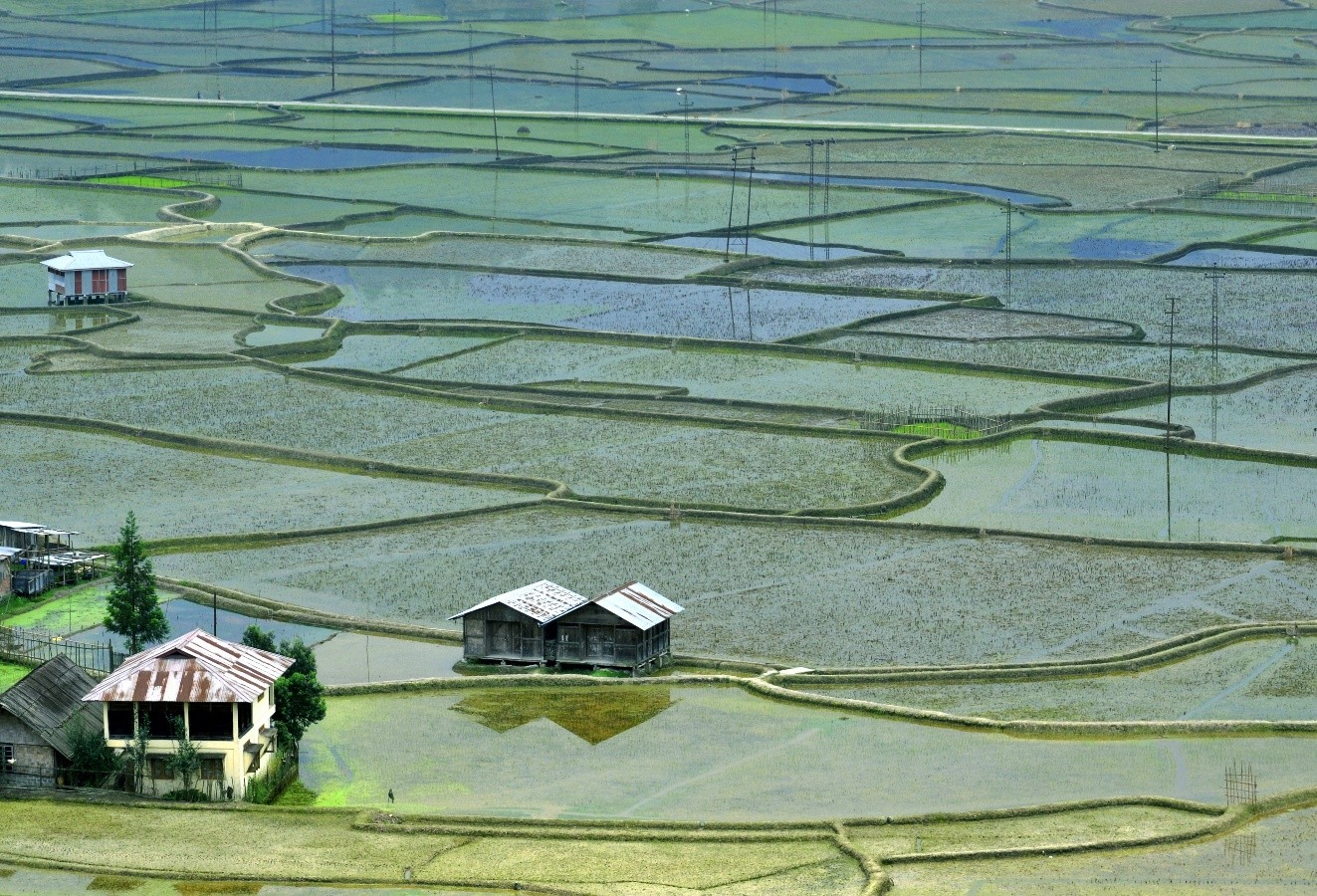
Apatani rice paddies in the Ziro Valley, with raised bunds separating each plot. Photo: Kuntal Narayan Chaudhuri, Wikimedia Commons, CC BY-SA 4.0
In 2014, the Apatani Cultural Landscape was placed on UNESCO's Tentative List of World Heritage Sites under criteria (iii) and (v), recognising it as an exceptional testimony to a living cultural tradition and an outstanding example of traditional land use. FAO has also identified the Apatani rice-fish system as a potential Globally Important Agricultural Heritage System, although it has not yet been designated.
Three crops from one field
At the core of the system, rice and fish are raised together in the same field. The Apatani grow several indigenous tall rice varieties, principally Emoh, Mipya and Pyaping, alongside a fish crop known as Ngihi. The fish is common carp (Cyprinus carpio), stocked into the fields shortly after the rice seedlings are transplanted and raised without any commercial feed. The fish live on the periphyton, the algal and microbial communities that colonise the submerged rice stems.
The returns are well documented. Saikia and Das (2008) recorded fish production of around 500 kg per hectare without supplementary feed, and reported a profit-to-turnover ratio of 65.84% for integrated rice-fish fields, meaning profit amounted to nearly two-thirds of the value of what the fields produced.
Rice yields in the Apatani system are also unusually high. Dollo and colleagues (2009) recorded yields of roughly 43 to 55 quintals per hectare, about 4.3 to 5.5 tonnes, with a maximum of 54.89 quintals. They attributed this to the Apatani approach to land and resource management, including soil and water conservation, crop diversity and integrated resource use.
The third crop is finger millet (Eleusine coracana), grown on the raised earthen bunds that divide the rice plots. The bunds hold water and prevent fish from escaping, and the Apatani have also made them productive ground. A paddy field, fish pond, and millet plot from the same unit of land constitute spatial intensification of a kind rarely achieved without external chemical inputs.
The valley also holds unusual agrobiodiversity, with 16 landraces of rice and 4 of millet recorded under cultivation.
A shared irrigation network
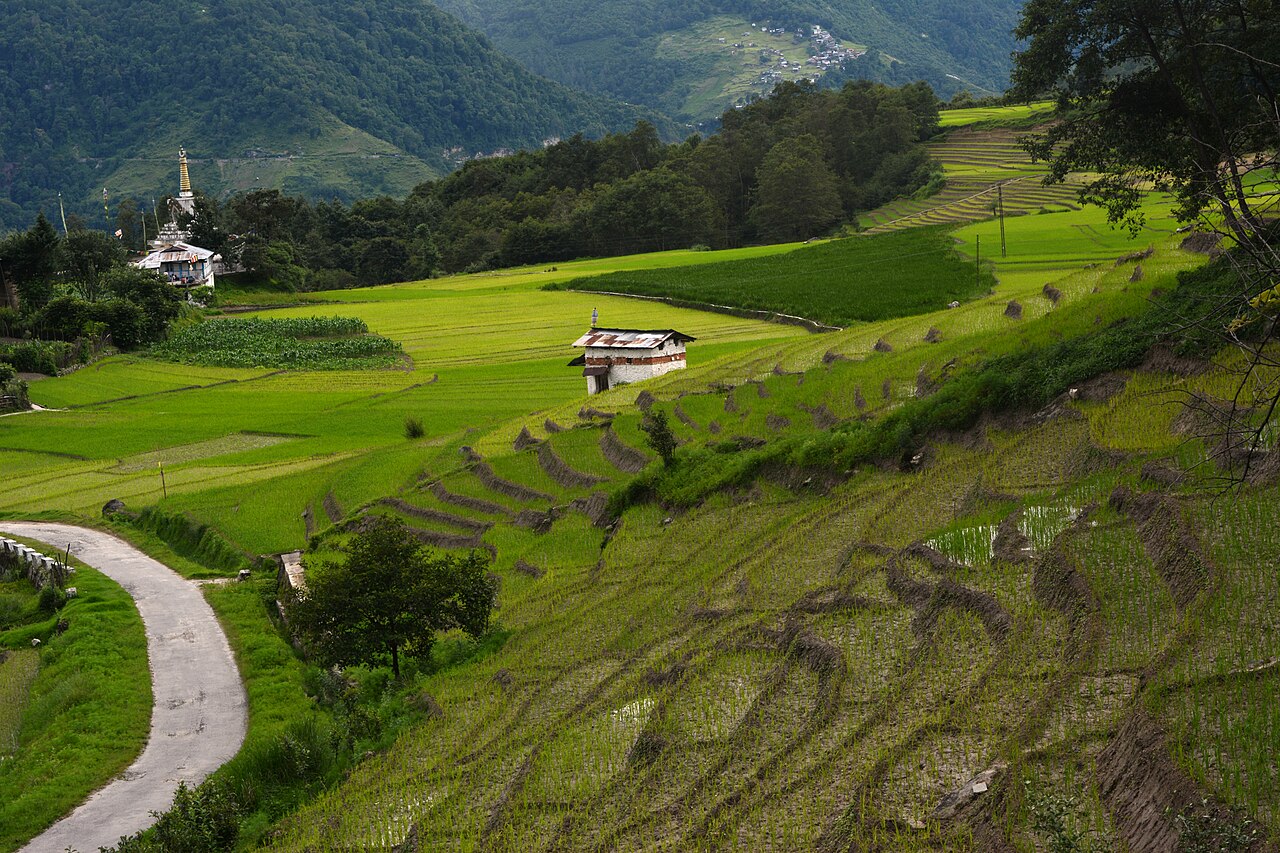
Paddy fields at Ziro. Photo: Ashwani Kumar, Wikimedia Commons, CC BY-SA 4.0
Water management sits at the heart of the system. The plateau is rain-fed and has no access to glacial rivers, yet the Apatani have engineered a community-managed network of channels carrying water from the surrounding hill streams to every terraced plot. Water cascades downward through the terraces, with bamboo pipes fitted at the inlets and outlets to regulate water levels and control fish movement, and bamboo screens that prevent fish from escaping during floods.
Within each plot, trenches 40 to 50 cm deep provide fish with shelter during the warmer hours of the day and serve as collecting areas when the field is drained for harvest. The whole network is governed collectively by the Bulyañ, the traditional village council, which enforces equitable water sharing, channel maintenance, and dispute resolution. That institution is what has kept the system working without any formal state irrigation infrastructure.
The UNESCO submission itself singles out the network, describing the entire cultivated area as well-watered by meticulously engineered channels despite limited water resources, and offering it as an example worth heeding in the face of global warming.
A closed nutrient loop
The system relies heavily on internal nutrient recycling. Soil fertility comes entirely from organic inputs: poultry droppings, pig and cattle manure, rice husks, wood ash, decomposed straw and weed biomass, all applied at field preparation. Weeds pulled during the season are piled in the field to decompose where they lie. At harvest, only the panicles are taken, and the straw and stubble stay on the field to be worked in the following season. Very little leaves the system, and soil organic matter builds over time.
The fish take part in the cycle too. Their excreta fertilise the water and sediment, stimulating the periphyton that feeds them, an internal biological loop that Saikia and Das (2015) describe in detail. That mutualism between rice and fish is one of the system's defining ecological features, and part of the reason it has sustained high productivity over centuries without degrading the soil.
The surrounding hill forests are conserved as watersheds, because the community understands that clearing them would cut the water supply to the paddies. Forest protection becomes part of the logic of farm productivity, which makes the Apatani stewards of the whole landscape rather than only of their own plots.
Zoned, governed and conserved
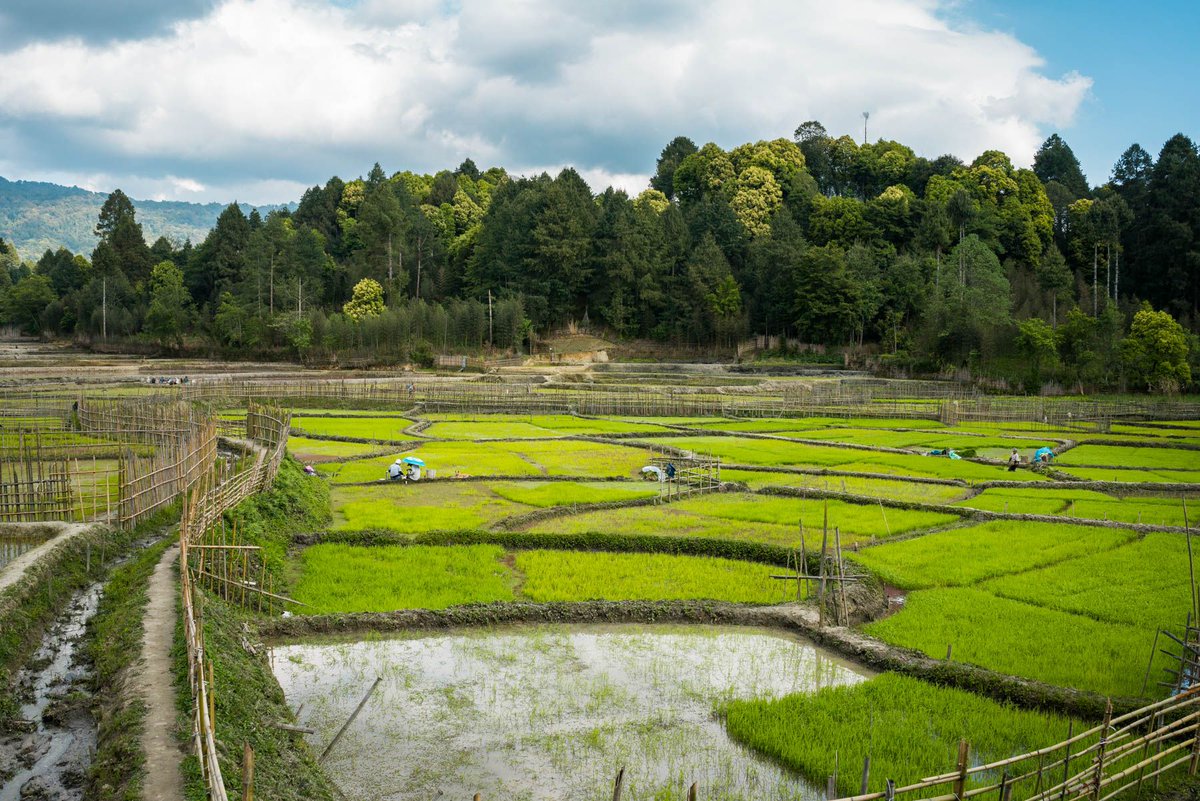
The Apatani cultural landscape, with cultivation confined to the valley floor and forest kept on the slopes. Photo: Mainaksinghabarma, Wikimedia Commons, CC BY-SA 4.0
One of the least appreciated features of the system is its zoning. Of a plateau of about 1,058 square kilometres, only around 32 are cultivated under wet rice, roughly 3%. The rest is set aside as a settlement, a community forest, private bamboo groves, a pine plantation, and a burial ground, and every family keeps a kitchen garden. No category encroaches on another, and the village council enforces the boundaries with social authority.
That discipline stands in sharp contrast to the deforestation and land conversion that accompany intensified farming elsewhere in the Himalayas. By concentrating cultivation in a bounded area and strictly governing forests and water, the Apatani have avoided the agricultural expansion that elsewhere drives erosion, watershed damage, and biodiversity loss. It is an indigenous answer to a land-use conflict that modern planners frequently struggle to resolve.
What farmers elsewhere can take from it
The Apatani system delivers several outcomes at once that modern agriculture tends to treat as competing.
Rice-fish co-culture travels: in paddy regions with shallow, well-managed water, common carp or a locally suitable species can add protein to the same plot, reduce pest pressure by eating pest larvae and weed seeds, and raise farm income without more land. Field operations for rice and fish largely overlap, so the extra labour is small, and recent work in Ziro Valley is refining how inputs can be optimised to make the system more productive still.
Bunds are productive space: turning the raised bunds between rice terraces into millet strips is a near zero-cost yield increase, and where bunds currently sit idle it adds a nutritious secondary crop, which matters most for food security in hill and tribal farming systems.
Crop residue is a resource: leaving straw and stubble in the field, decomposing weeds in place and returning all organic waste to the soil removes external fertiliser costs while steadily improving soil health. Farmers who burn or remove their residues are discarding their cheapest soil amendment.
Water governance has to be collective: individual investment in water management fails without shared maintenance. The Apatani show that common rules, a community council and social accountability can sustain irrigation over centuries without state infrastructure, a model that farmer collectives and water user associations can learn from.
Forest is an agricultural input: by treating upstream forest as the source of irrigation water, the Apatani tie forest protection directly to farm output. Framing forests as water infrastructure can help smallholder communities justify protecting them in economic terms, not only ecological ones.
Pressures on the system
For all its ecological and economic strengths, the system is under growing pressure. Outmigration of younger people, changing food preferences, urban employment and the slow spread of chemical-input farming are all reducing participation, and research in the valley has documented farmers turning away from rice-fish culture towards alternative livelihoods or cheaper rice. Those who sustain it are overwhelmingly women: nearly 80% of the farmers keeping the practice alive are Apatani women, making the system's future, in large part, a question of whether that work is recognised and rewarded. The UNESCO World Heritage nomination, which would bring international recognition and conservation support, remains at the tentative stage.
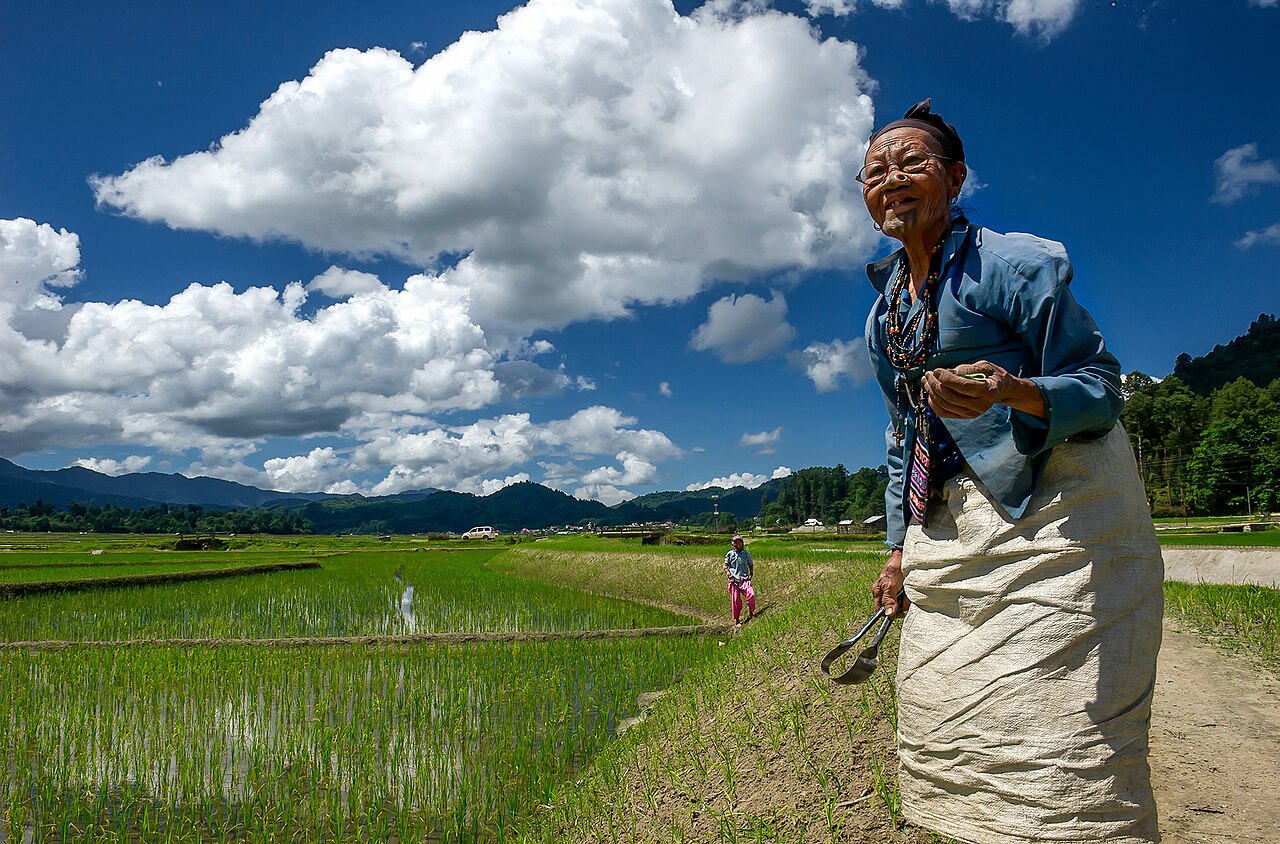
An Apatani woman in her field in the Ziro Valley. Women make up the large majority of the farmers who keep the rice-fish system going. Photo: Arunachal2007, Wikimedia Commons, CC BY-SA 4.0
Policy action is needed at several levels: documenting the system's genetic resources, meaning its crop landraces and fish stocks, recognising Apatani rice and rice-fish products under the Geographical Indication framework, taking the GIAHS proposal forward to designation, and building community incentive programmes that let traditional farming compete economically with external-input alternatives.
A working model, not a relic
The Apatani system is not a relic. It is a tested, functioning and productive model of sustainable agriculture that has run without synthetic inputs for centuries in one of the most climatically and geographically demanding environments in India. It delivers food security, biodiversity conservation, water efficiency, and economic returns together, making it a reference point for the agroecological transition farming now has to make. At a time when agriculture is asked to cut emissions, restore soils and feed more people, the Apatani have already worked out much of the answer, with bamboo, earthen bunds and community trust. Whether the rest of the world learns from them in time is the open question.
Sources
Saikia, S. K., and Das, D. N. (2008). Rice-fish culture and its potential in rural development, a lesson from Apatani farmers, Arunachal Pradesh, India. Journal of Agriculture and Rural Development, 6(1), 125-131.
Saikia, S. K., and Das, D. N. (2015). Sustainable aquaculture, agro-ecological role of periphyton in rice-fish farming. Reviews in Aquaculture, 7, 172-186.
Dollo, M., Samal, P. K., Sundriyal, R. C., and Kumar, K. (2009). Environmentally sustainable traditional natural resource management and conservation in Ziro Valley, Arunachal Himalaya, India. Journal of American Science, 5(5), 41-52.
Samaddar, A., Kacha, D., Kaviraj, A., Freed, S., Panemangalore, A. P., Das, S., and Saha, S. (2025). A novel strategy to optimize resources to boost production in rice-fish coculture at Ziro Valley, India. Aquaculture Reports, 41, 102679.
Sonowal, S. P. (2020). Assessment of cultural ecosystem services and lifestyle of Apatani tribe in Ziro Valley. School of Planning and Architecture, Bhopal.
UNESCO World Heritage Centre (2014). Apatani Cultural Landscape, Tentative List submission, reference 5893.
India Water Portal (2025). Fish, fields and feminism, how Apatani women sustain Ziro's aquaculture in Arunachal Pradesh.