


I got my own piece of land in 1983. Nothing fancy, just the back garden of my house. I started growing in soil and found it painfully slow. Worse than watching paint dry, if I'm being honest, which I'll put down to a natural impatience I've always had. But I wasn't about to let that put me off.
I started reading about hydroponics, and in particular about the problems farmers were having with it. I've always had a thing for problems. The harder, the better. So I decided this was the path for me.
What I found wrong with NFT trays in the UK
At the time, the two main UK hydroponic companies had both redesigned their NFT (Nutrient Film Technique) trays. The new designs added raised gullies and channels that essentially took the "film" out of Nutrient Film Technique. The whole point of NFT is a thin, continuous flow of nutrient solution across root surfaces. Once you add raised areas and deep channels, you lose that principle entirely.
I thought: that's as good a starting point as any. So I built my own NFT tray from scratch. It's a fairly simple method in concept, though getting it right is another story.
Of course, there were problems. And eventually, plant deaths.
The question was: why?
Watching roots tell you what went wrong
I started again and decided to watch more closely this time. Plants would grow fine for the first four to six weeks. Then problems would creep in. Doing some investigation, I found pools of nutrient solution forming across the tray. What had happened was simple enough: roots had intertwined and expanded, creating barriers that trapped the solution in separate pools.
Each of those pools was doing its own thing. pH and EC levels fluctuated independently from pool to pool, and that instability eventually caused root rot. For anyone who has dealt with Pythium or similar root pathogens in recirculating systems, this will sound familiar. Stagnant nutrient pockets are exactly the conditions these diseases need.
By this point, the bug had truly bitten me. I wanted to build a simple, low-maintenance hydroponic system that working farmers could actually use.
Fixing NFT by stripping it back
My first fix was to remove the spreader mat entirely. Then I increased the angle of the tray, giving each plant a stronger, more consistent flow. The results were immediate. Harvests improved dramatically.
But there was still a problem: it didn't scale.
The system worked well for small numbers of plants. For commercial quantities, it was a dead end. So I started testing other types of hydroponic systems. Ebb and flow came first. Then Deep Water Culture (DWC), which produces excellent growth but requires roughly 20 litres of water per plant. Multiply that across thousands of plants and the water consumption alone rules it out, even though the system itself scales well enough mechanically.
By the time I'd worked through all of these, sixteen years had passed.
How a history lesson sparked a new approach
I met up with a fellow grower who ran his own grow shop and shared my ambition to design and sell purpose-built equipment. We had a proper brainstorming session, and during it, an idea from a long-forgotten school history lesson came back to me: the Hanging Gardens of Babylon.
That was the moment everything clicked.
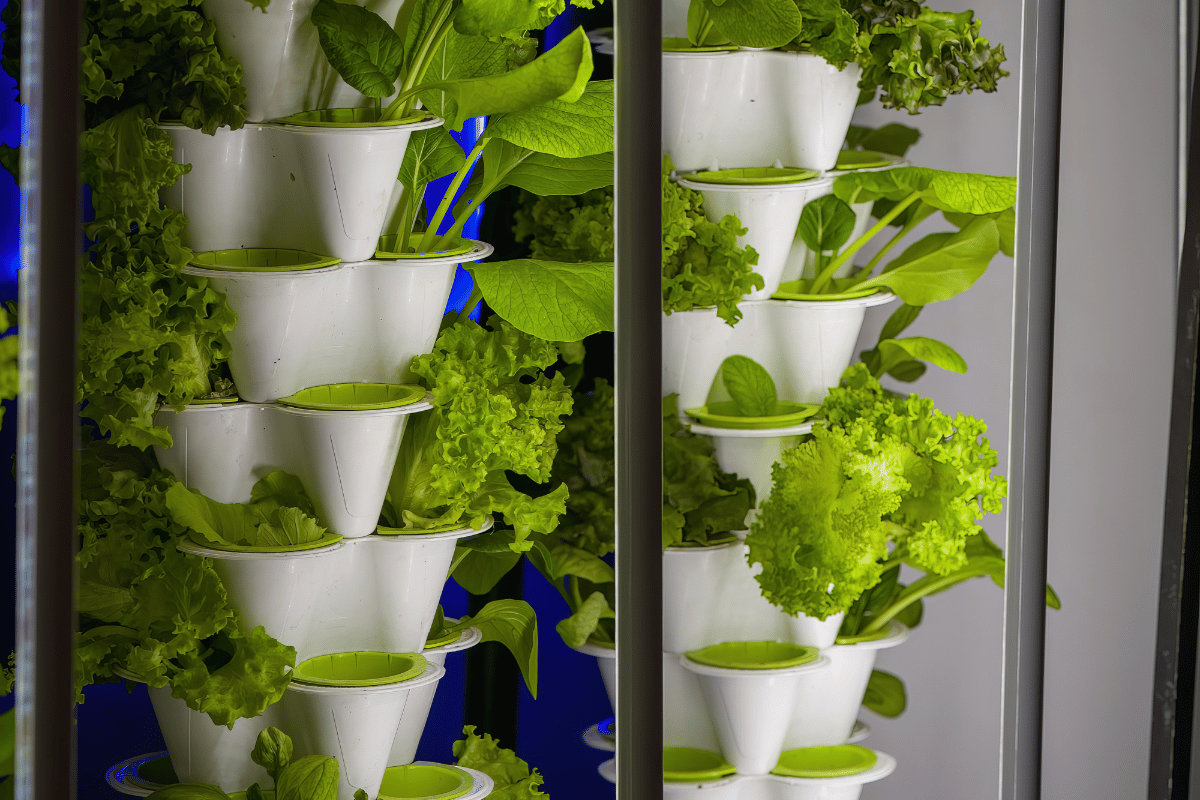
The concept that came out of that session became Nutrient Trickling Technique (NTT), and the brand became Quantumhydro. Where NFT relies on a thin horizontal film of solution, NTT uses a vertical trickling action. Think of nutrient solution being fed from above and trickling down through the root zone under gravity. Each plant receives a fresh, consistent supply without the pooling and stagnation problems that plagued my earlier NFT work.
Making the idea work took many forms. I went from single pots to multi-plant troughs with segmented lid sections. Some designs went straight in the bin. Eventually, I settled on an eight-plant trough that became a solid product, though it only appealed to certain grower groups.
Winning at London Olympia and what the judges noticed
In 2003, I entered Quantumhydro into the National Gardening Awards at London's Olympia stadium. To my genuine surprise, the system won double awards. What caught the judges' attention was something I hadn't expected: the terpene profiles. Each plant grown in the same NTT environment had held its own distinct terpene profile with remarkable strength. In most hydroponic systems, plants sharing the same nutrient reservoir tend to produce more uniform chemical profiles. The NTT approach, where each plant receives a fresh trickle rather than recirculated solution, seemed to preserve individual plant chemistry in a way the judges hadn't seen before.
Redesigning for commercial scale
Finding LinkedIn opened another door. I started showing the system to a wider audience, pitching it as a potential commercial farming solution. I'll be straight about what happened next: I got laughed off the platform.
But after some reflection, and after studying how existing commercial hydroponic farms were set up, I went back to the drawing board. Strangely enough, the second design stopped the laughter. The redesigned system addressed the scaling limitations that had held back the original trough concept, and people in the industry started taking it seriously.
Why Africa is the next step
Living in the UK leaves a hydroponic grower wanting. The growing season is short, light levels are low for much of the year, and energy costs for supplemental lighting eat into margins. So I've decided that a move to Africa is coming later in 2026.
In much of Africa, year-round growing is possible without artificial lighting. Even without significant startup funding, it's realistic to begin cheaply and earn a decent income from leafy greens production alone. The continent also holds untapped potential for medicinal plant cultivation. In the regions I'm looking at, 57 cultivation licences have been issued, but only 15 are currently active. That leaves a wide gap for growers who understand the practical side of soilless production.
Having spent forty years figuring out the problems with hydroponic systems and how to fix them, I've now set up a company and a website to bring those solutions to growers who need them most. The plan is simple: start with leafy greens, prove the system works in African growing conditions, and expand from there.