

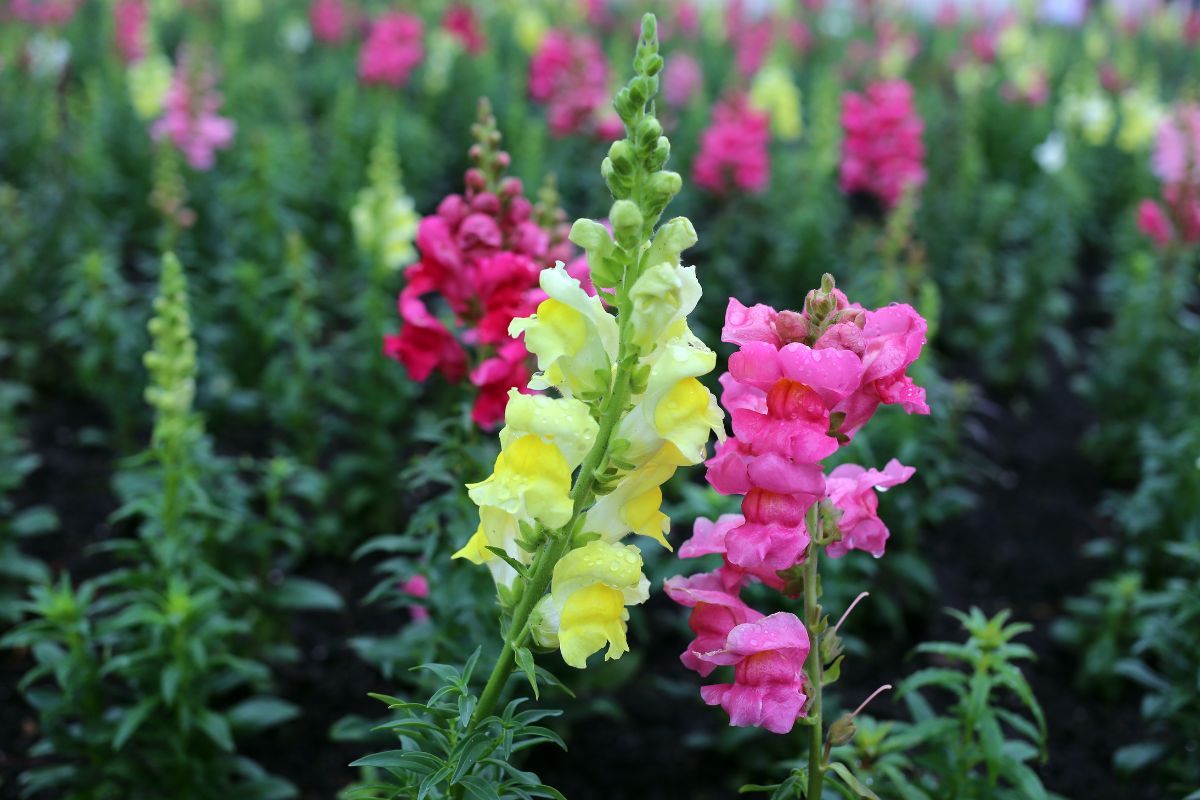
Snapdragons (Antirrhinum majus) are short-lived perennials usually grown as annuals, for their upright spikes of colourful flowers that open like a mouth when squeezed at the sides. They are cool-weather flowers, sown from autumn to spring, in full sun, sheltered from strong wind, in well-drained soil. Seeds need light to germinate, so they are pressed onto the surface without being covered. Dwarf types stay around 30 cm, while tall ones reach nearly 1 m and need support. Snapdragons flower from spring into autumn, often slowing in the summer heat and flowering again as the weather cools, and their main problem is rust, for which resistant varieties exist. They are non-toxic to dogs, cats and horses. This guide covers when and how to sow and plant, sun and soil, watering and feeding, pinching and staking, flowering and deadheading, self-seeding and winter, pots, cut flowers, and problems.
Annual or perennial
According to the Royal Horticultural Society, snapdragons are short-lived perennials usually grown as annuals. In mild climates they can survive winter and flower again the following year, though usually with less vigour, while in cold climates frost kills them. Snapdragons were formerly placed in the family Scrophulariaceae and are now classified in Plantaginaceae. The name Antirrhinum comes from the Greek words for "like" and "nose", from the face-like shape of the flower.
Snapdragon varieties by height
| Group | Height | Use |
| Dwarf | About 20 to 30 cm | Edging, window boxes, pots |
| Intermediate | About 40 to 50 cm | Beds and containers |
| Tall | Up to about 90 cm | Back of the border and cut flowers, with support |
There are varieties with single and double flowers, in white, yellow, orange, pink, red and bicolours. For gardens where rust is a problem, the RHS lists varieties with resistance, such as 'Bronze Dragon' and mixes sold as rust resistant.
When to sow and plant snapdragons
According to the RHS, snapdragons are sown from autumn to spring. That gives two seasons:
- Autumn, September to October: in mild-winter and Mediterranean climates, sowing or planting now gives early flowers in spring. In colder areas, autumn seedlings are overwintered in a cold frame or other frost-free shelter
- Late winter to spring, February to April: sowing for flowers from late spring through summer, with seedlings planted out once the risk of hard frost has passed
In cold-winter climates, seeds are best started indoors 8 to 10 weeks before the last frost, because snapdragons grow slowly from seed and usually take around three to four months to flower.
How to sow snapdragon seeds
Snapdragon seeds are tiny and need light to germinate, so scatter them thinly over the surface of moist seed compost and press them in lightly without covering them. The RHS recommends a germination temperature of 16 to 18°C, and seedlings usually appear within one to two weeks. Keep the compost moist by misting or watering from below. Once seedlings have about four true leaves, prick them out into pots or plant them out, 15 to 30 cm apart depending on the variety, so air can move between them.
You can sprinkle seed directly in the garden in mild climates, but sowing in trays is more reliable, because the tiny seeds are easily lost and the seedlings grow slowly at first.
Sun and soil
Snapdragons need full sun and a sheltered spot, away from strong winds that snap tall stems. In shade they flower less and grow weak. They grow in almost any soil, sandy, chalky or loamy, acid or alkaline, as long as it drains well and is moderately fertile. In hot climates, morning sun and some afternoon shade help them keep flowering longer.
Watering and feeding
Water snapdragons in dry weather, and much more often in containers. Water at the base of the plant rather than over the leaves, because wet foliage encourages rust. Keep the soil lightly moist but never waterlogged, which rots the roots. In moderately fertile soil, a little compost at planting is enough, while container plants benefit from a liquid flowering feed every few weeks.
Keeping snapdragons bushy and flowering
When young plants have a few pairs of leaves, pinching out the growing tip makes them branch, giving bushier plants with more, slightly smaller flower spikes. Skip pinching if you want one tall central spike, as for cut flowers. Tall varieties need a stake or support netting, especially in exposed spots. Cut faded spikes back to a pair of leaves to encourage new ones.
How many times do snapdragons bloom
Snapdragons can flower from spring into autumn. In hot summers they often slow down or stop flowering when the heat peaks, then produce a second flush as temperatures fall in late summer and autumn. Regular deadheading and steady watering through the summer help the plants recover for that autumn flowering.
Do snapdragons come back every year
In mild climates, snapdragons can survive winter and flower again, although they weaken after a year or two, so most gardeners replace them regularly. They also come back by self-seeding. Faded flowers ripen into seed pods, which BBC Gardeners' World describes as looking like upside-down skulls, and if left on the plant they drop seed that may germinate the following season. According to Sarah Raven, snapdragons only spread this way if winter is mild enough for the seeds or seedlings to survive. Seedlings from hybrid varieties may not look like the parent plants. To stop them spreading, deadhead before the pods ripen.
In cold areas, BBC Gardeners' World suggests digging up plants you want to keep and moving them to a cool place indoors where the temperature stays above 1°C, or taking cuttings.
Growing snapdragons in pots
Snapdragons grow well in containers, especially dwarf and intermediate varieties. Use a pot with drainage holes, good potting compost and a sunny, sheltered spot. Compost in pots dries out much faster than garden soil, so check it often, especially on hot days. Snapdragons are not long-term houseplants, because they need full sun and cool air, but seeds are easily started indoors and grown on outside.
Snapdragons as cut flowers
According to BBC Gardeners' World, taller cultivars make good cut flowers and last well over a week in water. Unpinched plants give the longest single stems, and spikes are usually cut when the lower flowers have opened and the upper buds are still closed.
Pests and diseases
- Rust: orange-brown pustules on the undersides of the leaves, the most common snapdragon disease. Resistant varieties, correct spacing, watering at the base and removing infected leaves all help
- Powdery mildew and downy mildew: white or greyish growth on the leaves in damp weather
- Grey mould: grey fuzz on flowers and stems in humid conditions
- Damping off and root rot: from overwatering and poor drainage
- Aphids: on young shoots and buds, controlled like aphids elsewhere in the garden
Snapdragons and bees
Bumblebees open the closed flowers with their weight to reach the nectar inside. The RHS lists many single-flowered snapdragons as plants for pollinators, while noting that double-flowered types, such as 'Madame Butterfly', do not provide food for pollinators. For a bee-friendly garden, choose single-flowered varieties.
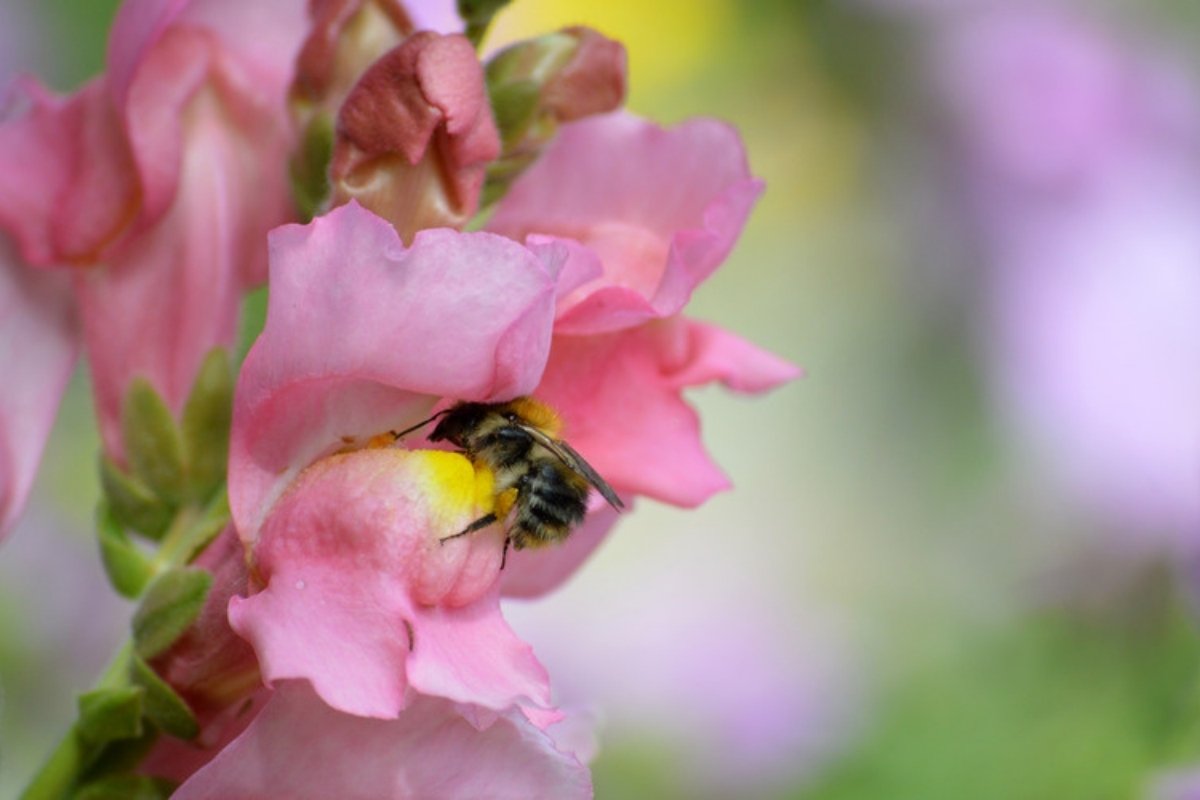
A bumblebee pushing its way into a pink snapdragon flower to reach the nectar
Are snapdragons poisonous
No. According to the ASPCA, snapdragons are non-toxic to dogs, cats and horses.
Frequently asked questions
Are snapdragons annuals or perennials
They are short-lived perennials usually grown as annuals. In mild climates they can survive winter and flower again, but they weaken with age.
How long do snapdragons take to grow from seed to bloom
Usually around three to four months. Seeds germinate in one to two weeks at 16 to 18°C, and plants grow slowly at first.
Can I just sprinkle snapdragon seeds
Yes, in mild climates, since the seeds need light and should not be covered. Sowing in trays is more reliable, because the seeds are tiny and the seedlings grow slowly.
When should snapdragons be planted
In autumn, September to October, for early spring flowers in mild climates, or from late winter to spring, February to April, for summer flowers.
Do snapdragons like sun or shade
Full sun, with shelter from wind. In very hot climates, some afternoon shade helps them keep flowering.
Are snapdragons better in pots or in the ground
They grow well in both. Dwarf and intermediate varieties suit pots, which need regular watering, while tall varieties do best in the ground with support.
Important notes
For persistent disease problems, a local agronomist can help with an accurate diagnosis, and any treatment should use only registered products, following the label.
References
- Royal Horticultural Society, Antirrhinum majus 'Madame Butterfly'.
- Royal Horticultural Society, Antirrhinum majus 'White Giant'.
- Royal Horticultural Society, Antirrhinum majus 'Bronze Dragon'.
- BBC Gardeners' World, How to grow snapdragons.
- Sarah Raven, How to plant, grow and care for antirrhinums.
- ASPCA, Common snapdragon.