



A smallholder does not need a drone or a tractor to farm with precision. A phone, a few simple soil checks and a notebook are enough to put the right effort in the right place at the right time. Weed control, the largest labour cost on many small farms, shows how.
What precision really means on a small farm
Precision agriculture is a habit more than a machine. You observe the field, decide based on what you see, act at the right time and record what happened. Large farms do this with sensors and satellites, and a smallholder can do much of it with the phone already in their pocket.
In my work on weed management in Nigerian rice and maize, the costliest losses rarely come from not knowing which herbicide exists. They come from acting too late, applying a product under the wrong field conditions, or treating the whole farm the same when the problem sits in one corner. Each of these is a decision problem, and simple tools improve decisions.
Know your field before you spend money
Walk the field slowly before land preparation and again after the first rains. Your phone can do three useful jobs on that walk.
Map it: free map apps let you drop a pin or walk the boundary to estimate the size of the field. Knowing the real area stops you buying too much or too little seed, fertiliser or herbicide.
Photograph it: take photos from the same spots each season, such as the wet corner, the sandy ridge and the patch where weeds always come first. Over time these photos become your field history.
Note the trouble spots: low areas that hold water, patches where the crop turns yellow, places where Striga or spear grass returns every year. These zones deserve different treatment from the rest of the field.
Simple soil checks add to this. A jar test, in which soil is shaken in water and left to settle, shows roughly how sandy or clayey it is, and squeezing moist soil in the hand tells you how it drains. Where low-cost soil test kits or extension soil testing are available, a pH and nutrient check every few seasons is worth more than guessing.
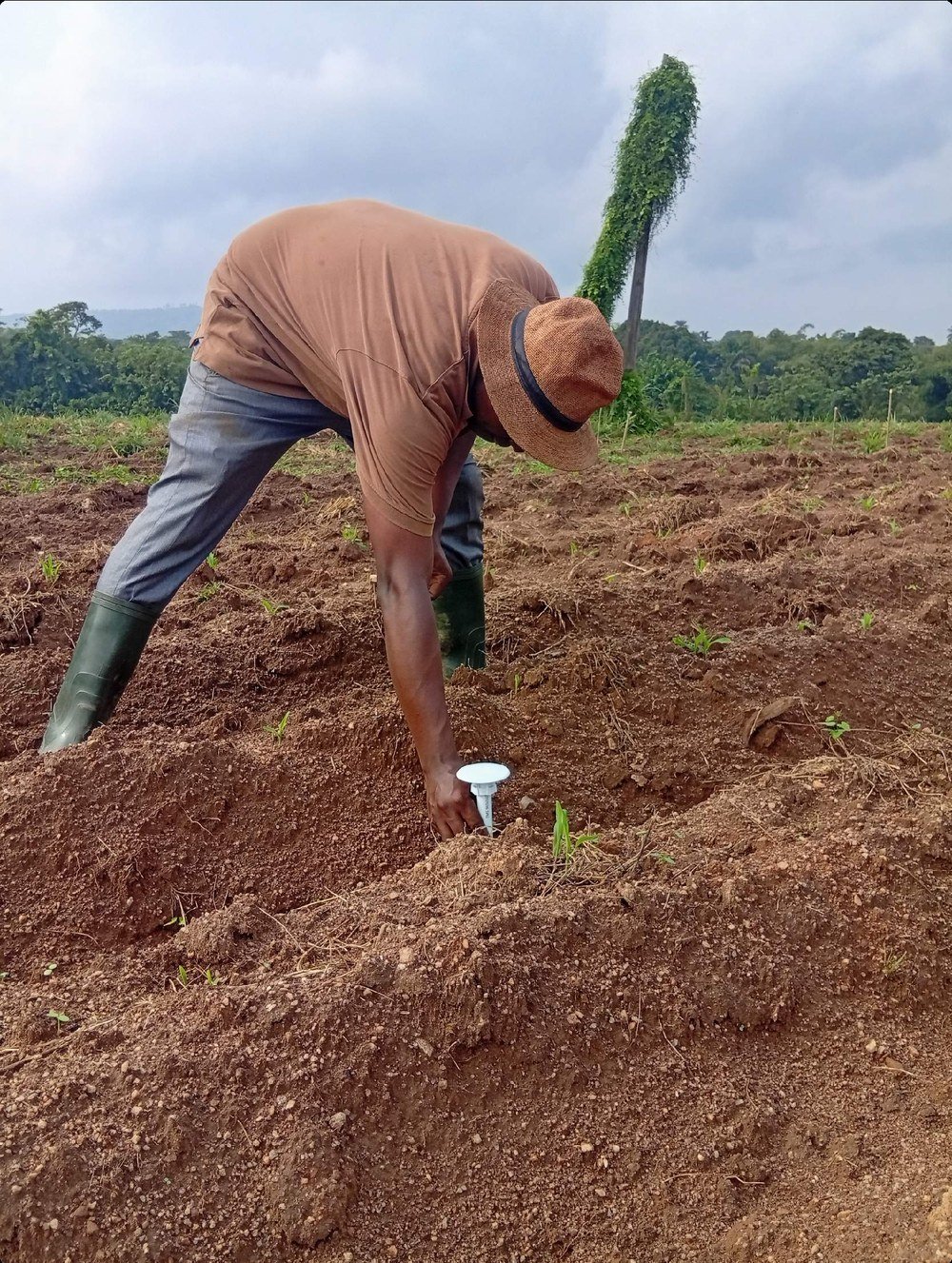
Checking soil conditions beside young maize with a low-cost soil probe. Photo: Oyebanji O. Alagbo
Time weeding to the crop's growth stage
Every crop has a critical period when weeds do the most damage, usually the first weeks after emergence. Weeds removed in this window cost little yield, while weeds left through it compete with the crop for water, light and nutrients, and much of that loss cannot be recovered later. Weeding after this period helps next season more than this one, which is why the timing of weed control matters as much as the method.
Use the phone to stay on time.
Set reminders from the planting date: schedule scouting and weeding from the day you plant, instead of waiting until the weeds look bad.
Scout the same trouble spots each week: take a photo each time. Small weeds are cheaper to remove, with a hoe or with less herbicide.
Compare the photos week to week: if one zone is ahead of the rest, treat that zone first.
Not every answer is a chemical one. Good land preparation, timely planting, the right plant spacing, mulching, rotation and hand or mechanical weeding all reduce weed pressure, and combining them is cheaper and more durable than relying on herbicides alone.
Match herbicides to the field
A herbicide that works well in one field can fail in another. In our work on rainfed lowland rice, poor control of grass weeds under waterlogged conditions led us to study how the dose of glyphosate needed changes with field conditions. The practical lesson for farmers is simple: the label rate assumes the conditions on the label.
Before spraying, check four things.
The label: is the product registered for your crop and your weeds, and is it applied before or after the weeds emerge?
The field: is the soil flooded, very dry or freshly tilled? Water level and soil moisture change how many herbicides perform.
The weather: a free weather app shows whether rain is due within hours of spraying, which can wash the product off.
The weeds: are they small enough for the product? Large weeds often survive.
Wear protective clothing, keep sprayers clean and calibrated, and never use more than the label allows.
Keep simple records and compare
Records turn one season's experience into next season's advantage. A notebook works, and so does a notes app on the phone or a shared spreadsheet. For each field, write down the following.
| What to record | Why it matters |
| Planting date and variety | Sets the weeding calendar |
| Main weeds seen | Shows which weeds are increasing |
| Each weeding, with date, method and cost | Shows what control really costs |
| Product, rate and weather on the day | Explains a spray that failed |
| Harvest from each field or zone | Shows where money was well spent |
After two or three seasons, patterns appear. You see which zones always need early weeding, which method paid off, and where a cheaper practice did as well as an expensive one. Researchers in Nigeria often lack this kind of field data, so farmers who keep records also help improve local advice.
Digital tools that already help African farmers
Several free or low-cost phone tools now bring expert advice to the field.
AKILIMO: site-specific advice on fertiliser and agronomic practices, developed by IITA and partners and starting with cassava.
PlantVillage Nuru: a phone app that recognises crop pests and diseases through the camera and can work offline.
Plantix: photo-based diagnosis of crop problems, with suggested responses.
FAO Digital Services Portfolio: FAO's set of digital services for farmers and extension workers, covering weather, markets and crop advice.
Hello Tractor: links farmers with tractor owners, so mechanisation can be hired rather than bought.
Weed management has fewer such tools, even though weeds are often the largest labour cost on a smallholding. At Obafemi Awolowo University, our team is developing Weed Doctor NG, a phone tool that gives Nigerian farmers weed control options for their crop, location and growth stage, in English, Pidgin, Yorùbá, Hausa and Igbo. It is currently in pilot testing, and it builds on the same idea as other decision support systems for weed management.
No app replaces walking the field. These tools work best when they support the farmer's own observation and records.
Where to start this season
- Walk and photograph each field, and mark the trouble spots.
- Do a jar or hand test of the soil, and a soil test where you can.
- Set phone reminders for scouting and weeding from planting day.
- Read the label and check the field and the weather before any spray.
- Start a simple record for every field.
Precision means doing the right thing in the right place at the right time, and that is within reach of every smallholder with a phone.
Sources
AKILIMO. CGIAR Research Program on Roots, Tubers and Bananas.
FAO. Digital Services Portfolio.
Hello Tractor. hellotractor.com.
Plantix. plantix.net.
PlantVillage. Penn State University.